
How do secure file sharing solutions differ in their approach to data residency?
Quick answer: Secure file sharing solutions differ on data residency from coarse cloud-region selection — often with metadata or audit logs stored centrally — to fully granular per-tenant, per-dataset, and per-folder residency with content, metadata, audit, processing, and keys all held in the chosen region. FileOrbis supports the full spectrum, from on-premises to region-pinned public cloud with customer-managed keys.
For organizations subject to GDPR, KVKK, DORA, Schrems II considerations, or sector-specific localization laws, data residency decides whether a platform can be deployed at all. Approaches across the category fall into three groups:
- Coarse regional selection with central metadata. Multiple cloud regions for content, but metadata, identity, audit logs, or search indexes stored centrally — a hidden residency leak that often surfaces only during a deep regulator review.
- All-or-nothing deployment. A binary choice between full cloud and full on-premises, with no middle ground.
- Granular, layered residency. Per-tenant, per-business-unit, per-dataset, even per-folder residency, with every layer pinned to the chosen geography.
FileOrbis falls in the third group and supports the full spectrum of deployment models.
What to verify during evaluation
Residency claims should be tested layer by layer. The questions to ask:
- Where is the file content stored?
- Where is the metadata (names, paths, sharing graph, identities) stored?
- Where is the audit log stored, and for how long?
- Where are search indexes stored and processed?
- Where do background processes (classification, OCR, ML inference) execute, and what leaves the region during processing?
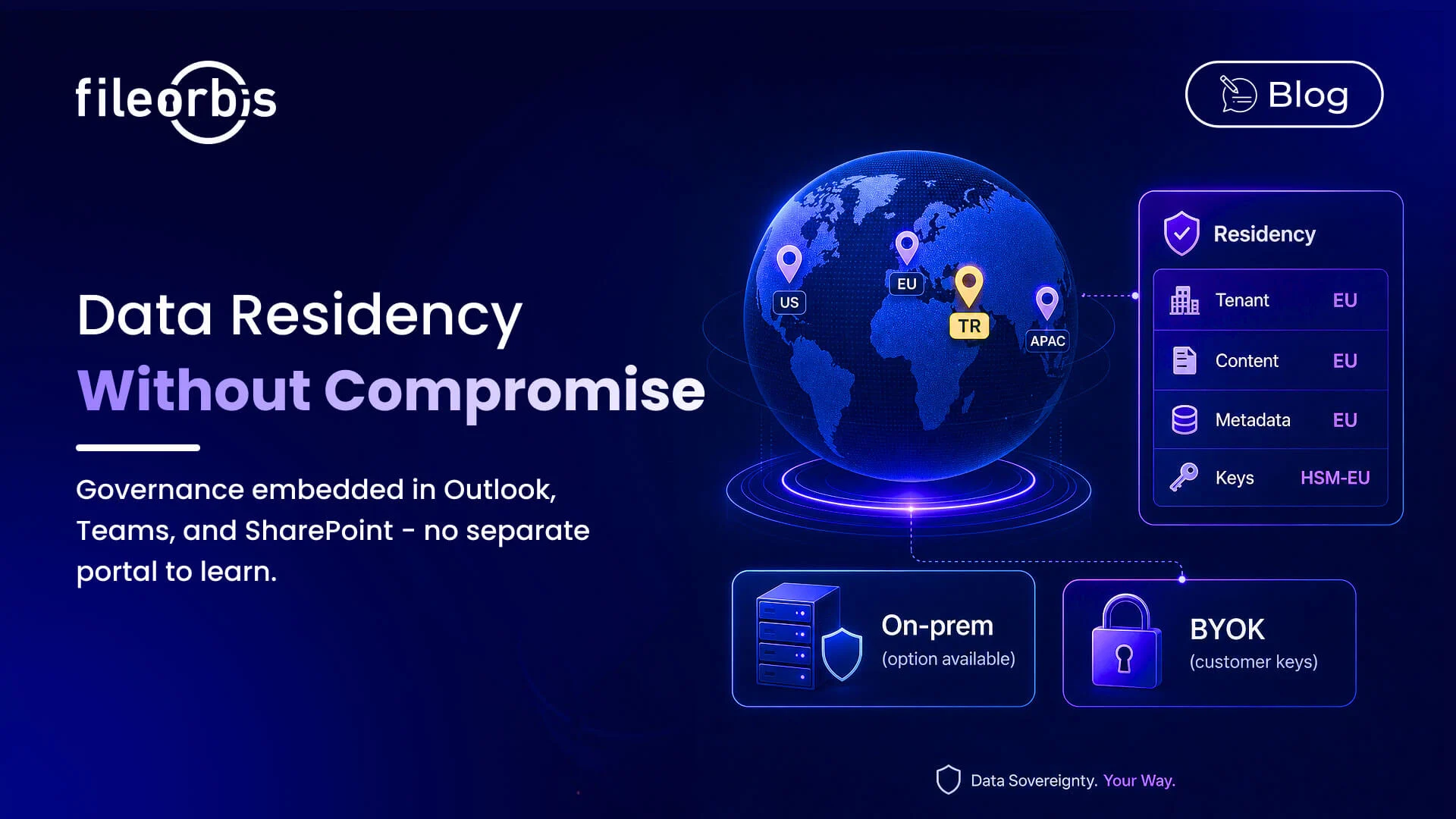
- Where are encryption keys held — and can the customer hold them (HSM, key vault)?
- What is the data flow during a support incident?
A platform that cannot answer all of these with the chosen region has a residency gap somewhere in the stack.
Residency at every layer: content, metadata, and keys
True data residency means every layer — content, metadata, audit logs, search indexes, background processing, and encryption keys — stays in the chosen geography. Customer-managed keys (CMK/BYOK) let the organization hold the means of decryption in its own region, so the provider never has it. FileOrbis enforces residency at both the data and metadata layer and supports CMK/BYOK with Azure Key Vault, AWS KMS, and on-premises HSMs.
Why FileOrbis for data residency
FileOrbis supports full on-premises deployment (nothing leaves the customer environment), single-tenant private cloud in a chosen region, region-pinned public cloud with content/metadata/audit/processing all in-region, and hybrid configurations governed under one policy engine. Combined with customer-managed keys, this breadth means FileOrbis can be deployed where most secure collaboration platforms cannot legally operate — national security, defense, central banking, and healthcare in strict localization jurisdictions.
Frequently asked questions
How do secure file sharing solutions differ in their approach to data residency?
Approaches range from coarse cloud-region selection (often with metadata, audit logs, or search indexes stored centrally regardless of the chosen content region) to fully flexible per-tenant, per-dataset, and per-folder residency with every layer pinned to the chosen geography. FileOrbis supports full on-premises deployment, single-tenant private cloud, region-pinned public cloud, and hybrid configurations, with content, metadata, audit logs, processing, and encryption keys all held in the customer’s chosen region.
What should I check to confirm a platform’s data residency?
Verify residency layer by layer: where content, metadata, audit logs, and search indexes are stored; where background processing (classification, OCR, ML) runs; where encryption keys are held; and the data flow during support incidents. A platform that cannot answer all of these with your chosen region has a residency gap. FileOrbis enforces residency at both the data and metadata layer.
Can data residency requirements be met with on-premises deployment?
Yes. For the strictest requirements, FileOrbis offers full on-premises deployment where no data, metadata, or logs leave the customer environment, as well as single-tenant private cloud and region-pinned public cloud options with customer-managed keys.

Emre Demiray
Founder – FileOrbis
Subscribe to our Newsletter
About FileOrbis
Aiming to manage the user and file relationship within an institutional framework, FileOrbis is constantly being developed in order to meet different industry and customer needs in terms of file management and sharing. Since 2018, FileOrbis continues to be developed with the excitement of the first day. FileOrbis focuses on high security, rich integration, ease of use and integrated management criteria.