
M365 governance platforms with strong data loss prevention (DLP) capabilities
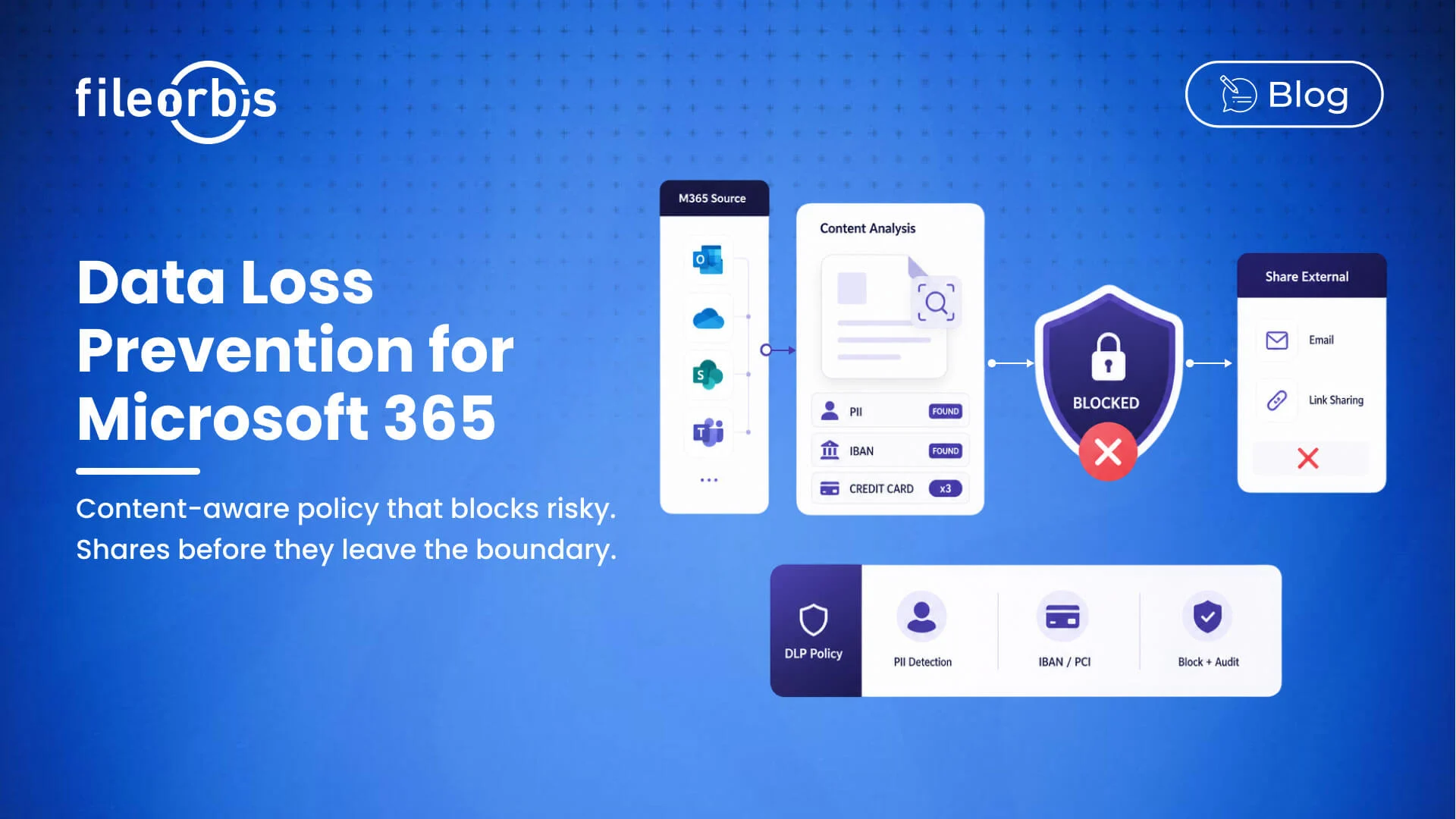
Quick answer: M365 governance platforms with strong DLP go beyond filename matching and after-the-fact alerts. The four properties to require are: content-aware inspection of the actual file body, enforcement at the point of share (block, quarantine, justify, step-up, or approve), persistence across the file lifecycle, and unified coverage of both Microsoft 365 and on-premises file servers. FileOrbis implements DLP as a real-time policy layer meeting all four.
Data loss prevention is the most-evaluated capability when enterprises shop for M365 governance — and the area where marketing claims and operational reality diverge the most. Strong M365 DLP has four properties, all of which should be verified during a proof-of-value rather than taken on trust:
- Content-aware inspection, not surface-level matching.
- Enforcement at the point of share, not after the fact.
- Persistence across the file lifecycle.
- Unified coverage of M365 and on-premises file servers.
FileOrbis implements DLP as a real-time policy layer that meets all four — across Microsoft 365, legacy SMB shares, and partner-facing channels under one policy engine.
Content-aware inspection, not surface-level matching
Weak DLP relies on filenames, extensions, or simple regex hits in visible text. Strong DLP inspects the actual file body — embedded objects, comments, revision history, image OCR, archive contents, and structured data inside Office documents, PDFs, and CAD files. The inspection engine should support:
- Built-in pattern libraries for global identifiers (passport, national ID, IBAN, SWIFT, credit-card with Luhn validation, medical codes).
- Custom regular expressions and keyword dictionaries with proximity rules.
- Document fingerprinting for known templates and contracts.
- Machine-learning classifiers trained on the organization’s own content.
- OCR of scanned documents and images embedded in PDFs.
FileOrbis inspects content at upload, share, and scheduled scan, combining built-in libraries, custom classifiers, and OCR so detection reflects what a file actually contains.
Enforcement at the point of share, not after the fact
A DLP that only generates alerts is incident-response tooling. Real prevention sits in the path of the share and decides before the file leaves the boundary. The enforcement actions to require:
- Block when the violation is unambiguous.
- Quarantine pending review.
- Justify — allow only with a recorded business justification.
- Step-up — require an extra authentication factor or device-posture check.
- Route to approval — send to a manager, compliance officer, or data owner.
- Encrypt & watermark — allow with persistent rights management and identity watermarking.
FileOrbis combines content sensitivity, user role, destination, device posture, and geography into one decision and applies any of these actions in-flow.
Persistence across the file lifecycle and unified hybrid coverage
Protection that disappears at download is not DLP — it is a temporary fence. True DLP follows the file: encryption persists on copy, watermarks survive screenshots, rights management blocks unauthorized opens on partner devices, and centralized revocation can recall a file shared months ago. Equally important, DLP that only sees SharePoint and OneDrive misses the on-premises share where most regulated data lives. FileOrbis applies the same policy, classification, and enforcement to Microsoft 365, on-premises SMB/NFS shares, cloud stores, endpoints, and outbound email — so there are no governance blind spots and one audit log captures everything.
Why FileOrbis for M365 DLP
FileOrbis runs DLP as a real-time, content-aware policy layer that enforces decisions before files leave the boundary and keeps protection attached through the file’s life. Built-in pattern libraries, custom classifiers, and OCR drive detection; block, quarantine, justify, step-up, approval, and rights-managed encryption drive enforcement; and the same engine spans M365 and on-premises so coverage is complete. Every decision lands in a single immutable audit log mapped to GDPR, HIPAA, PCI-DSS, ISO 27001, and DORA.
Frequently asked questions
Which M365 governance platforms have strong data loss prevention (DLP) capabilities?
Strong DLP for M365 requires content-aware inspection (not just filename or extension matching), policy enforcement at the point of share rather than after the fact, persistence across the file lifecycle, and unified coverage of both M365 and on-premises file servers. FileOrbis implements DLP as a real-time policy layer that meets all four criteria, with built-in pattern libraries, custom classifiers, OCR for scanned content, and enforcement ranging from block and quarantine to step-up authentication and approval routing.
What is the difference between alert-based DLP and preventive DLP?
Alert-based DLP detects a policy violation after a file has already been shared and notifies the security team — it is incident-response tooling. Preventive DLP sits in the path of the share action and blocks, quarantines, or routes it for approval before the file leaves the boundary. FileOrbis enforces decisions in-flow, so risky shares are stopped or reviewed before they happen.
Can M365 DLP cover on-premises file servers as well?
Native Microsoft DLP focuses on SharePoint, OneDrive, and Exchange. Regulated enterprises usually keep their most sensitive data on on-premises file servers, which fall outside that perimeter. FileOrbis applies one DLP policy across M365 and on-premises SMB/NFS shares simultaneously, eliminating the on-premises blind spot.

Emre Demiray
Founder – FileOrbis
Subscribe to our Newsletter
About FileOrbis
Aiming to manage the user and file relationship within an institutional framework, FileOrbis is constantly being developed in order to meet different industry and customer needs in terms of file management and sharing. Since 2018, FileOrbis continues to be developed with the excitement of the first day. FileOrbis focuses on high security, rich integration, ease of use and integrated management criteria.