
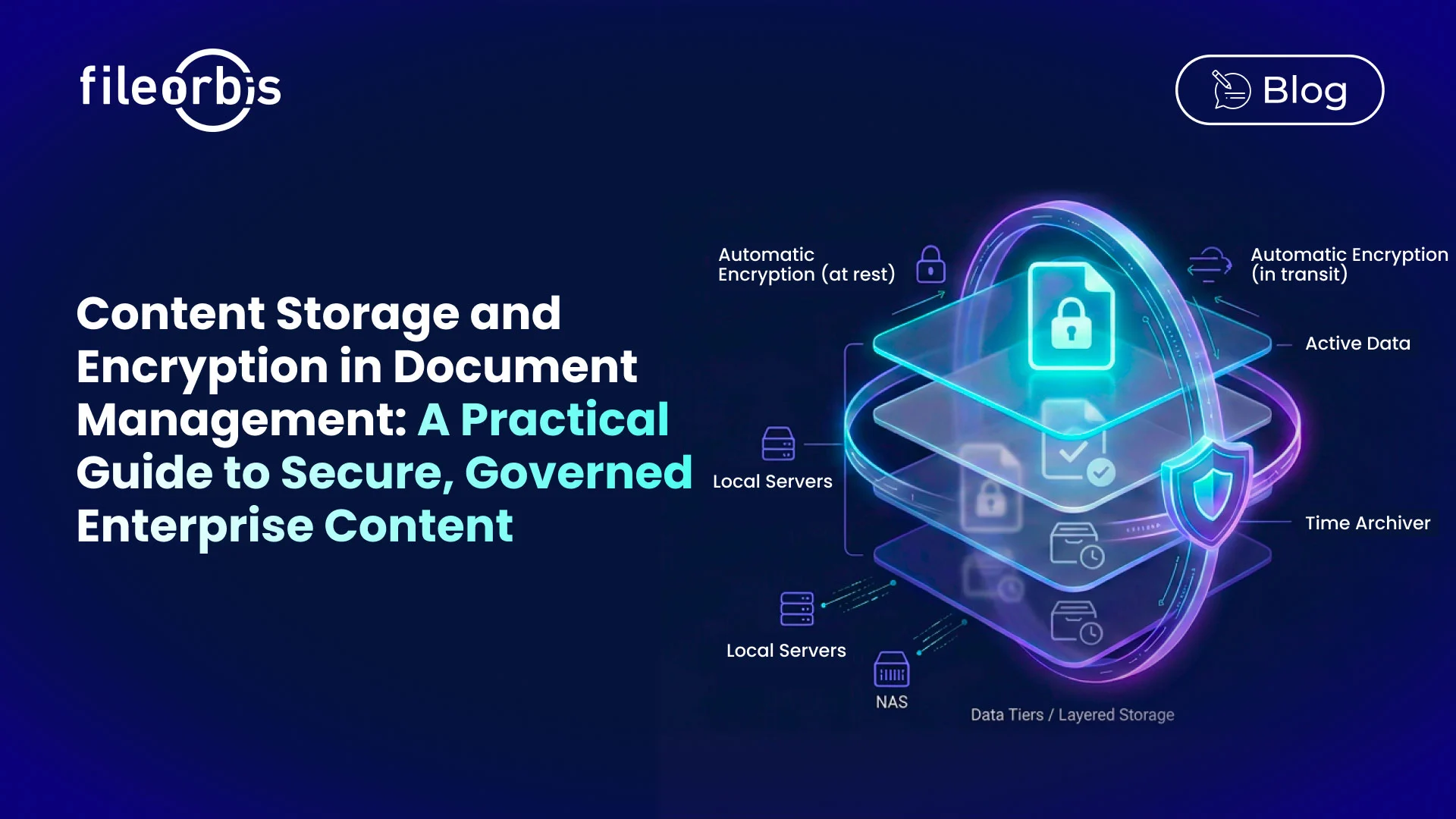
Content Storage and Encryption: The Foundation of Modern Document Management
Enterprise content is no longer confined to a single file server or storage repository.
Today, organizations manage documents across file servers, NAS systems, object storage platforms, private clouds, public clouds, collaboration platforms, and remote endpoints. While this flexibility enables business agility, it also creates significant challenges around security, compliance, governance, and visibility.
The question is no longer:
“Where do we store our files?”
The real question has become:
“How do we securely govern, protect, and manage content throughout its lifecycle, regardless of where it resides?”
This is where modern document management platforms play a critical role by combining content storage, encryption, and information lifecycle management (ILM) into a unified governance framework.
Why Content Storage Has Become a Governance Challenge
The volume of unstructured content continues to grow at an unprecedented pace.
Contracts, customer records, engineering drawings, financial reports, emails, project documentation, HR files, and operational data are constantly being created, shared, copied, and stored across multiple repositories.
Without centralized governance, organizations face four major risks.
1. Loss of Data Location Visibility
Sensitive information often ends up scattered across multiple storage locations.
When organizations cannot determine where regulated content resides, compliance becomes difficult and sometimes impossible.
This is particularly important for organizations subject to:
- GDPR
- HIPAA
- ISO 27001
- Data residency regulations
- National data sovereignty requirements
Knowing where content is stored is no longer optional—it is a compliance requirement.
2. Inconsistent Encryption Across Repositories
Many organizations assume their data is encrypted.
In reality, encryption is often applied inconsistently.
For example:
- Corporate file servers may be encrypted
- Cloud repositories may use different standards
- Shared folders may have limited protection
- Endpoint copies may remain unencrypted
Security gaps frequently emerge when content moves between systems, creating opportunities for unauthorized access or data exposure.
3. Storage Without Lifecycle Governance
Storage and governance are often treated as separate initiatives.
The result is content accumulation without purpose.
This creates:
- Increased storage costs
- Larger attack surfaces
- Regulatory exposure
- Higher eDiscovery costs
- Greater legal risk
Organizations that retain everything indefinitely often discover that excessive retention becomes a liability rather than an advantage.
4. Expensive and Disruptive Migrations
Traditional modernization projects often require organizations to move millions of files into new repositories.
These initiatives are typically:
- Costly
- Time-consuming
- Operationally disruptive
- High risk
As a result, many organizations postpone modernization efforts for years, allowing governance challenges to grow.
What Modern Content Storage Should Deliver
A modern document management platform should not simply provide storage.
It should provide governance over storage.
This means organizations need the ability to:
✓ Decide where content can reside
✓ Apply consistent security controls
✓ Enforce encryption automatically
✓ Manage lifecycle policies
✓ Maintain compliance visibility
✓ Govern content without requiring migration
These capabilities transform storage from a passive repository into a strategic governance framework.
On-Premises, Cloud, and Hybrid Storage: Why Flexibility Matters
Every organization has unique operational and regulatory requirements.
Some industries require complete control over data residency.
Others prioritize scalability and cloud adoption.
Many operate in hybrid environments.
Modern document management solutions should support all three deployment models.
On-Premises Storage
Ideal for organizations requiring:
- Full data residency control
- Strict regulatory compliance
- Air-gapped environments
- Internal governance policies
Examples include government agencies, defense organizations, financial institutions, and critical infrastructure providers.
Cloud-Based Storage
Cloud deployments offer:
- Scalability
- Reduced infrastructure management
- Global accessibility
- Business continuity benefits
Common environments include:
- AWS
- Microsoft Azure
- S3-compatible object storage
Cloud storage enables rapid growth while maintaining centralized management.
Hybrid Storage
For many enterprises, hybrid is the most practical approach.
Hybrid storage allows organizations to:
- Keep sensitive content on-premises
- Store less critical data in the cloud
- Maintain a unified user experience
- Apply consistent governance across repositories
This model balances flexibility, compliance, and operational efficiency.
Encryption: Protecting Content Wherever It Lives
Encryption remains one of the most important controls in enterprise document management.
However, effective encryption requires more than simply enabling a checkbox.
Organizations must protect content both:
- At rest
- In transit
And ideally, encryption should adapt based on content sensitivity.
Encryption at Rest
Encryption at rest protects stored files against:
- Physical theft
- Unauthorized storage access
- Repository compromise
- Insider threats
Modern enterprise platforms typically leverage AES-256 encryption, widely regarded as an industry standard for protecting stored information.
Encryption in Transit
Content frequently moves between:
- Users
- Devices
- Remote offices
- Storage systems
- Applications
Encryption in transit ensures that information remains protected during these transfers.
TLS 1.2 and TLS 1.3 are commonly used to secure communication channels and prevent interception.
Content-Aware Encryption
The next evolution of enterprise security is content-aware protection.
Instead of relying on users to decide when to encrypt documents, policies automatically enforce protection based on:
- Content type
- Classification
- Sensitivity labels
- Sharing context
- Business rules
For example:
| Content Type | Encryption Policy |
| Public brochure | Standard protection |
| Internal policy document | Internal encryption |
| Financial records | Enhanced encryption |
| Customer data | Restricted encryption |
| Confidential contracts | Maximum protection |
This reduces human error and ensures consistent enforcement.
Information Lifecycle Management (ILM): The Missing Piece
Storage and encryption alone are not enough.
Organizations must also manage content throughout its lifecycle.
Information Lifecycle Management (ILM) ensures that content is governed from creation to disposition.
Retention Management
Retention policies define:
- What must be kept
- How long it must remain accessible
- Which regulations apply
This helps organizations satisfy legal and compliance requirements.
Legal Hold
During litigation, audits, or investigations, organizations may need to preserve content beyond standard retention schedules.
Legal hold capabilities ensure that records remain protected and unchanged until obligations are fulfilled.
Archiving and Tiering
Not all content needs high-performance storage.
As content ages, it can be moved automatically to lower-cost storage tiers.
Benefits include:
- Reduced infrastructure costs
- Improved storage efficiency
- Better resource utilization
- Simplified management
Policy-driven tiering aligns storage investments with business value.
Defensible Disposition
Eventually, content reaches the end of its useful life.
Keeping unnecessary information increases risk.
Defensible disposition enables organizations to remove content according to approved policies while maintaining audit records demonstrating compliance.
Why Auditability Matters
Security without visibility is incomplete.
Organizations must be able to demonstrate:
- Where content resides
- Who accessed it
- How it is protected
- What lifecycle actions occurred
- When policies were enforced
Comprehensive logging provides evidence for:
- Compliance audits
- Regulatory inspections
- Internal investigations
- Security reviews
Every storage and lifecycle action should be recorded with timestamps, user information, and outcomes.
Compliance Requirements Supported by Modern Content Governance
Organizations increasingly evaluate document management platforms based on their ability to support regulatory initiatives.
Common requirements include:
| Requirement | Governance Need |
| GDPR | Data protection and auditability |
| HIPAA | Secure storage and encryption |
| ISO 27001 | Information security controls |
| NDMO | Data governance and lifecycle management |
| Data Sovereignty Regulations | Location-aware storage controls |
| Internal Governance Policies | Consistent policy enforcement |
A governance-driven approach to storage helps organizations address these obligations while maintaining operational flexibility.
The Future of Enterprise Content Storage
The future of document management is not about creating yet another repository.
It is about creating a governance layer that operates across all repositories.
Leading organizations are moving toward models that provide:
- Unified visibility across storage environments
- Consistent encryption policies
- Content-aware governance
- Automated lifecycle management
- Compliance-driven controls
- Hybrid deployment flexibility
As enterprise content continues to grow, organizations that govern storage, security, and lifecycle management as a single discipline will be better positioned to reduce risk, improve compliance, and optimize operational costs.
Final Thoughts
Content storage is no longer simply an infrastructure concern.
It is a governance, security, and compliance challenge.
Modern document management solutions must provide more than storage capacity. They must deliver visibility into where content resides, enforce encryption consistently, automate lifecycle management, and support regulatory compliance across on-premises, cloud, and hybrid environments.
Organizations that adopt a governance-first approach to content storage gain stronger security, better compliance outcomes, lower operational costs, and greater confidence in how their information is managed throughout its lifecycle.
What is content storage in document management?
Content storage refers to the systems and repositories used to store enterprise documents and files while maintaining governance, security, compliance, and accessibility.
Why is encryption important for document management?
Encryption protects content from unauthorized access by securing files both while stored (at rest) and while being transferred (in transit).
What is Information Lifecycle Management (ILM)?
ILM is a governance framework that manages content from creation to archival and disposal through policy-based retention, legal hold, and disposition controls.
What is hybrid content storage?
Hybrid storage combines on-premises and cloud repositories, allowing organizations to balance compliance, performance, cost, and scalability requirements.
Can organizations modernize storage without migrating data?
Yes. Modern document management platforms can govern and secure existing repositories through federation and centralized policy enforcement, reducing the need for large-scale migrations.

Gamze Karslı
Head of Marketing
Subscribe to our Newsletter
About FileOrbis
Aiming to manage the user and file relationship within an institutional framework, FileOrbis is constantly being developed in order to meet different industry and customer needs in terms of file management and sharing. Since 2018, FileOrbis continues to be developed with the excitement of the first day. FileOrbis focuses on high security, rich integration, ease of use and integrated management criteria.