
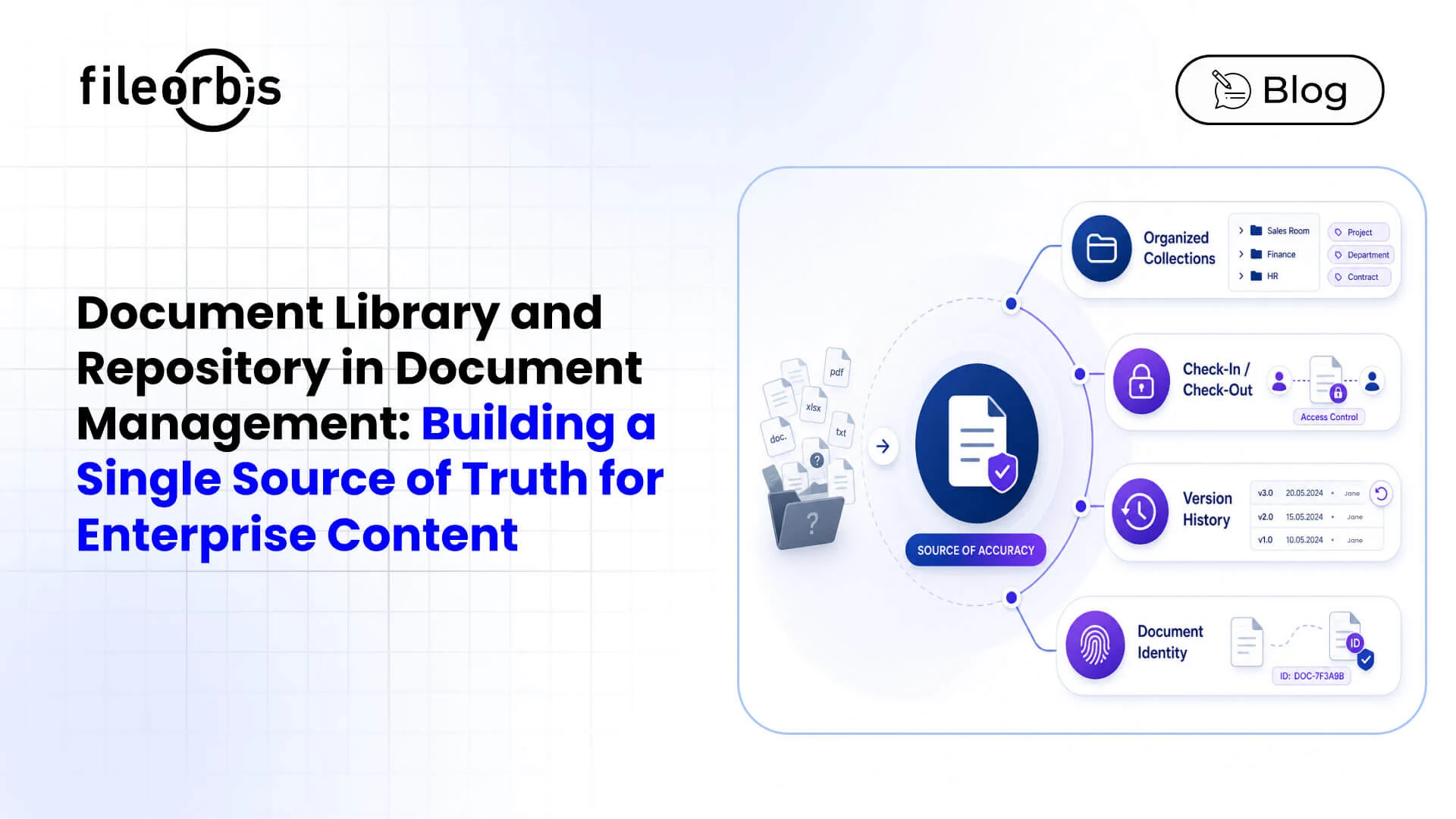
Why Every Enterprise Needs a Modern Document Library and Repository
Documents are the backbone of every business process.
Contracts, financial records, engineering drawings, HR documents, project files, customer communications, and operational procedures all drive daily business activities. Yet many organizations still manage these critical assets across disconnected file shares, email inboxes, personal drives, cloud folders, and collaboration platforms.
The result?
- Multiple copies of the same file
- Conflicting document versions
- Lost edits
- Limited accountability
- Compliance challenges
- Increased security risks
As organizations grow, unmanaged content becomes increasingly difficult to control.
A modern document management platform addresses these challenges through a structured document library and repository that ensures users always access, edit, and share the correct version of the correct document.
Rather than simply storing files, a document repository provides governance, traceability, and operational consistency across the entire content lifecycle.
The Challenge: Files Without a Repository
Most organizations do not struggle because they lack storage.
They struggle because they lack organization.
Without a centralized repository, content quickly becomes fragmented across multiple locations, creating confusion and inefficiency.
Conflicting Edits
One of the most common document management problems occurs when multiple users edit the same file simultaneously.
Without proper controls:
- Users overwrite each other’s changes
- Important updates are lost
- Teams waste time reconciling differences
- Errors become difficult to identify
The larger the organization, the more frequently these issues occur.
Version Confusion
Ask five employees which version of a document is the latest, and you may receive five different answers.
Common file names such as:
- Contract_v1
- Contract_v2
- Contract_Final
- Contract_Final_v2
- Contract_Final_Final
often become the unofficial version management strategy.
This confusion slows business processes and introduces unnecessary risk.
Lost Document History
Traditional file systems struggle to maintain document lineage.
When files are:
- Renamed
- Moved
- Shared
- Copied
- Archived
critical historical context is often lost.
Organizations lose visibility into how documents evolved over time and who made specific changes.
Lack of Accountability
Without a managed repository, it becomes difficult to answer important questions:
- Who modified this document?
- When was it changed?
- What was changed?
- Which version was approved?
- Who currently owns the document?
A modern repository solves these problems by introducing structure, control, and traceability.
What Is a Document Library and Repository?
A document repository is a centralized environment designed to store, organize, govern, and manage enterprise content throughout its lifecycle.
Unlike traditional file storage, repositories provide:
- Structured document collections
- Controlled editing processes
- Version management
- Document identity
- Metadata-driven organization
- Security and governance controls
- Auditability and compliance visibility
The repository becomes the authoritative source of truth for enterprise content.
Organizing Document Collections Effectively
A repository’s first responsibility is organizing content in a way that supports business processes.
Libraries and Folder Structures
Most organizations require logical hierarchies that reflect how teams operate.
Examples include:
- Department libraries
- Project repositories
- Customer folders
- Regional workspaces
- Functional archives
These structures help users quickly locate relevant information while maintaining governance standards.
Project-Based Workspaces
Many business activities require dedicated document collections.
Examples include:
- Legal matters
- Mergers and acquisitions
- HR investigations
- Procurement initiatives
- Construction projects
- Engineering programs
Project workspaces create focused environments where teams can collaborate while maintaining security and separation from other business content.
Virtual Data Rooms
Highly sensitive activities often require enhanced isolation and control.
Virtual Data Rooms (VDRs) provide secure workspaces for:
- Due diligence
- M&A transactions
- Board communications
- Investor relations
- Legal reviews
These environments maintain strict access controls while preserving collaboration capabilities.
Metadata: The Key to Scalable Organization
Folders alone are no longer enough.
Modern enterprises generate too much content for manual filing systems to remain effective.
Metadata transforms repositories into intelligent content environments.
What Is Metadata?
Metadata is information about a document rather than the document itself.
Examples include:
- Department
- Project
- Owner
- Sensitivity level
- Customer
- Contract type
- Creation date
- Retention category
Why Metadata Matters
Metadata enables users to:
- Search faster
- Filter content
- Group related files
- Automate governance
- Improve reporting
- Drive retention policies
Rather than forcing users to remember folder locations, metadata makes content discoverable through multiple pathways.
Document Check-In and Check-Out: Preventing Content Chaos
One of the most valuable repository capabilities is document check-in and check-out.
This process eliminates the risk of conflicting edits.
What Is Check-Out?
When a user checks out a document:
- The document is reserved for editing
- Other users can still view it
- Editing rights are temporarily restricted
- The repository records who owns the lock
This prevents simultaneous modifications.
What Is Check-In?
When editing is complete:
- The document is returned to the repository
- The lock is released
- A new version is created
- The modification history is updated
This ensures changes are captured systematically.
Benefits of Check-In and Check-Out
Organizations gain:
- Reduced editing conflicts
- Clear document ownership
- Better collaboration
- Stronger governance
- Improved auditability
For highly regulated environments, these controls are often essential.
Version History: Preserving Document Evolution
Every important business document evolves over time.
Version control ensures that evolution is captured and preserved.
Automatic Versioning
Modern repositories automatically create new versions whenever documents change.
This removes the burden of manual version management from users.
Benefits include:
- Consistent history
- Reduced human error
- Better visibility
- Faster recovery
Full Revision Timelines
Each version records:
- Author
- Timestamp
- Version number
- Change history
This creates a complete historical record of document development.
Rollback Capabilities
Mistakes happen.
Version history enables organizations to:
- Restore previous versions
- Recover deleted content
- Undo accidental changes
- Resolve editing conflicts
Rollback functionality significantly reduces operational risk.
Document Identity: The Foundation of Traceability
One of the most overlooked aspects of document management is document identity.
A repository should assign every document a unique and persistent identifier.
Why Document Identity Matters
Files frequently change.
They may be:
- Renamed
- Moved
- Shared
- Archived
- Reclassified
Without a persistent identity, tracking becomes difficult.
Persistent File IDs
A unique file ID remains attached to a document regardless of:
- Location
- Name
- Version
- Ownership
This ensures continuity across the document lifecycle.
Maintaining Chain of Custody
Document identity enables organizations to maintain a complete chain of custody.
Every action can be linked to:
- A specific document
- A specific user
- A specific timestamp
- A specific outcome
This is particularly valuable for compliance and legal requirements.
Security and Governance in Modern Repositories
Repositories must provide more than organization.
They must also enforce governance.
Role-Based Access Control
Access should be granted according to business need.
Permissions typically define who can:
- View
- Edit
- Download
- Share
- Delete
- Approve
This minimizes unauthorized access.
Classification-Aware Security
Security policies can adapt based on content sensitivity.
Examples include:
- Public
- Internal
- Confidential
- Restricted
- Legal Hold
Classification-driven controls improve both security and compliance.
Delegated Administration
Large organizations often require distributed ownership.
Department leaders can manage their own content while remaining within centrally defined governance policies.
Auditability and Compliance
Organizations increasingly operate under strict regulatory requirements.
A repository helps support compliance by providing complete visibility into content activities.
Comprehensive Audit Trails
Every activity can be logged, including:
- Access events
- Downloads
- Edits
- Shares
- Version creation
- Permission changes
This visibility simplifies compliance reporting and investigations.
Supporting Regulatory Requirements
Modern repositories help organizations align with:
- GDPR
- HIPAA
- ISO 27001
- NDMO
- Industry-specific regulations
- Internal governance frameworks
Auditability is often the difference between demonstrating compliance and merely claiming it.
The Business Benefits of a Centralized Repository
Organizations that implement repository-driven document management gain measurable advantages.
Improved Productivity
Employees spend less time searching for information and more time using it.
Better Collaboration
Teams work from the same source of truth.
Reduced Risk
Version control and auditability reduce operational errors.
Stronger Compliance
Governance becomes systematic rather than manual.
Enhanced Security
Access controls and content governance protect sensitive information.
The Future of Enterprise Document Repositories
The role of repositories continues to evolve.
Future-ready organizations are investing in repositories that provide:
- Intelligent classification
- Automated governance
- Metadata-driven organization
- Content-aware security
- AI-ready content structures
- Hybrid cloud flexibility
The repository is no longer simply a place to store files.
It is becoming the operational foundation for secure digital work.
Final Thoughts
A document library and repository is far more than a digital filing cabinet.
It is the system that ensures employees work with the correct document, understand its history, preserve its integrity, and maintain accountability throughout its lifecycle.
By combining structured organization, metadata-driven management, check-in/check-out controls, version history, document identity, governance, and auditability, modern repositories create a trusted single source of truth for enterprise content.
Organizations that invest in repository-driven document management gain greater efficiency, stronger security, improved compliance, and a more reliable foundation for digital collaboration.
What is a document repository?
A document repository is a centralized platform used to store, organize, govern, and manage enterprise documents while maintaining version control, security, and compliance.
What is document check-in and check-out?
Check-in and check-out controls prevent multiple users from overwriting each other’s work by locking documents during editing and creating new versions when changes are completed.
Why is version history important?
Version history preserves every change made to a document, enabling rollback, auditability, and improved collaboration.
What is document identity?
Document identity is a unique and persistent identifier assigned to a file that remains unchanged even if the document is moved, renamed, or shared.
How do document repositories improve compliance?
Repositories provide audit trails, access controls, version management, and governance capabilities that help organizations meet regulatory and internal compliance requirements.

Gamze Karslı
Head of Marketing
Subscribe to our Newsletter
About FileOrbis
Aiming to manage the user and file relationship within an institutional framework, FileOrbis is constantly being developed in order to meet different industry and customer needs in terms of file management and sharing. Since 2018, FileOrbis continues to be developed with the excitement of the first day. FileOrbis focuses on high security, rich integration, ease of use and integrated management criteria.