
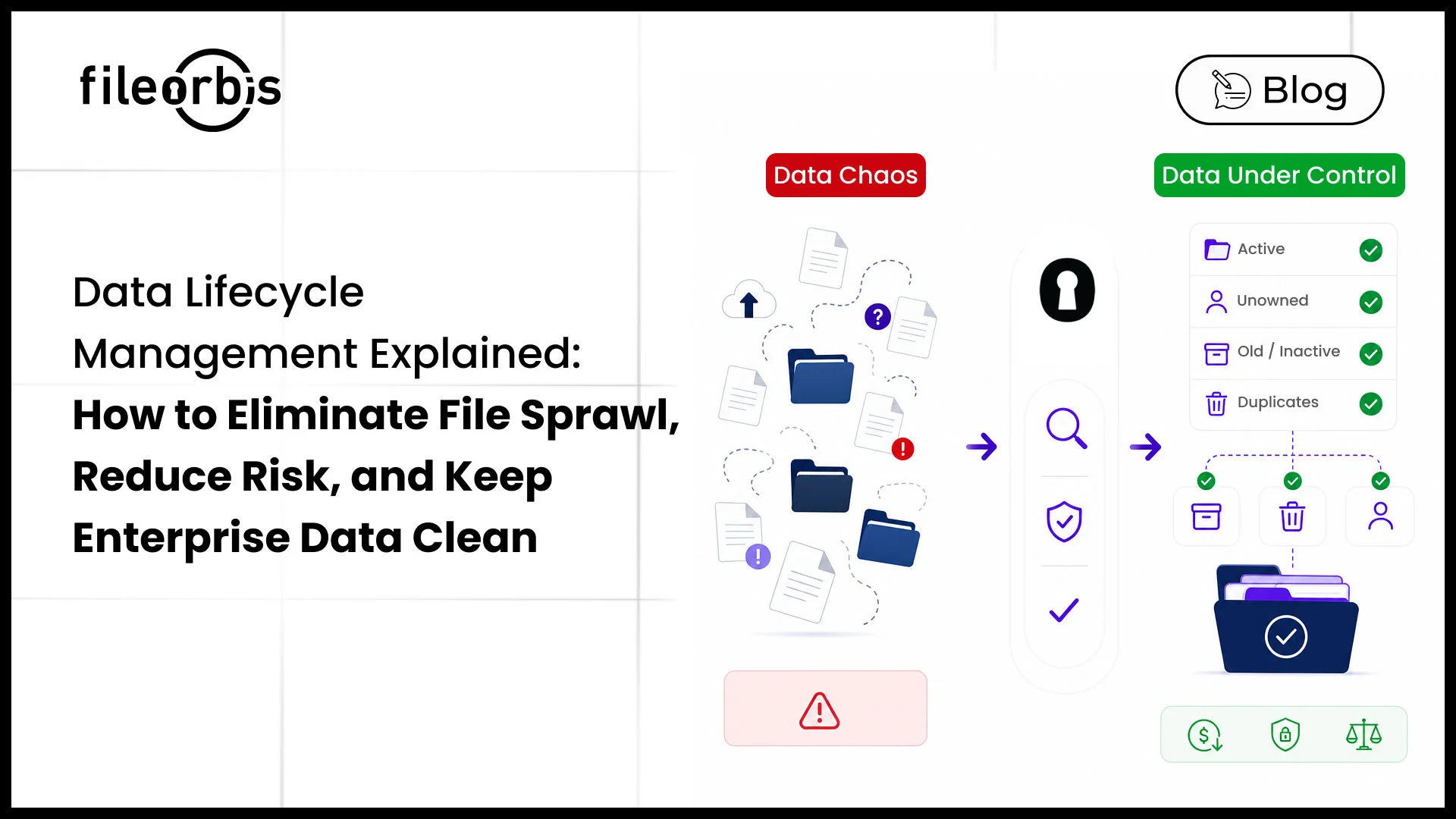
Data Lifecycle Management Explained: How to Eliminate File Sprawl, Reduce Risk, and Keep Enterprise Data Clean
Your Biggest Data Risk Might Be the Files Nobody Uses
Most organizations spend significant time protecting their data.
They invest in:
- Access controls
- Encryption
- Backup systems
- Compliance tools
- Threat detection
But few organizations spend enough time asking a different question:
Should this data still exist at all?
Over time, enterprise repositories accumulate enormous amounts of forgotten content.
Old project folders.
Duplicate contracts.
Files owned by employees who left years ago.
Sensitive records that should have been archived.
Documents that continue to appear in AI search results despite no longer being relevant.
The result is what many organizations experience today:
File sprawl.
And file sprawl is more than a storage problem.
It is a governance problem, a compliance problem, a security problem, and increasingly, an AI problem.
This is where Data Lifecycle Management (DLM) becomes essential.
Rather than simply storing files indefinitely, Data Lifecycle Management ensures every piece of content has a purpose, an owner, a retention policy, and a clear path through its lifecycle.
What Is Data Lifecycle Management?
Data Lifecycle Management (DLM) is the practice of managing content from creation through archival and eventual disposal.
The goal is simple:
Ensure the right data is retained for the right amount of time while eliminating unnecessary, redundant, outdated, and risky content.
A modern lifecycle strategy helps organizations answer critical questions:
- Which files are still active?
- Which files are no longer needed?
- Who owns this data?
- Which content should be archived?
- Which records must be retained?
- Which files should never be indexed by AI systems?
- Which content can be safely deleted?
Instead of relying on guesswork, organizations gain visibility and control over the entire lifecycle of enterprise content.
Why File Sprawl Has Become a Major Business Problem
Most repositories grow continuously.
Very little content is ever reviewed once it is created.
As a result, organizations accumulate years of unmanaged information.
Stale Files Continue Consuming Storage
Thousands—or even millions—of files remain untouched for years.
Yet they continue consuming expensive storage resources.
Organizations pay to store data that provides little or no business value.
Ownerless Data Creates Governance Gaps
Employees leave.
Departments reorganize.
Projects end.
But files remain.
Without ownership, organizations lose accountability and visibility into critical information assets.
Duplicate Documents Multiply Risk
The same document often exists in multiple locations.
A contract may appear in:
- Legal folders
- Sales repositories
- Project workspaces
- Archive systems
This duplication increases storage costs and creates uncertainty about which version should be considered authoritative.
Expired Content Remains Accessible
Contracts, records, and project files often remain available long after they have fulfilled their purpose.
The longer unnecessary content remains accessible, the greater the risk.
AI Systems Learn from Outdated Information
As organizations adopt AI-powered search and assistants, stale content creates a new challenge.
AI systems cannot distinguish valuable information from outdated information unless governance controls exist.
The result is AI generating answers based on obsolete documents.
The Shift from Data Protection to Data Governance
Traditional approaches focus on protecting content.
Modern organizations must go further.
They must govern content.
Governance means understanding:
- Where data lives
- Who owns it
- How long it should be retained
- When it should be archived
- When it should be deleted
- Whether it should be available to AI systems
Data Lifecycle Management transforms content from a collection of files into a managed information asset.
Understanding the Lifecycle of Enterprise Data
Every file follows a lifecycle.
Although organizations may define stages differently, a typical lifecycle includes:
Active
Frequently accessed and actively used content.
Examples include:
- Current projects
- Ongoing contracts
- Operational documents
Stale
Files that have not been accessed or modified for an extended period.
These files may still have value but require review.
Archive Candidate
Content that is no longer actively used but may need to be retained for compliance or business purposes.
Pending Review
Files requiring ownership, retention, or deletion decisions.
Archived
Content moved to long-term storage.
Legal Hold
Content protected from deletion due to regulatory, legal, or investigative requirements.
Excluded from AI
Content intentionally removed from AI indexes to improve retrieval quality and reduce risk.
Identifying Stale and Unused Data
One of the most valuable aspects of lifecycle management is understanding which content no longer serves a business purpose.
Modern lifecycle solutions analyze signals such as:
- Last opened date
- Last modified date
- Last shared date
- Last downloaded date
- Creation date
These signals help determine whether content remains relevant.
For example:
A file that has not been accessed for three years, is not part of an active workflow, and contains no regulated data may be a strong candidate for archival.
This allows organizations to focus attention where it matters most.
Solving the Ownerless Data Problem
One of the most common governance challenges involves files that no longer have an identifiable owner.
This happens when:
- Employees leave the organization
- Accounts are disabled
- Data migrations occur
- Service accounts create content
- Ownership metadata is lost
Without ownership, accountability disappears.
Modern lifecycle management solutions help organizations identify ownerless data and suggest likely owners based on:
- Access history
- Department relationships
- Folder ownership
- Project associations
- Most recent editors
This restores accountability while reducing administrative effort.
Eliminating Duplicate and Redundant Content
Duplicate data creates more problems than many organizations realize.
It increases:
- Storage costs
- Compliance complexity
- Search noise
- AI confusion
Lifecycle management helps identify:
- Exact duplicates
- Near duplicates
- Redundant content
Organizations can then designate a master copy while archiving or restricting duplicate versions.
The result is a cleaner, more trustworthy content environment.
Automating Retention Management
One of the most challenging governance responsibilities is determining how long content should be retained.
Different content types often require different retention periods.
Examples include:
- Employee records
- Contracts
- Financial reports
- Customer information
- Operational documentation
Lifecycle management helps organizations automate retention recommendations while ensuring decisions remain aligned with business and regulatory requirements.
Legal Hold: Protecting Critical Content
Not all files can be archived or deleted.
Some content must be preserved due to:
- Litigation
- Investigations
- Regulatory reviews
- Internal audits
Legal hold capabilities ensure that protected content remains untouched regardless of lifecycle policies.
This reduces compliance risk while preserving critical evidence.
Smart Archiving Instead of Risky Deletion
Deleting large volumes of content can be risky.
Organizations need confidence before removing information.
Modern lifecycle management solutions prioritize controlled actions such as:
- Archiving
- Soft deletion
- Quarantine
- Approval-based cleanup
This approach allows organizations to reduce risk while maintaining flexibility.
Why AI Data Hygiene Matters
As AI becomes part of everyday business operations, data quality becomes increasingly important.
AI systems are only as good as the information they can access.
The Problem with Stale AI Data
When AI indexes contain:
- Duplicate documents
- Obsolete records
- Expired contracts
- Archived content
users receive less accurate results.
This reduces trust in AI systems.
Lifecycle Management Creates Cleaner AI
By governing content lifecycle states, organizations can ensure that AI systems focus on:
- Current information
- Relevant content
- Authoritative documents
rather than outdated or redundant files.
This significantly improves AI performance and trustworthiness.
Practical Examples of Lifecycle Management in Action
Archiving an Old Project
A project repository contains 80,000 files.
Only a small percentage has been accessed within the last two years.
The system identifies the repository as an archive candidate, routes it for approval, and moves it to lower-cost storage.
Reassigning Ownership
A departed employee leaves behind thousands of files.
Lifecycle management groups content by department and recommends new owners.
Administrators can approve reassignment in bulk.
Cleaning Duplicate Contracts
The same contract appears across multiple repositories.
The system identifies a master copy and recommends archiving duplicates.
Reviewing Sensitive Historical Data
An HR archive contains personal information that has not been accessed for years.
The system flags the content for review and routes decisions to the responsible data owner.
The Business Benefits of Data Lifecycle Management
Organizations that implement lifecycle governance gain measurable benefits.
Lower Storage Costs
Unused content is archived rather than consuming premium storage.
Reduced Compliance Risk
Retention policies become more consistent and defensible.
Stronger Governance
Every file gains a clear lifecycle status and ownership model.
Better Security
Sensitive content is reviewed and managed proactively.
Improved AI Quality
AI systems work with cleaner, more relevant information.
The Future of Information Governance
As data volumes continue to grow, manual governance becomes impossible.
Organizations need automation that can:
- Identify risk
- Recommend actions
- Support approvals
- Preserve compliance
- Improve AI readiness
Data Lifecycle Management is becoming a foundational component of modern information governance.
It enables organizations to move beyond simply storing files and toward actively managing their information assets.
Final Thoughts
The biggest risk in many organizations is not the data they use every day.
It is the data they forgot existed.
Stale files, duplicate documents, ownerless content, outdated records, and unmanaged archives create significant security, compliance, operational, and AI-related challenges.
Data Lifecycle Management provides a structured framework for identifying, governing, archiving, retaining, and cleaning enterprise content throughout its lifecycle.
Organizations that embrace lifecycle governance gain more than reduced storage costs.
They create cleaner repositories, stronger compliance, better security, improved AI outcomes, and a more trustworthy foundation for enterprise information management.
What is Data Lifecycle Management?
Data Lifecycle Management is the process of governing data from creation through archival and disposal to improve compliance, security, and operational efficiency.
Why is file sprawl a problem?
File sprawl increases storage costs, creates governance challenges, introduces compliance risks, and reduces the quality of AI search and retrieval systems.
What is ownerless data?
Ownerless data refers to files that no longer have a valid owner due to employee departures, migrations, disabled accounts, or missing metadata.
How does lifecycle management improve AI systems?
Lifecycle management removes stale, duplicate, and outdated content from AI indexes, ensuring AI tools retrieve more accurate and relevant information.
What are the benefits of data lifecycle automation?
Data lifecycle automation reduces storage costs, improves governance, strengthens compliance, supports legal hold requirements, and enables cleaner, more trustworthy AI environments.

Gamze Karslı
Head of Marketing
Subscribe to our Newsletter
About FileOrbis
Aiming to manage the user and file relationship within an institutional framework, FileOrbis is constantly being developed in order to meet different industry and customer needs in terms of file management and sharing. Since 2018, FileOrbis continues to be developed with the excitement of the first day. FileOrbis focuses on high security, rich integration, ease of use and integrated management criteria.