
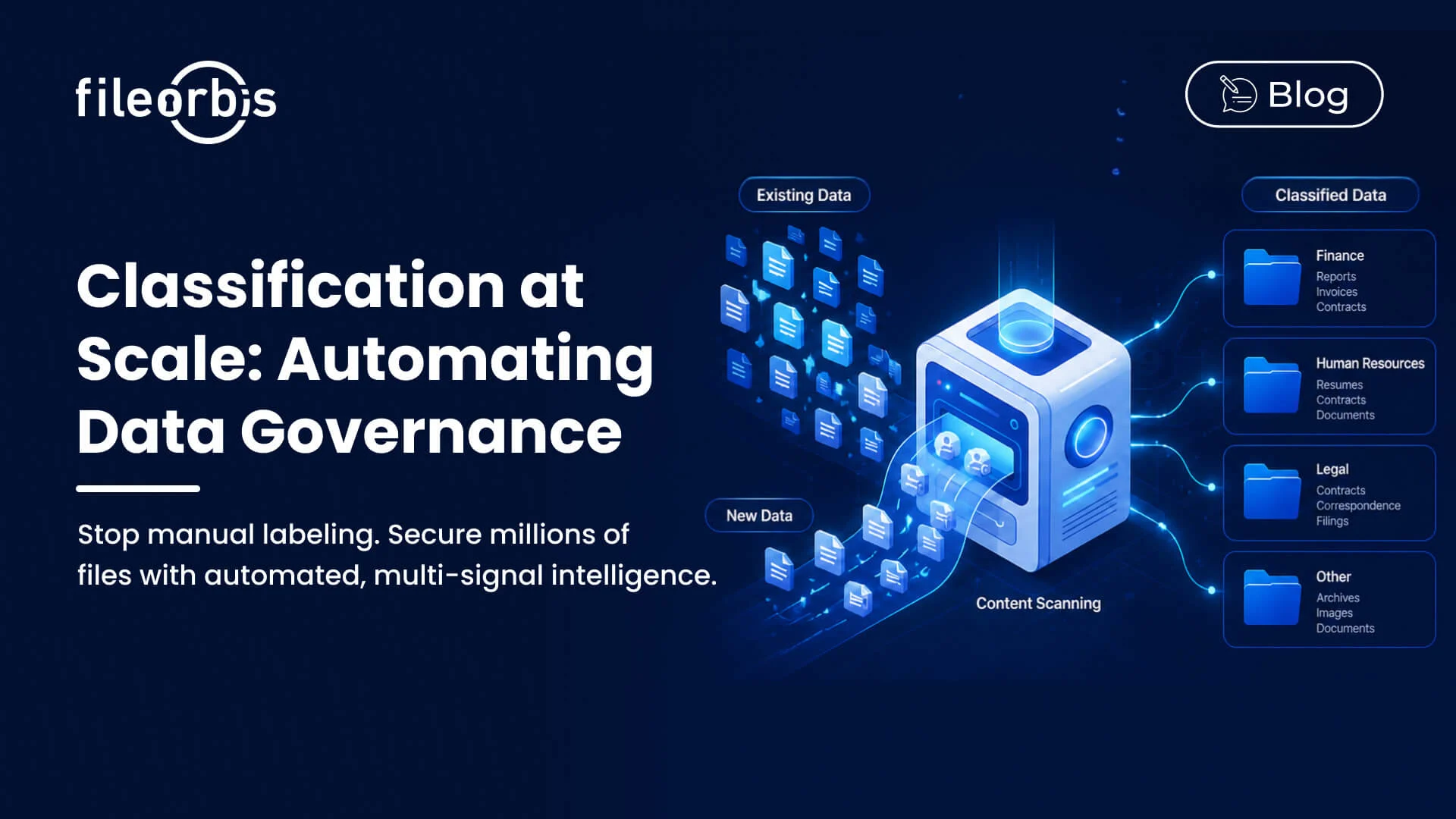
Classification at Scale: Automating Data Governance
Data governance programs fail most often not because of policy gaps, but be-cause of policy application gaps. An organization may have excellent data classi-fication policies on paper while the actual file estate — millions of documents ac-cumulated over years — remains unclassified, unlabeled, and ungoverned. File-Orbis closes this gap with classification automation that operates at enterprise scale, across all connected storage systems, without interrupting ongoing work.
The Scale Imperative
Consider the mathematics of manual classification: a large enterprise might have 10 million files distributed across file servers, SharePoint libraries, and departmental storage. If a user can review and classify one file per minute a generous estimate for anything beyond a cursory review — classifying the entire estate manually would require approximately 167,000 person-hours. That is roughly 80 full-time employees working for an entire year, focused exclusively on classification.
The practical conclusion is that manual classification cannot produce a classi-fied enterprise file estate. It can produce a partially classified file estate with unknown gaps — which is arguably worse than an unclassified estate because it creates false confidence in governance coverage.
Automation is not an efficiency preference; it is the only viable approach at enterprise scale.
FileOrbis Classification Automation Architecture
Scan-at-Rest: Classifying the Existing Estate
FileOrbis performs retrospective classification scans across all connected storage systems, working through existing files in the background without impacting user access performance. The scanning engine:
- Prioritizes recently modified and frequently accessed files for early classi-fication
- Processes lower-priority archival content during off-peak periods
- Reports scan progress and coverage percentage through the governance dashboard
- Generates classification gap reports that identify storage areas with low or no classification coverage
Organizations typically achieve initial classification coverage of their active file estate within days to weeks of deployment, depending on the volume of content and the scan priority configuration.
Scan-on-Create: Classifying New Content Immediately
Every new file created in or uploaded to a connected storage system is submitted to the classification engine at the moment of ingestion. Classification labels are applied before the file is available for sharing or external access — ensuring that the classification gap does not grow as the organization continues to create content.
Multi-Signal Classification
The FileOrbis classification engine evaluates multiple signals to determine the appropriate classification for each file:
Content signals: Pattern matching against defined sensitive data types, key-word proximity analysis, and structural recognition of common sensitive data formats (see the detailed pattern list in the DLP section).
Structural signals: File type, extension, and format characteristics. Spread-sheets are evaluated differently from PDFs; executable files trigger distinct clas-sification paths regardless of their declared type.
Metadata signals: File creation date, modification history, creator identity, and application of origin. Files created by users in sensitive roles or in sensitive periods (e.g., during active legal matters) receive elevated initial classifications pending content review.
Location signals: Folder taxonomy and storage hierarchy. Files in designated sensitive storage areas inherit the classification of their context unless content analysis indicates a different classification is warranted.
Inheritance signals: Documents that reference, embed, or are derived from classified parent documents can inherit or be escalated to the parent’s classifi-cation level.
Human-in-the-Loop Classification Review
Automated classification is accurate at scale but is not infallible. FileOrbis incorporates a review workflow for low-confidence classification decisions:
When the classification engine assigns a label but with a confidence score below a defined threshold, the file is added to a review queue. A designated data steward reviews the file in context and confirms, overrides, or escalates the classification. Override decisions are recorded with the steward’s identity and reasoning, providing a learning signal that improves future automated accuracy.
High-confidence classifications are applied automatically without requiring hu-man review, ensuring that the classification program scales without proportional growth in human review effort.
Tag-Based Organization and Search
In addition to governance-driven classification labels, FileOrbis supports a paral-lel tagging system for organizational metadata — project codes, client identifiers, subject matter categories, retention schedules, and custom taxonomy elements defined by the organization.
Tags are applied through: – Automated rules based on folder location or file characteristics – User application at upload or modification time – Bulk tagging operations applied by administrators to defined file sets Tags are indexed for search, enabling complex queries that combine governance classifications with organizational metadata — for example, finding all “Confi-dential” documents associated with a specific client that were modified in the last 90 days by members of the legal team.
Subscribe to our Newsletter
About FileOrbis
Aiming to manage the user and file relationship within an institutional framework, FileOrbis is constantly being developed in order to meet different industry and customer needs in terms of file management and sharing. Since 2018, FileOrbis continues to be developed with the excitement of the first day. FileOrbis focuses on high security, rich integration, ease of use and integrated management criteria.