FileOrbis Edge Acceleration

Deliver local-network speeds across remote sites by caching downloads and routing traffic locally, without compromising data residency and governance.


Edge Offloading

Instant uploads


Cached Downloads

Local Speed


Location Clusters

Clustered nodes


Data Residency

Local compliance

Why file performance breaks down, and where the edge helps

Trusted by Content-Critical Businesses Worldwide

Key Benefits

How FileOrbis Edge works

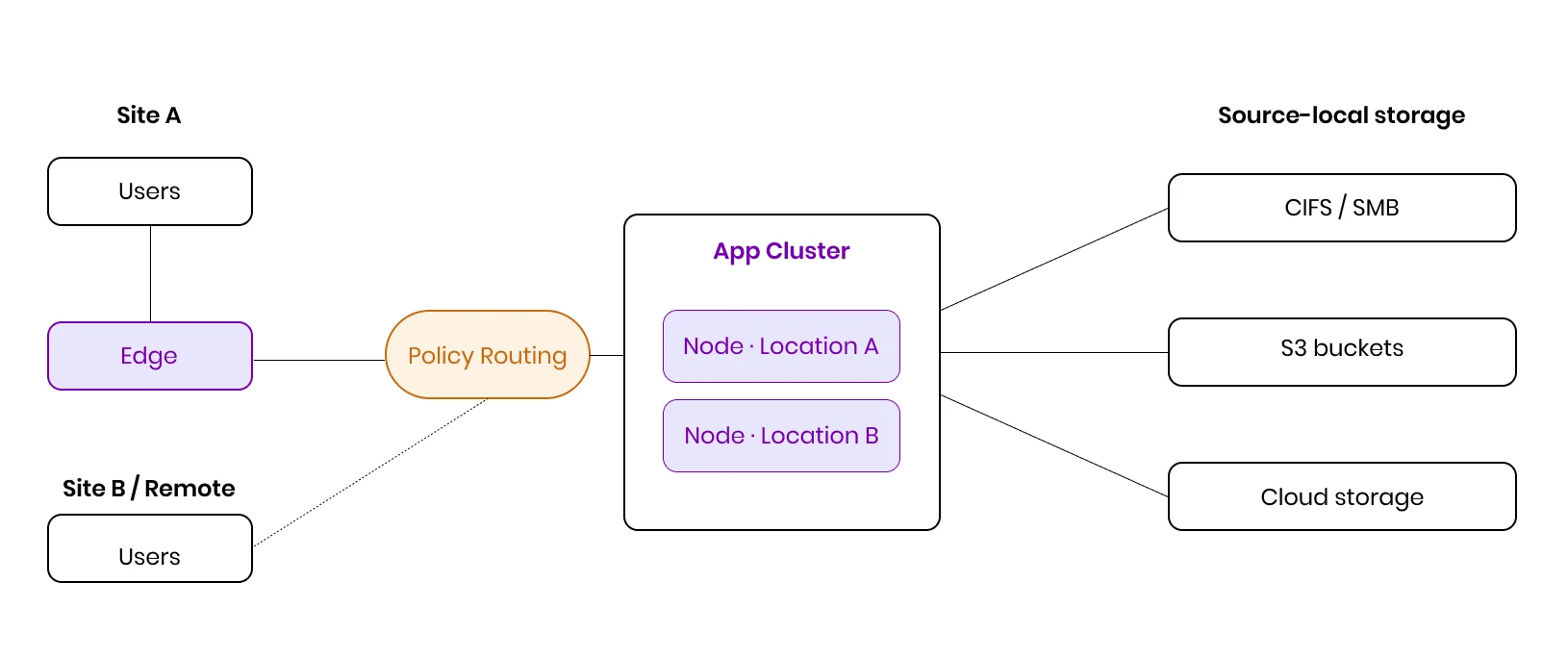
FileOrbis Edge routes each user to a nearby edge server and application node, which
reaches the storage that lives closest to that site.

Core Capabilities


Edge Offloading & Acceleration

Offloads large file uploads and heavy transfers to nearby edge nodes, bypassing central server bottlenecks and accelerating access across weak links.


Intelligent Edge  Caching

Automatically caches frequently accessed content at local sites, providing LAN-like download speeds for remote teams        without replicating full storage.


Location-Aware Clustering

Dynamically routes user      requests to the closest geographic or logical data cluster, reducing latency across international branches.


Governed Data Residency
Enforces strict compliance and data residency rules, ensuring files stay within specified geographic boundaries while remaining fully audited and classified.

COMPLIANCE & CONTROL

Speed Without Compromising Data Residency

Maintain complete regulatory control and local compliance while accelerating global file delivery.

USE CASES

Where FileOrbis Edge delivers

FileOrbis Edge is built for the environments where central-only file platforms struggle: unstable connectivity, distances, and very large files.

How FileOrbis Edge compares to global file systems

The closest category to FileOrbis Edge is the global file system. Here is what FileOrbis adds on top of edge caching and a shared namespace.

ApproachWhat it optimizesWhere FileOrbis Edge differs
Traditional central file platformA single application server or region that every user connects back toFileOrbis Edge removes the round trip: local edge offload, cached downloads, and location-independent nodes so each site works against something nearby.
Global file systems / cloud file servicesA single global namespace with edge caching over cloud object storageFileOrbis Edge adds full file governance and secure collaboration, including link, web, and Drive sharing, policy-based routing, classification, and enforced data residency, on top of edge acceleration and multi-site clustering across CIFS/SMB, S3, and cloud sources.

Hear From Our Customers

“FileOrbis gave us a single pane of glass across on-prem and cloud content. We reduced over-permissioned access fast and finally had audit-ready visibility.”

Security & Risk Lead, Enterprise Organization

“External sharing used to be our biggest leak point. With content-aware policies and full traceability, we enabled collaboration without losing control.”

IT Manager, Regulated Industry

“We consolidated multiple tools into one governed platform. Users got faster access, and our compliance reporting became dramatically simpler.”

Head of Infrastructure, Global Company

See FileOrbis Edge on your network

Bring local-network speed to every site, without giving up governance. Talk to a FileOrbis solutions architect about mapping edge servers and location-independent clusters to your environment.

Frequently Asked Questions

How can we help you?

FileOrbis Edge is a distributed acceleration layer that offloads uploads to a local edge server, serves downloads from the nearest cached copy, and routes users to location-independent application clusters so they reach the data source closest to them, while keeping every transfer inside FileOrbis’s governance.

Yes. Because edge servers, application nodes, and their attached storage are pinned to physical locations, data stays where it is produced, with content created in the EU written to and served from disks in the EU, never round-tripped through another region. This lets you enforce data residency and sovereignty requirements such as GDPR and EU AI Act obligations by architecture, with access policies, classification, and audit applied to every transfer.

Yes. Because uploads are written to a local edge server and streamed to the application server in the background, users are not blocked by a slow or intermittent link. The edge absorbs latency and reconnects on the user’s behalf, which makes it well suited to maritime, remote-site, and multi-country deployments.

Yes. Multiple application servers can be joined into a single cluster, and those nodes can live in different physical locations. Users are routed to the node that serves their location for fast, local file access.

Each application node can attach and transfer its own file environments directly, including CIFS/SMB shares, S3 buckets, and cloud storage, so repositories located near a site are reached by the node next to them rather than across the WAN.

You shape edge and location-independent clusters around your network map. Based on network conditions and need, FileOrbis feeds each user from the closest data source, the nearest edge server, the nearest application node, and source-local storage.

No. The client is released as soon as the edge server receives the file. The edge then queues and streams it to the application server in the background, so the person can finish their task without waiting for the full transfer.

Yes. Access policies, content classification, and the audit trail apply to edge-accelerated transfers exactly as they do to central ones. Governance travels with the data.

Environments with unstable connectivity, multiple locations, or very large files, including shipping and maritime, construction and engineering, energy and field operations, multi-branch enterprises, and data-heavy media and design teams.

Request FileOrbis Demo Today

Do you want to contact one of our representatives to get information or see FileOrbis in action? Schedule a custom live demo of Fileorbis made just for you.