
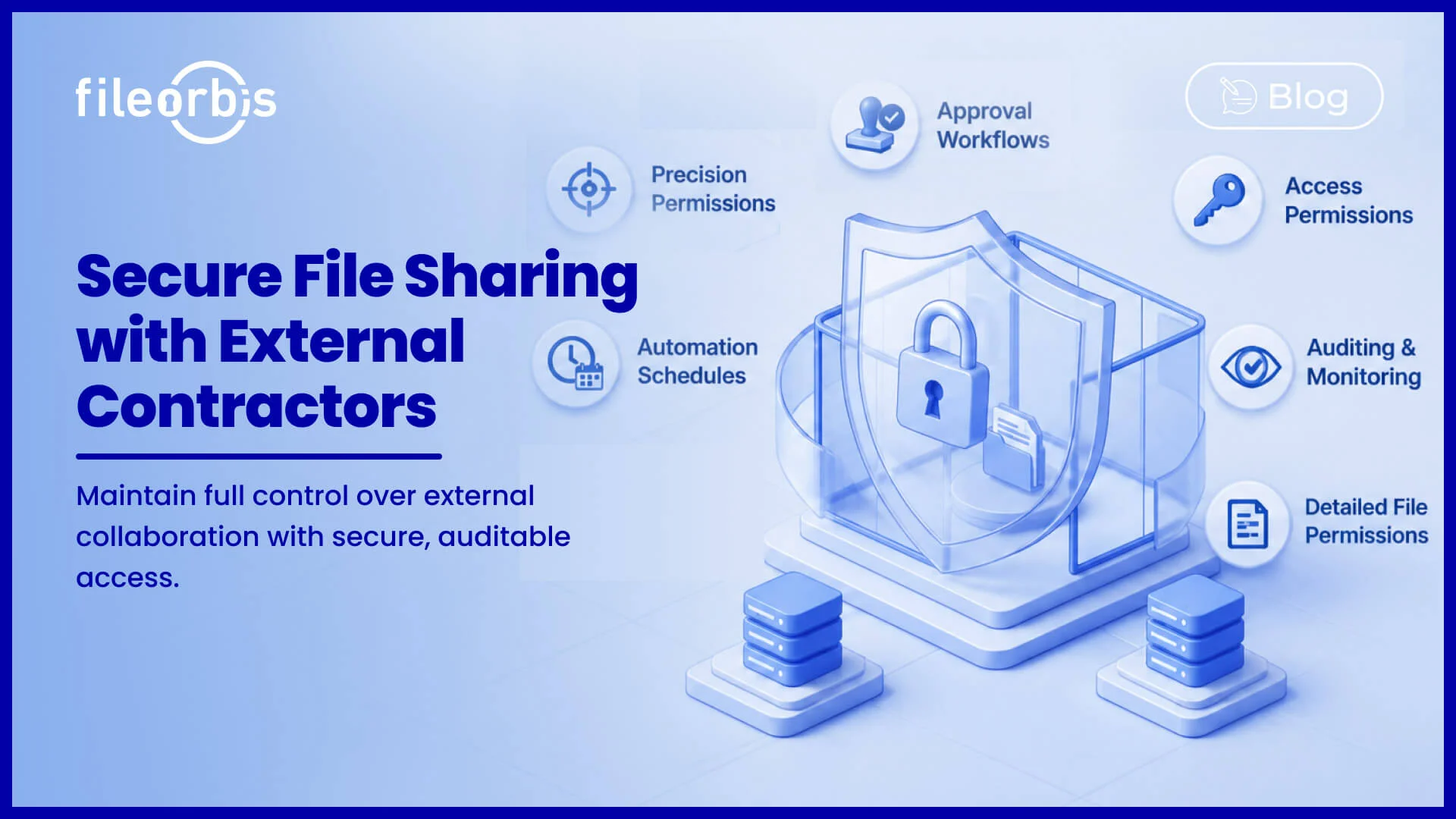
Secure File Collaboration with External Contractors: Maintaining Control Beyond Your Perimeter
External contractors present a unique security challenge. They need real access to real files to do their work — but the governance principles that apply to employees must extend to the engagement in a way that is workable for both parties. Too many controls create friction that reduces productivity and drives workarounds. Too few controls create the exposure that leads to incidents.
FileOrbis is built around the concept of controlled external access: giving exter-nal parties exactly what they need to work effectively, with every interaction tracked, time-bounded, and revocable.
The External Contractor Risk Surface
Before examining solutions, it is worth being precise about the risks that exter-nal contractor file access introduces:
Persistent Access After Engagement End When a contractor’s project is complete, their access to organizational files should terminate. In practice, manually revoking access across shared drives, email attachments, and ad-hoc sharing links is difficult to do completely. Former contractors frequently re-tain access to files indefinitely — not through malicious intent, but through administrative oversight.
Uncontrolled File Forwarding A file shared with a trusted contractor can be forwarded to a subcontractor, a colleague, or a third party outside the orig-inal agreement. Standard file sharing links provide no mechanism to restrict redistribution once the file leaves the recipient’s inbox.
Lack of Activity Visibility Organizations typically do not know when exter-nal contractors access files, which files they download, or how many times they return to a document. This absence of visibility makes post-incident investiga-tion difficult and prevents proactive identification of unusual behavior.
Absence of Approval Records When sensitive documents are shared with external parties without a documented authorization, the organization cannot demonstrate that the sharing was intentional, authorized, and appropriate — a significant gap in a compliance or legal context.
Inappropriate Scope of Access When contractors are added to a shared drive or a SharePoint site, they often gain access to a broader range of content than their engagement requires. The principle of least privilege — granting access only to what is necessary — is frequently violated through the use of group-based access grants.
FileOrbis External Collaboration: Designed for Control
Virtual Collaboration Rooms
For each external engagement, FileOrbis administrators or project owners can create a dedicated virtual collaboration room — an isolated workspace that contains only the files, folders, and documents relevant to that engagement. The contractor accesses only their room; they have no visibility into or navigation path to any other part of the organizational file estate.
Rooms can be provisioned in minutes. Files are added by dragging them from connected storage into the room — they remain in their original locations; the room provides a governed access view. When the engagement ends, the room is deactivated and all external access is terminated with a single action.
Per-File and Per-Folder Access Granularity
Within a collaboration room, access permissions can be defined at the individual file level:
- Read-only access for reference documents and specifications
- Download-permitted access for deliverables the contractor needs lo-cally
- Edit access for collaborative drafting or feedback annotation
- Upload-only access for receiving contractor deliverables without grant-ing read access to other content
This granularity ensures that contractors have exactly the access their work requires — and no more.
Secure External Links with Enforced Controls
When sharing files with external contractors who do not require a persistent collaboration room, FileOrbis generates secure links with enforced controls:
- Automatic expiration after a defined period
- Password protection with the password delivered through a separate chan-nel
- View-only mode preventing download or print
- Access logging capturing every viewing event and IP address
- Download limits restricting the number of times the file can be saved locally
These controls are not optional — they are enforced at the platform level, re-gardless of what the recipient does with the link after receiving it.
Contractor Activity Monitoring
The FileOrbis audit dashboard provides real-time and historical visibility into contractor activity:
- Which files each contractor has accessed
- When each access occurred and from which IP address or device
- Which files have been downloaded, and how many times
- Which files are currently open in active sessions
This visibility is available to project owners and administrators without requir-ing IT involvement. Unusual activity — such as a contractor accessing files outside of working hours or downloading an unusually large number of docu-ments — can be identified and investigated proactively.
Automatic Access Termination
Access expiration policies in FileOrbis can be set to terminate contractor access automatically:
- On a specific calendar date corresponding to the engagement end date
- After a defined period of inactivity
- When a project status is changed to “complete” in a connected project management system
Automatic termination eliminates the administrative overhead of manually re-voking access and closes the risk window created by access that persists past its intended duration.
Approval Workflows for External Sharing Authorization
Before any file is made available to an external contractor, the sharing event can be routed through an internal approval workflow. The approver reviews the content being shared, the identity of the recipient, and the applicable access controls before confirming the authorization. This approval record is attached to the audit log of every subsequent access to the shared content — creating a documented chain of custody from authorization through engagement completion.
Subscribe to our Newsletter
About FileOrbis
Aiming to manage the user and file relationship within an institutional framework, FileOrbis is constantly being developed in order to meet different industry and customer needs in terms of file management and sharing. Since 2018, FileOrbis continues to be developed with the excitement of the first day. FileOrbis focuses on high security, rich integration, ease of use and integrated management criteria.