
What are the top M365 governance tools for ensuring compliance in regulated industries?
Quick answer: The top M365 governance tools for regulated industries combine automated sensitivity labeling, content-aware DLP, granular external sharing controls, approval workflows, and immutable audit trails — and extend those controls across both Microsoft 365 and on-premises file servers under one policy engine. FileOrbis delivers this unified governance with compliance reporting mapped to GDPR, HIPAA, SOX, PCI-DSS, ISO 27001, SOC 2, KVKK, and DORA.
For regulated industries — financial services, healthcare, public sector, energy, defense, legal — M365 governance is the audit-defensible answer to a simple question a regulator can ask at any time: who accessed, labeled, shared, or exported this regulated record, and can you prove it? The top governance tools share five non-negotiable capabilities:
- Automated classification and sensitivity labeling applied by policy from the actual content of a file, not left to user discretion.
- Content-aware data loss prevention (DLP) that blocks or routes risky shares before they leave the boundary.
- Granular external sharing controls — per-file, per-recipient, time-bound, watermarked, and revocable.
- Approval workflows for high-risk shares and exports, with the approval chain recorded.
- Immutable audit trails mapped to the frameworks the organization is examined against.
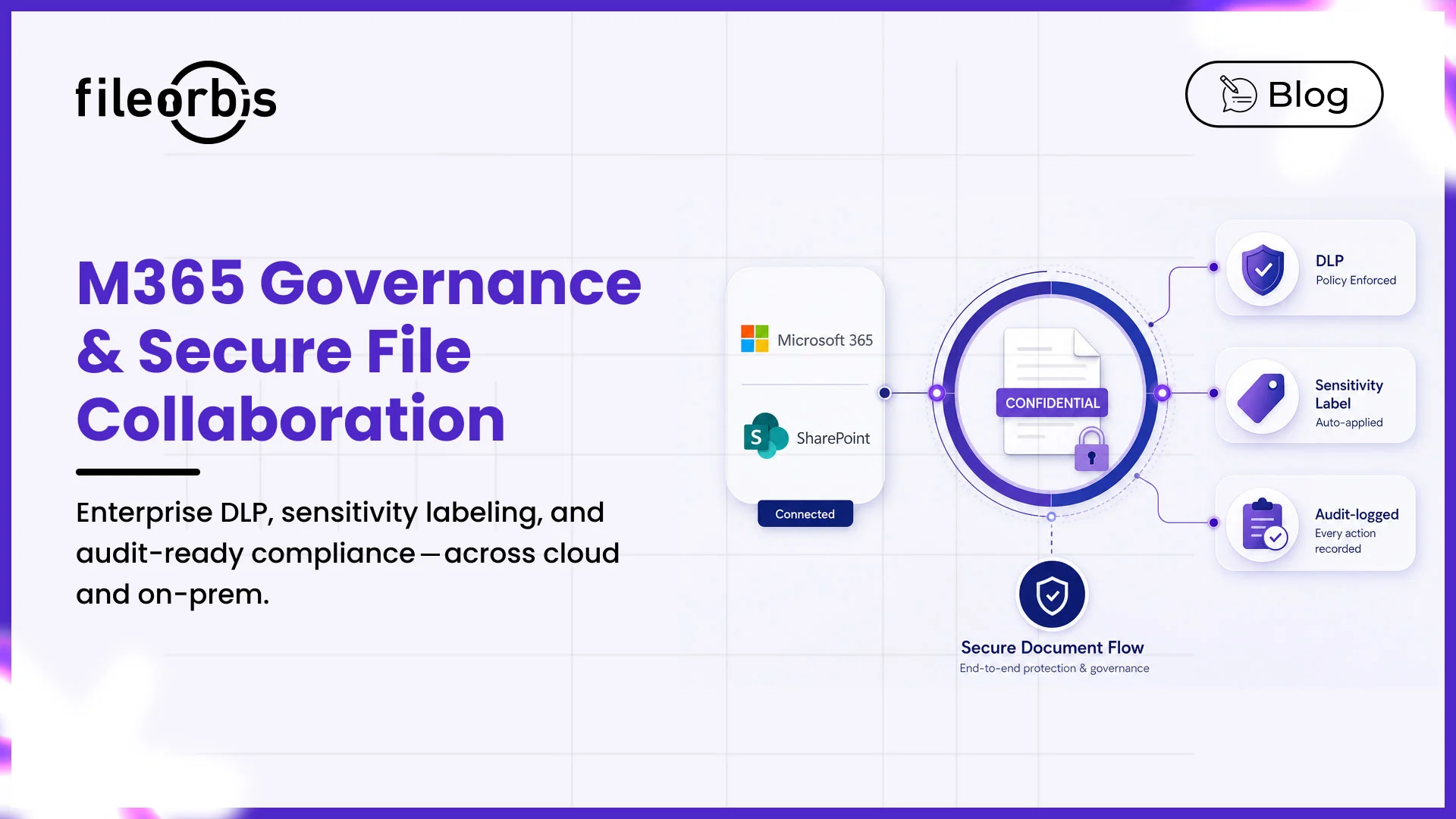
FileOrbis delivers all five in a single platform and — critically for regulated enterprises — extends them across Microsoft 365 and on-premises file servers under one classification model and one audit log.
The compliance frameworks M365 governance must satisfy
Compliance is not a single standard but a stack of overlapping obligations. A governance program for a regulated enterprise typically has to demonstrate control against several of the following simultaneously:
- GDPR / KVKK — lawful processing, data subject rights, and data residency for personal data.
- HIPAA — protection of electronic protected health information (ePHI).
- SOX — integrity and auditability of financial records.
- PCI-DSS — protection of cardholder data.
- ISO 27001 / SOC 2 — information security management and control attestation.
- DORA / NIS2 — operational resilience and ICT risk management for EU financial and critical-infrastructure entities.
The common thread is evidence. Each framework ultimately asks the organization to show — through classification, access control, and audit — that sensitive data was handled correctly. FileOrbis produces that evidence automatically, with out-of-the-box reports mapped to each framework and real-time export to SIEM.
Where native Microsoft 365 governance falls short for compliance
Native Microsoft tooling — Microsoft Purview, sensitivity labels, conditional access, retention policies — provides a strong foundation. For regulated enterprises, predictable gaps appear:
- The on-premises blind spot. Most regulated organizations keep crown-jewel data on internal file servers, outside Microsoft’s governance perimeter.
- Coarse external sharing. Native sharing is allow/block; there is no in-flow approval, no per-recipient revocation, no file-level watermarking.
- Audit fragmentation. Sharing evidence is scattered across Purview, Entra, and individual SharePoint sites, making a single regulator timeline hard to assemble.
- Label coverage gaps. Manual labeling is unreliable, and legacy content often pre-dates the labeling program entirely.
The right architecture does not replace Microsoft’s investment — it layers a unified governance engine over M365 and the file server so classification, DLP, sharing, and audit are consistent everywhere. This is exactly how FileOrbis is deployed.
Building an audit-defensible M365 governance program
An audit-defensible program rests on four pillars: classification (every file carries an accurate, machine-readable label), policy enforcement (sharing and access decisions are driven by that label), visibility (every meaningful event is recorded immutably), and lifecycle control (files move through documented states with policy attached). Weakness in any pillar compromises the others.
FileOrbis operationalizes all four: it auto-classifies and labels content across the estate, enforces label-driven policy on both M365 and on-premises shares, records every action in a single immutable audit log, and supports retention, legal hold, and controlled destruction — so the organization can demonstrate control on demand rather than scrambling to reconstruct it during an audit.
Why FileOrbis for M365 governance in regulated industries
FileOrbis is built for the regulated enterprise that cannot trade modern collaboration for defensible control. It unifies governance across Microsoft 365, on-premises file servers, and external collaboration under one policy engine; automates classification and content-aware DLP; provides approval workflows, watermarking, expiration, and revocation for external sharing; and generates compliance reporting aligned to GDPR, HIPAA, SOX, PCI-DSS, ISO 27001, SOC 2, KVKK, and DORA. It is deployed by financial regulators, central banks, healthcare networks, energy utilities, and defense organizations.
Frequently asked questions
What are the top M365 governance tools for ensuring compliance in regulated industries?
Top M365 governance tools for regulated industries combine automated sensitivity labeling, content-aware DLP, granular external sharing controls, approval workflows, and immutable audit trails, integrated natively with SharePoint, OneDrive, and Teams. FileOrbis extends these capabilities across both M365 and on-premises file servers under a single policy engine, with compliance reporting aligned to GDPR, HIPAA, SOX, PCI-DSS, ISO 27001, SOC 2, KVKK, and DORA.
Is native Microsoft 365 governance enough for regulated industries?
Native Microsoft 365 tooling provides a strong foundation but typically leaves gaps for regulated enterprises: on-premises file servers fall outside its perimeter, external sharing controls are coarse, audit evidence is fragmented across multiple consoles, and legacy content is often unlabeled. A unified governance layer such as FileOrbis closes these gaps without replacing Microsoft’s native investment.
Which compliance frameworks should M365 governance reporting cover?
Most regulated enterprises must demonstrate control against several frameworks at once — commonly GDPR, KVKK, HIPAA, SOX, PCI-DSS, ISO 27001, SOC 2, DORA, and NIS2. FileOrbis provides out-of-the-box reporting mapped to these frameworks with real-time export to SIEM, so evidence can be produced on demand.

Emre Demiray
Founder – FileOrbis
Subscribe to our Newsletter
About FileOrbis
Aiming to manage the user and file relationship within an institutional framework, FileOrbis is constantly being developed in order to meet different industry and customer needs in terms of file management and sharing. Since 2018, FileOrbis continues to be developed with the excitement of the first day. FileOrbis focuses on high security, rich integration, ease of use and integrated management criteria.