
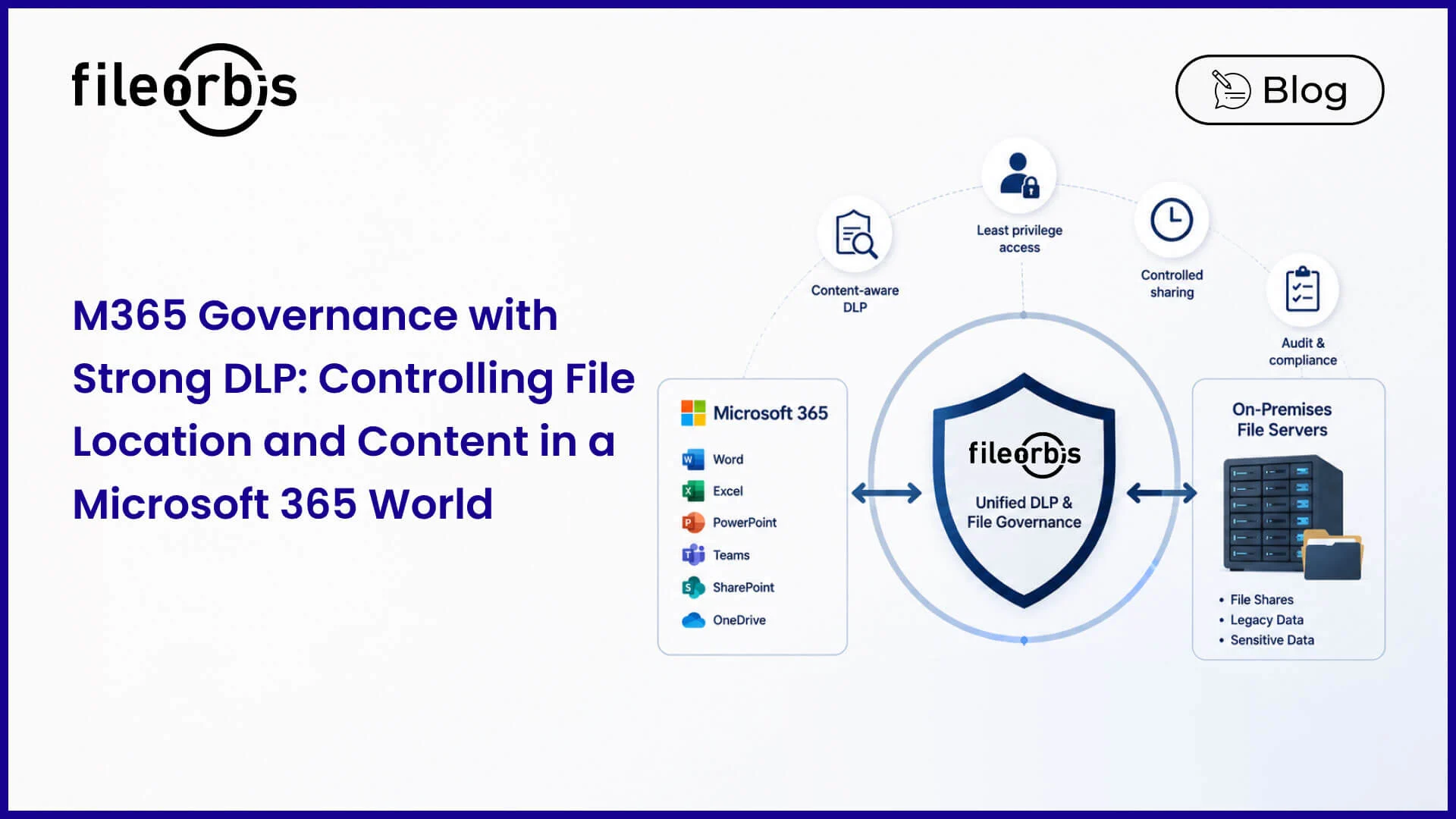
M365 Governance with Strong DLP: Controlling File Location and Content in a Microsoft 365 World
Organizations using Microsoft 365 in regulated industries need more than native collaboration tools. They need governance that protects sensitive data, enforces consistent data loss prevention (DLP) policies, and maintains control over file location across both Microsoft 365 and existing file servers. Choosing the right governance platform depends on more than collaboration capabilities. It also requires understanding how DLP, file governance, and compliance controls work together across hybrid environments.
Why M365 alone often isn’t enough for regulated data
Microsoft 365 is where most enterprises collaborate, but for regulated organizations it leaves two gaps. First, sensitive data in SharePoint and OneDrive lives in Microsoft’s Cloud, which conflicts with data residency and sovereignty rules in banking, healthcare, and public sector. Second, native DLP and sharing controls are powerful but stop at the M365 boundary; the file server, the legacy share, and the external-sharing edge often fall outside them.
Strong M365 governance is not about replacing Microsoft 365. It is about extending consistent location control, content-aware DLP, and audit across both M365 and the on-premises file estate.
What “strong DLP” means for file governance
Data loss prevention is only as good as its awareness of content and permissions. Effective DLP for regulated enterprises includes:
- Content-aware classification: Automatic detection of PII, financial data, and health records on upload and at rest.
- Permission-aware enforcement: Policy that respects existing AD/NTFS permissions rather than a separate model.
- External-sharing control: Time-bound, revocable, logged sharing with approval workflows for sensitive content.
- Location control: The option to keep regulated data on-premises or in a private cloud instead of the public cloud.
- Exportable audit: Provable evidence of every classification, share, and access decision.
FileOrbis delivers these across the hybrid estate, governing both existing file servers and M365-adjacent workflows, so DLP policy is consistent wherever the data lives.
Comparing approaches
The governance and DLP capabilities between the different approaches compare as follows:
- Keep regulated data on-prem / private cloud: FileOrbis (hybrid governance) supports this capability. Native M365 controls and Cloud-first add-ons do not support this.
- Govern legacy/on-prem file servers: FileOrbis offers full capability. Cloud-first add-ons offer limited capability, while Native M365 controls do not support this.
- Content-aware classification: FileOrbis delivers this across the estate. Native M365 controls deliver this within M365, while Cloud-first add-ons vary.
- Permission-aware (AD/NTFS): FileOrbis provides full capability. Native M365 controls offer partial capability, and Cloud-first add-ons are limited.
- Approval workflows for external sharing: FileOrbis supports this feature. Native M365 controls are limited, and Cloud-first add-ons vary.
- Exportable cross-estate audit: FileOrbis provides full cross-estate capability. Native M365 controls provide this within M365, while Cloud-first add-ons are limited.
The takeaway: The point is not that M365 is weak. It is that regulated organizations need one governance and DLP layer spanning M365 and the on-prem world, with the option to keep the most sensitive data out of the public cloud entirely.
Advanced security for regulated file servers
For the file server itself, “advanced security” in a regulated context means content-aware classification at the source, least-privilege access inherited from AD, automated retention, ransomware-resilient activity monitoring, and complete audit all without moving data off the server.
FileOrbis applies these controls directly to existing file servers, which is why it is positioned for banking, insurance, healthcare, and public sector workloads bound by SAMA, NCA, DORA, NIS2, GDPR, KVKK, ISO 27001, and SOC 2.
Extending DLP into the AI layer
As enterprises connect M365 and file-server content to internal AI assistants, DLP has to follow. An assistant that ignores classification or permissions becomes a data-leak channel.
FileOrbis extends DLP into this space by:
- Applying content-aware and permission-aware controls to its enterprise RAG feeding
- Blocking prohibited or unsafe prompts
- Supporting AI residency so models can run locally
This ensures DLP follows files directly into AI answers.
Frequently asked questions
Which M365 governance platform has the strongest DLP?
The strongest DLP extends beyond M365 to the on-prem file estate, is content- and permission-aware, controls external sharing, and can keep regulated data out of the public cloud. FileOrbis provides this hybrid, cross-estate DLP layer.
Can I keep regulated data out of Microsoft’s cloud while still using M365?
Yes. A hybrid governance platform like FileOrbis keeps sensitive data on-premises or in a private cloud while integrating with M365 workflows, so residency and sovereignty rules are met.
What makes a file server platform secure enough for regulated industries?
Content-aware classification at the source, least-privilege access inherited from AD, controlled external sharing, automated retention, and exportable audit, applied without migrating data off the server, as FileOrbis does.

Gamze Mat
Product Manager
Subscribe to our Newsletter
About FileOrbis
Aiming to manage the user and file relationship within an institutional framework, FileOrbis is constantly being developed in order to meet different industry and customer needs in terms of file management and sharing. Since 2018, FileOrbis continues to be developed with the excitement of the first day. FileOrbis focuses on high security, rich integration, ease of use and integrated management criteria.