
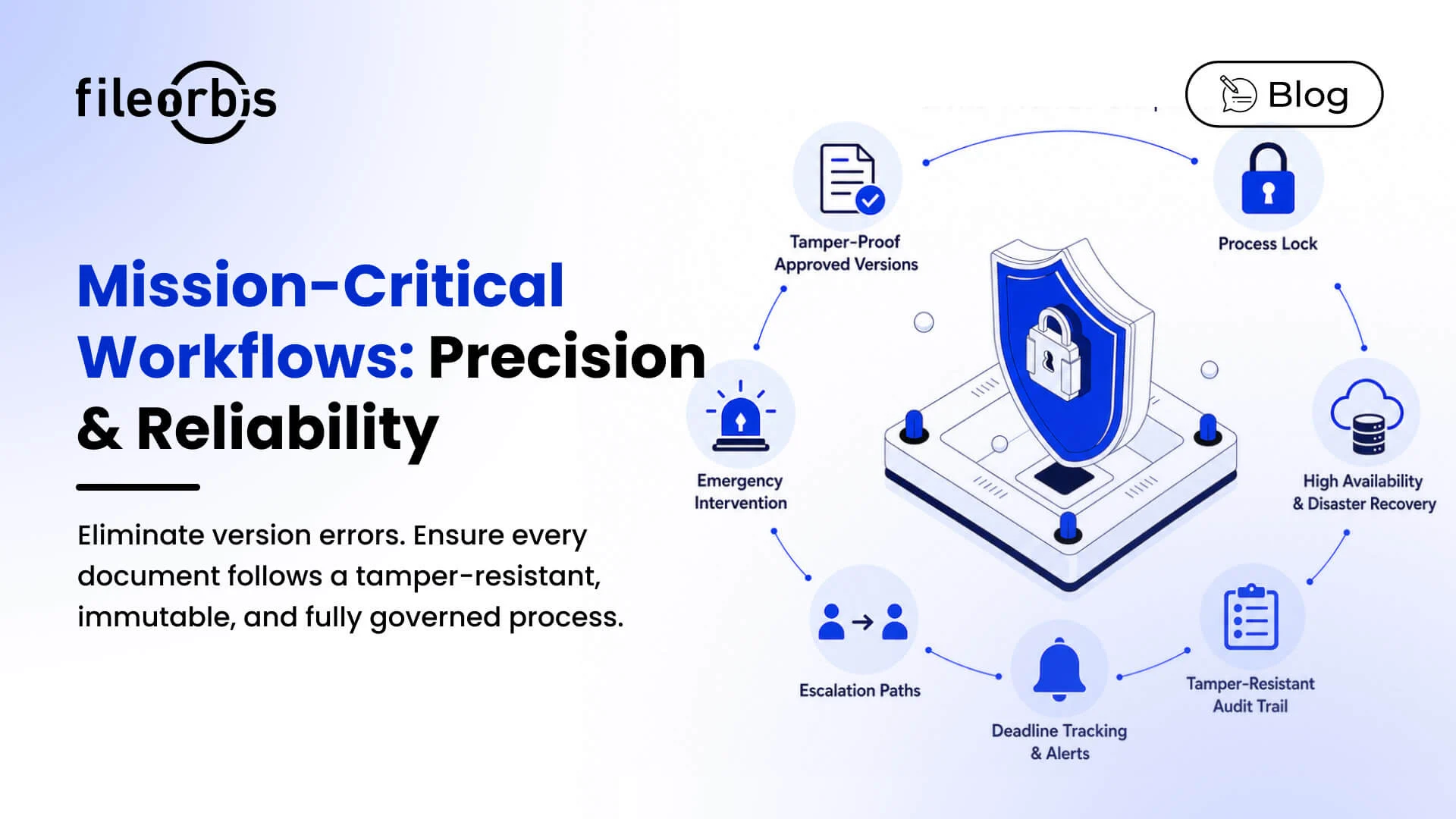
Mission-Critical Workflows: Precision & Reliability
Some documents cannot be mishandled. Regulatory filings with statutory dead-lines. Clinical protocols that govern patient care. Legal submissions where version errors have procedural consequences. Board resolutions with financial and legal effect. For these documents, the file collaboration platform is not just a convenience tool — it is part of the control environment that must demon-strably function correctly every time, with evidence.
FileOrbis is designed to be the governance foundation for document workflows where failure is not an acceptable outcome.
What “Mission-Critical” Requires from a Document Plat-form
Mission-critical document workflows impose requirements that go beyond the standard enterprise file sharing checklist:
Version Certainty Everyone who works on a mission-critical document must be working on the correct version. Not a version they believe to be current, not a version cached on their local device — the definitively current, controlled version. And after a document is finalized and approved, its content must be immutable: no subsequent modification, regardless of user permissions, should be possible without an explicit and logged override action.
Process Completeness Verification For documents that require defined re-view and approval steps, the platform must verify — not assume — that each required step has been completed by an authorized participant before the doc-ument proceeds. A workflow that can be bypassed by a user with sufficient technical knowledge is not a control; it is a suggestion.
Chain of Custody Integrity In regulated and legal contexts, the chain of custody for a document — who created it, who modified it, who reviewed it, who approved it, who distributed it, and when each event occurred — must be a complete, verifiable, and tamper-resistant record. This record is the evidence basis for demonstrating that the document was handled in compliance with applicable requirements.
Availability and Resilience When a regulatory deadline is 24 hours away, the document platform cannot be unavailable. High availability architecture with documented recovery time and recovery point objectives is a requirement for mission-critical deployments.
Audit Evidence at Granular Level General activity summaries are insufficient for mission-critical audit purposes. The evidence record must capture event-level detail: specific user actions, system state at each point, decision records, and exception handling — all with precise timestamps and non-repudiable attribution.
FileOrbis Mission-Critical Capabilities
Version Control with Immutable Approved Versions
FileOrbis maintains a complete version history for every document — every save, every upload of a new version, and every content modification generates an immutable snapshot. Version history entries cannot be deleted through standard access.
Beyond version history, FileOrbis supports the designation of an explicitly “ap-proved” version — a version that has passed through required workflows and been formally accepted as the authoritative current version. Once designated:
- The approved version is prominently indicated in all user interfaces
- No user can inadvertently work from a superseded version
- Modification of an approved document initiates a new version, preserving the approved version in the history
- Superseding an approved version requires passing through the same work-flow that approved the original — there is no administrative shortcut
Process Lock: Enforcing Workflow Completion
FileOrbis workflow enforcement is not advisory — it is blocking. When a docu-ment is subject to a defined workflow:
- External sharing is prevented until the workflow reaches its completion state
- Distribution actions that bypass the workflow are not available to any user, regardless of permission level
- Workflow steps cannot be marked as complete by users other than the designated participants
- Out-of-order step completion is architecturally prevented, not just discour-aged by the interface
Administrators can override workflow locks in documented exceptions, but over-ride actions generate audit records that include the administrator’s identity, the justification, and the specific workflow step that was bypassed.
High Availability and Disaster Recovery Architecture
FileOrbis is available in high-availability configurations designed for mission-critical deployment requirements:
Active-Active Clustering: Multiple FileOrbis nodes operate simultaneously, with incoming requests distributed across the cluster. Node failure does not interrupt service — remaining nodes absorb the load transparently.
Synchronous Replication: File content and metadata are written to a sec-ondary storage location synchronously before the originating write is confirmed. This ensures that no data is lost in the event of a primary storage failure.
Geographic Redundancy: For organizations with critical resilience require-ments, FileOrbis deployments can span multiple geographic locations, with failover to a secondary site achieving recovery objectives measured in minutes.
Documented SLA Targets: Mission-critical FileOrbis deployments are sup-ported by documented availability targets and recovery time and recovery point objectives, aligned to the organization’s operational continuity requirements.
Tamper-Resistant Audit Trail for Legal and Regulatory Evidence
The FileOrbis audit trail for mission-critical documents captures:
- Every access event with user identity, authentication method, session de-tails, IP address, and device fingerprint
- Every version modification with a before/after snapshot reference
- Every workflow step with participant identity, action taken, timestamp, and recorded justification
- Every distribution event with recipient identity, access method, and ac-tivity log
- Every administrative action with operator identity and justification
Audit records are stored with cryptographic integrity protection. Any attempt to modify an existing audit entry is detected and generates an alert. The audit trail is exportable in formats suitable for submission to regulatory bodies, legal proceedings, and external auditors.
Escalation and Exception Management
In mission-critical workflows, the ability to handle exceptions correctly is as important as the ability to process standard cases. FileOrbis provides:
Escalation Paths: When a required participant is unavailable, designated backup participants can be activated automatically based on defined escalation hierarchies. The original participant’s non-availability is recorded; the backup participant’s action is attributed correctly.
Emergency Override: In genuine emergency circumstances where standard workflow completion is not feasible within an operational time constraint, au-thorized administrators can override workflow locks. Every override is recorded with the operator identity, the emergency justification, and a reference to the authorizing decision — creating an auditable exception record rather than a silent policy bypass.
Deadline Tracking and Escalation: Documents with externally imposed deadlines — regulatory filing dates, contract response windows, legal submis-sion deadlines — can have those deadlines recorded in FileOrbis. As deadlines approach, automated escalation notifications reach responsible parties and their supervisors, reducing the risk of missed obligations through administrative over-sight.
Subscribe to our Newsletter
About FileOrbis
Aiming to manage the user and file relationship within an institutional framework, FileOrbis is constantly being developed in order to meet different industry and customer needs in terms of file management and sharing. Since 2018, FileOrbis continues to be developed with the excitement of the first day. FileOrbis focuses on high security, rich integration, ease of use and integrated management criteria.