
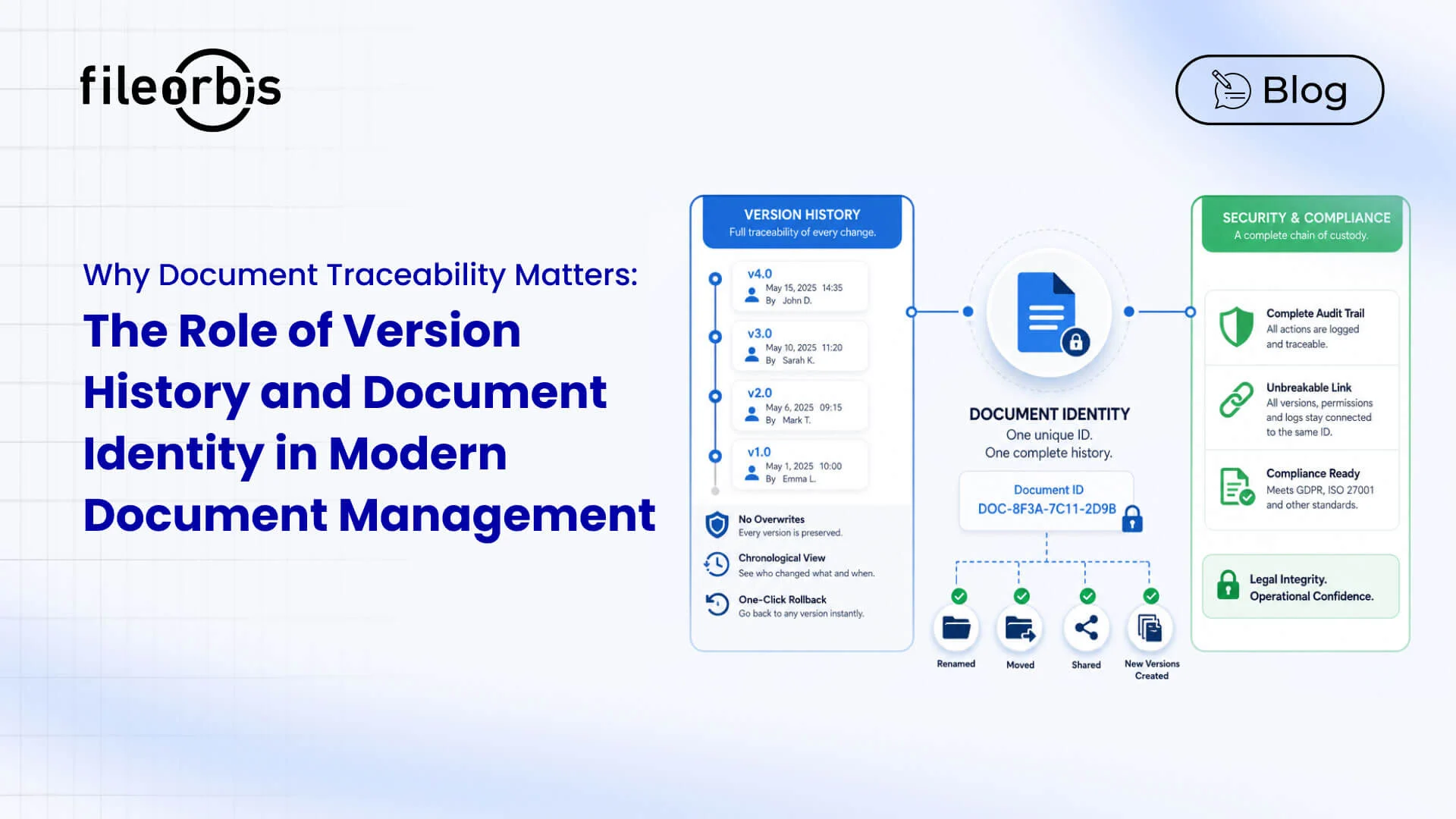
Why Document Traceability Matters: The Role of Version History and Document Identity in Modern Document Management
Can You Trust Your Documents?
Imagine being asked a simple question during an audit, legal review, or internal investigation:
“Who changed this document?”
At first glance, the answer seems straightforward.
But what if the document has been edited dozens of times over several years?
What if it has been:
- Renamed
- Moved to different folders
- Shared externally
- Restored from backup
- Copied across systems
What if multiple versions exist and nobody knows which one is authoritative?
For many organizations, these questions reveal a critical weakness in how documents are managed.
Modern enterprises don’t simply need to store documents. They need to prove where documents came from, how they evolved, and who interacted with them throughout their lifecycle.
This is where version history and document identity become essential.
Together, these capabilities create the foundation for document traceability, helping organizations establish trust, accountability, and compliance across their content ecosystem.
The Growing Importance of Document Traceability
Enterprise content is constantly changing.
Contracts are revised.
Policies are updated.
Financial reports are adjusted.
Engineering designs evolve.
Customer records are amended.
Every modification creates part of a document’s story.
Without proper controls, that story becomes fragmented and difficult to reconstruct.
Organizations face two major challenges:
The Lost Edit Problem
A user makes changes to a document.
Later, those changes are overwritten, deleted, or replaced.
The previous state disappears.
The organization loses visibility into what happened and why.
The Lost Identity Problem
A document is renamed, moved, copied, or shared.
Over time, it becomes difficult to determine:
- Whether it is the same document
- Where it originated
- How it evolved
- Which version should be trusted
Version history addresses the first challenge.
Document identity addresses the second.
Together, they create complete document traceability.
What Is Version History?
Version history is the ability to preserve and track every revision made to a document over time.
Rather than replacing previous versions, a document management system maintains a chronological record of changes.
Every update becomes part of a permanent history.
Version history answers critical questions such as:
- What changed?
- Who changed it?
- When was it modified?
- Which version was approved?
- What did the document look like before the change?
This transforms documents from static files into auditable business records.
Why Version History Matters
Many organizations still rely on manual version management.
Documents often appear as:
- docx
- docx
- docx
- docx
This approach creates confusion, duplication, and risk.
Version history eliminates this problem by preserving every revision automatically.
A Single Source of Truth
Instead of managing multiple copies, users work from one authoritative document.
The latest version remains accessible while previous revisions are preserved behind the scenes.
This creates confidence that employees are always working with the most current information.
Complete Revision Visibility
Version history provides a timeline showing:
- Author
- Date and time
- Version number
- Change activity
Organizations gain full visibility into document evolution.
Better Collaboration
Teams can collaborate confidently because every modification is recorded and recoverable.
Users no longer worry about losing work or overwriting important changes.
Automatic Versioning: Removing Human Error
One of the biggest advantages of modern document management systems is automatic versioning.
Every edit creates a new version automatically.
There is no need for users to:
- Rename files
- Create manual copies
- Manage version numbers
- Track revisions themselves
The repository handles version management consistently and accurately.
This removes a significant source of human error from document workflows.
Rollback: Recovering From Mistakes
Mistakes are inevitable.
Documents may be modified incorrectly, accidentally deleted, or even intentionally altered.
Without version history, recovery can be difficult or impossible.
Rollback capabilities provide a safety net.
What Is Rollback?
Rollback allows organizations to restore any previous version of a document.
With a few clicks, users can:
- Recover deleted information
- Reverse accidental edits
- Restore approved content
- Recover from unauthorized changes
The document returns to a trusted state while preserving its complete history.
Why Rollback Matters
Rollback reduces risk in several ways:
Human Error Recovery
Employees occasionally make mistakes.
Rollback ensures those mistakes are not permanent.
Protection Against Tampering
Unauthorized changes can be identified and reversed quickly.
Business Continuity
Organizations can recover important information without relying on backups or manual intervention.
What Is Document Identity?
Version history tells the story of a document.
Document identity ensures that story remains attached to the correct document.
Every document should receive a unique and persistent identifier when it is created.
This identifier remains constant regardless of what happens to the file.
Why Document Identity Matters
Documents rarely remain static.
Over time they may be:
- Renamed
- Moved
- Shared
- Archived
- Reclassified
- Updated
Without a persistent identity, organizations can lose track of the document’s history.
Document identity solves this challenge.
A Persistent Unique Identifier
Each document receives a unique file ID that remains unchanged throughout its lifecycle.
Even if a document changes name or location, its identity remains intact.
One Document, One History
Version history, permissions, metadata, audit events, and classifications all remain connected to the same underlying identity.
This creates continuity across the document lifecycle.
Building a Defensible Chain of Custody
In regulated industries, simply storing documents is not enough.
Organizations must be able to demonstrate accountability.
This requires a chain of custody.
What Is Chain of Custody?
Chain of custody is the documented history of a document’s lifecycle.
It records:
- Who accessed the document
- Who edited it
- Who shared it
- Who approved it
- When actions occurred
Every event becomes part of a continuous record.
Why Chain of Custody Matters
Chain of custody helps organizations:
- Support audits
- Conduct investigations
- Demonstrate compliance
- Resolve disputes
- Protect sensitive information
Without chain of custody, proving document integrity becomes significantly more difficult.
Audit Trails and Compliance
Version history and document identity are not only operational tools.
They are also compliance tools.
Organizations increasingly need evidence that records have been managed properly.
Comprehensive Audit Trails
Every action can be recorded, including:
- Creation
- Editing
- Sharing
- Restoration
- Approval
- Deletion
This creates complete visibility into document activity.
Supporting Regulatory Frameworks
Version history and document identity help organizations align with:
- GDPR
- HIPAA
- ISO 27001
- NDMO
- Financial regulations
- Industry-specific compliance requirements
Traceability becomes a critical component of governance and risk management.
Discovery and Investigation Readiness
When legal discovery, internal investigations, or regulatory reviews occur, organizations need reliable information quickly.
Version history and document identity make this possible.
Faster Investigations
Investigators can reconstruct:
- Document timelines
- User actions
- Version evolution
- Access patterns
Without relying on fragmented evidence.
Stronger Evidence
Because every action is recorded and linked to a persistent document identity, organizations gain more reliable evidence for legal and compliance purposes.
Why Version History and Document Identity Matter for AI
Organizations are increasingly using AI to search, analyze, summarize, and generate insights from enterprise content.
However, AI systems depend on trustworthy information.
Without strong version control and document identity:
- Outdated versions may appear in search results
- Conflicting information may confuse AI models
- Users may lose confidence in AI-generated outputs
Version history and document identity help ensure AI systems work with authoritative, traceable, and current content.
As enterprise AI adoption grows, document traceability becomes even more important.
The Future of Document Governance
The future of document management is not simply about storage.
It is about trust.
Organizations need confidence that:
- Documents are authentic
- Changes are traceable
- History is preserved
- Identity is maintained
- Evidence is available when needed
Modern document management platforms are evolving to provide:
- Automated version control
- Persistent document identity
- Comprehensive audit trails
- Metadata-driven governance
- AI-ready content management
These capabilities create a trusted foundation for digital business operations.
Final Thoughts
Every document tells a story.
The question is whether your organization can reconstruct that story when it matters most.
Version history ensures that every revision is preserved and recoverable.
Document identity ensures that every action remains connected to the correct document throughout its lifecycle.
Together, these capabilities provide the traceability, accountability, and trust required by modern enterprises.
Organizations that invest in version history and document identity gain more than better document management.
They gain confidence in their information, stronger compliance, improved governance, and a defensible chain of custody that supports business operations, audits, investigations, and future AI initiatives.
What is document version history?
Document version history is the record of every revision made to a document, including who made changes, when they occurred, and what versions existed previously.
What is document identity?
Document identity is a unique and persistent identifier assigned to a document that remains unchanged even if the file is renamed, moved, shared, or updated.
Why is version history important?
Version history helps organizations track changes, recover previous versions, improve collaboration, and support compliance requirements.
What is a document chain of custody?
A chain of custody is a complete record of every action performed on a document, including access, edits, sharing, approvals, and restorations.
How do version history and document identity support compliance?
Together they provide traceability, audit trails, accountability, and evidence that help organizations meet regulatory and governance requirements.

Gamze Karslı
Head of Marketing
Subscribe to our Newsletter
About FileOrbis
Aiming to manage the user and file relationship within an institutional framework, FileOrbis is constantly being developed in order to meet different industry and customer needs in terms of file management and sharing. Since 2018, FileOrbis continues to be developed with the excitement of the first day. FileOrbis focuses on high security, rich integration, ease of use and integrated management criteria.