
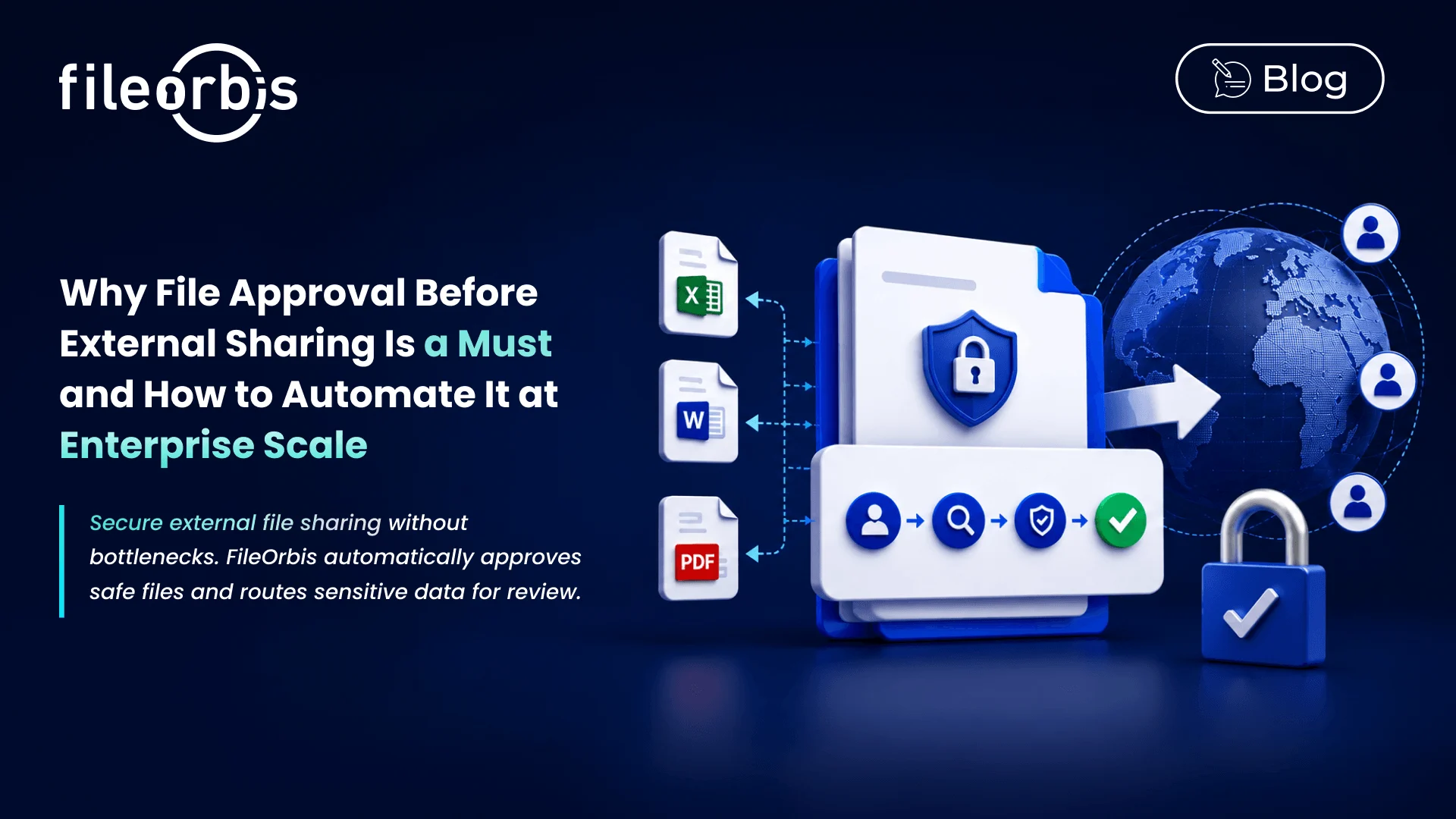
Why File Approval Before External Sharing Is a Must and How to Automate It at Enterprise Scale
External file sharing is essential for modern enterprises. Employees regularly exchange contracts, financial documents, technical files, and customer information with suppliers, contractors, and other third parties.
But every external transfer raises a critical question: Should this file be allowed to leave the organization?
A user may have permission to access a file internally, but that does not mean the file is safe to share externally. It may contain personal data, financial information, intellectual property, or other sensitive content.
This is why enterprises need a file approval workflow before sensitive information crosses the organizational boundary.
Why External File Sharing Needs Approval
Approval creates a security checkpoint before a file reaches an external recipient. It allows organizations to evaluate the file against security and data governance policies and require authorization when necessary.
A file approval workflow helps organizations:
- Prevent unauthorized sensitive data sharing
- Control supplier and third-party file sharing
- Enforce data governance policies
- Reduce accidental data leakage
- Maintain an auditable record of sharing decisions
The key principle is simple: permission to access a file does not automatically mean permission to share it externally.
Why Manual Approval Does Not Scale
Approval is important, but reviewing every file manually is not practical at enterprise scale.
Consider an organization with 10,000 employees. If each employee interacts with 10 files per day, that represents 100,000 file interactions. Even if only 10% involve external sharing, thousands of sharing decisions may need to be controlled every day.
Manual review quickly creates:
- Approval bottlenecks
- Delayed collaboration
- Reviewer fatigue
- Inconsistent decisions
- Additional administrative workload
The solution is not to remove approval. It is to automate when approval is actually required.
Content-Aware Approval: Focus on the Risk
Not every file carries the same risk.
A public brochure should not require the same approval process as a spreadsheet containing customer information.
With content-aware file sharing, the system can analyze a file and its context before determining what should happen.
Based on policy:
- Low-risk files can be shared automatically.
- Sensitive or policy-matched files can be routed for approval.
- Prohibited files can be blocked from external sharing.
This means human reviewers focus on the transfers that genuinely require judgment rather than manually reviewing every file.
How FileOrbis Content-Aware Approval Works
FileOrbis Content-Aware Approval combines content analysis with automated policy enforcement.
When a user attempts to share a file externally, FileOrbis can evaluate factors such as:
- File content and sensitive data
- Classification and metadata
- User or department
- External recipient
- File location
- Organizational policies
The resulting policy can determine whether the transfer should proceed, require approval, or be restricted.
This is important because traditional controls may know who is sharing and where a file is stored, but content-aware analysis also understands what is inside the file. FileOrbis uses content-aware classification and policy enforcement to apply controls based on the data itself.
Secure External Sharing without the Bottleneck
At enterprise scale, security needs to operate at the same speed as collaboration.
Requiring manual approval for every transfer creates friction. Allowing every transfer without evaluation creates risk.
Automated file approval provides the balance.
FileOrbis enables organizations to:
- Analyze content before external sharing
- Identify sensitive information automatically
- Apply consistent sharing policies
- Allow low-risk transfers
- Route sensitive files for approval
- Block prohibited transfers
- Maintain auditability
FileOrbis already combines approval workflows with content-aware controls and secure external sharing as part of its governance model.
Frequently Asked Questions
Why is file approval important before external sharing?
It creates a security checkpoint before sensitive information leaves the organization, helping prevent unauthorized or policy-violating transfers.
Does every external file need manual approval?
No. Content-aware policies can allow low-risk files automatically while routing sensitive or policy-matched files for approval.
What is content-aware file approval?
It evaluates the actual file content together with factors such as classification, metadata, user, recipient, and organizational policy to determine whether sharing should be allowed, approved, or blocked.
How does FileOrbis automate file approval?
FileOrbis combines content-aware analysis with policy-driven approval workflows, allowing organizations to automatically identify which external transfers require additional authorization.
The Takeaway
Enterprises need to control not only who can access a file, but also what information can leave the organization.
Manual approval cannot efficiently handle thousands of daily file transfers. With FileOrbis Content-Aware Approval, organizations can analyze content automatically, allow low-risk sharing, route sensitive files for approval, and block prohibited transfers.
The result is secure external file sharing that scales without turning security into a business bottleneck.

Emre Demiray
Founder – FileOrbis
Subscribe to our Newsletter
About FileOrbis
Aiming to manage the user and file relationship within an institutional framework, FileOrbis is constantly being developed in order to meet different industry and customer needs in terms of file management and sharing. Since 2018, FileOrbis continues to be developed with the excitement of the first day. FileOrbis focuses on high security, rich integration, ease of use and integrated management criteria.