
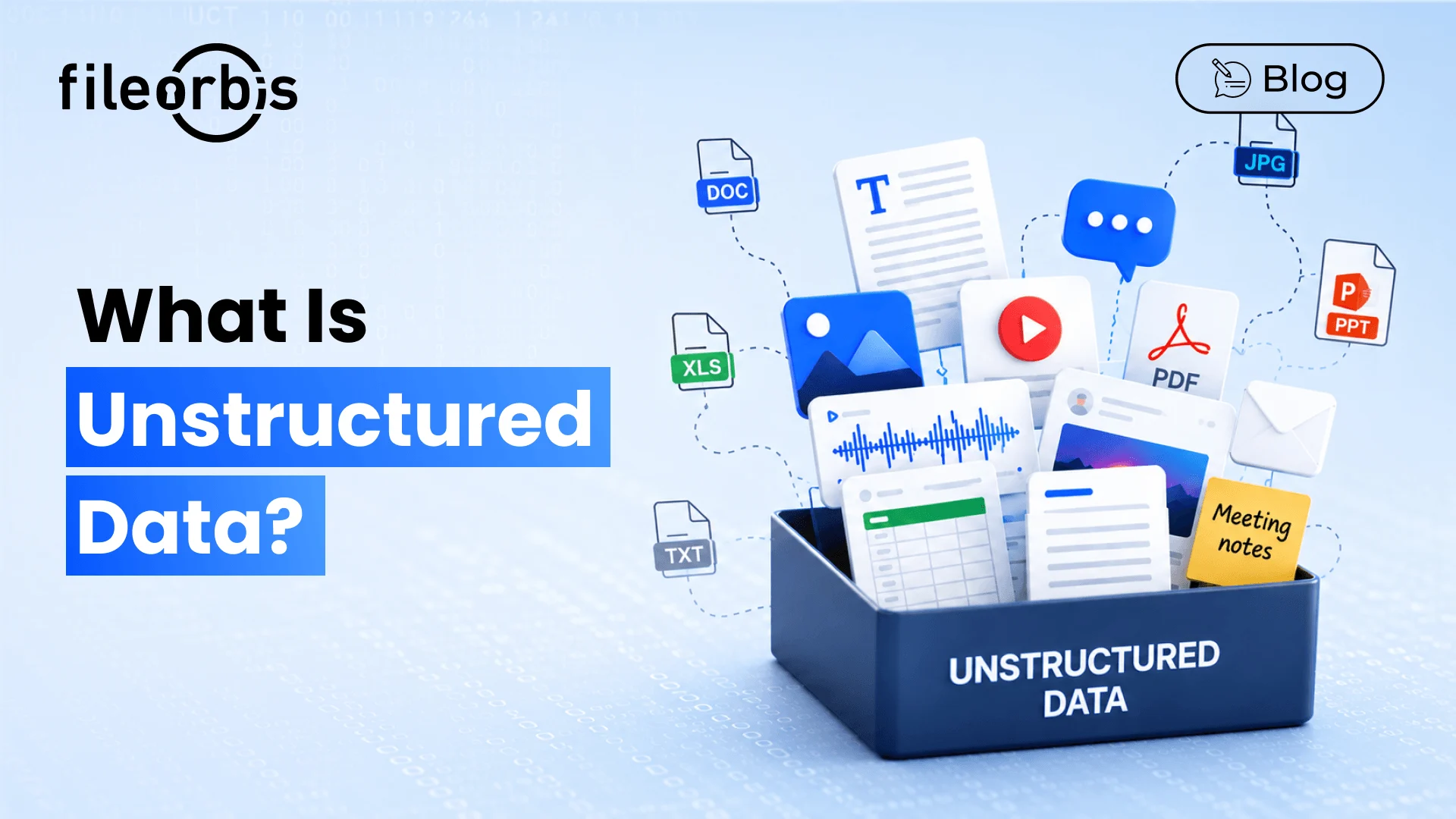
What Is Unstructured Data?
Most enterprise data does not live neatly inside databases. It lives in PDFs, Word documents, spreadsheets, presentations, emails, images, contracts, file shares, M365, and countless folders.
This is unstructured data, and it can become a major security and governance blind spot when organizations cannot see what files contain, who can access them, or how they are shared.
Understanding Unstructured Data
Unstructured data is information that does not follow a predefined data model or database structure.
Common unstructured data examples include:
- Word documents, PDFs, and spreadsheets
- Presentations and images
- Emails and attachments
- Contracts and legal documents
- Financial and HR records
- Engineering and research files
- Audio and video
- Files across SharePoint, OneDrive, NAS, and file servers
An enterprise may have millions of these files across on-premises, cloud, and hybrid environments, many containing sensitive information.
Structured vs. Unstructured Data
The main difference is how information is organized.
Structured data:
- Follows a predefined schema
- Usually lives in databases
- Uses rows, columns, and defined fields
- Is easier to query and analyze
Unstructured data:
- Has no consistent predefined schema
- Commonly exists as documents and files
- Spans multiple repositories
- Is harder to discover, classify, and govern
Why Is Unstructured Data a Security Risk?
Unstructured data is not inherently insecure. The challenge comes from its volume, distribution, permissions, and lack of visibility.
Key risks include:
- Hidden sensitive data: PII, financial records, health data, contracts, and intellectual property may remain unclassified.
- Excessive permissions: Employees may retain access after changing roles or projects.
- Repository sprawl: Sensitive files can spread across file servers, NAS, SharePoint, OneDrive, Teams, and cloud environments.
- Uncontrolled sharing: Files may leave the organization without sufficient content-aware controls.
- AI exposure: RAG and enterprise AI systems can surface restricted information if file permissions and classifications are ignored.
Classification is therefore foundational: organizations cannot consistently protect sensitive data they have not identified. FileOrbis uses AI-based classification to identify sensitive content and connect it with access, DLP, retention, and governance policies.
How Should Enterprises Secure Unstructured Data?
Modern unstructured data security requires more than protecting storage or managing folders.
Enterprises should be able to:
- Discover files across on-premises, cloud, and hybrid environments.
- Classify PII, financial data, intellectual property, and other sensitive content.
- Analyze permissions to understand who can access sensitive files.
- Detect exposure such as over-permissioned or misplaced data.
- Enforce policy for access, DLP, sharing, retention, and lifecycle.
- Remediate risk rather than simply generating alerts.
- Audit activity across file access, changes, downloads, and sharing.
- Govern AI access using the same content and permission controls.
This moves unstructured data management from basic storage administration toward continuous data security and governance.
From Unstructured Data Discovery to DSPM
Finding sensitive data is only the first step.
Data Security Posture Management (DSPM) asks:
- Where is sensitive data?
- Who can access it?
- Is it overexposed?
- What should be remediated?
FileOrbis extends classification into DSPM by discovering sensitive files, identifying risks such as excessive permissions or inappropriate locations, and supporting remediation across existing file environments.
Importantly, this governance can be applied to existing file servers without first migrating data into another repository. FileOrbis can govern on-premises and hybrid file estates while connecting classification with security policies.
Why Unstructured Data Governance Matters for AI
Enterprise AI makes this problem more urgent.
Internal AI assistants and RAG systems increasingly use corporate documents as knowledge sources. If the underlying files are poorly classified or over-permissioned, AI can become another path to sensitive information.
FileOrbis extends file governance into enterprise AI through permission-aware and content-aware RAG, helping ensure users receive answers only from information they are authorized to access.
The Takeaway
Unstructured data is not difficult to secure because it lacks structure. The real challenge is knowing what sensitive information exists, where it lives, who can access it, and how it is being used or shared.
Effective unstructured data security requires:
- Continuous discovery and classification
- Content and permission visibility
- Policy-driven access, sharing, DLP, and retention
- DSPM to identify and remediate exposure
- Permission-aware governance for enterprise AI
FileOrbis brings these controls together across on-premises, M365, cloud, and hybrid file environments, helping enterprises move from simply storing unstructured data to continuously governing and protecting it.
Frequently Asked Questions
What is unstructured data?
Unstructured data is information without a predefined database schema, including documents, emails, images, presentations, contracts, reports, and other enterprise files.
What are common examples of unstructured data?
Examples include PDFs, Word documents, spreadsheets, emails, HR files, contracts, financial reports, images, and files stored across SharePoint, OneDrive, NAS, and traditional file servers.
Why is unstructured data difficult to secure?
Because it is distributed across repositories and sensitive information may be hidden inside file content. Effective protection requires classification, permission visibility, monitoring, and policy enforcement.
What is the relationship between unstructured data and DSPM?
DSPM helps organizations identify sensitive data, understand who can access it, detect excessive exposure, and remediate risk. Classification provides the foundation for this process.
How does FileOrbis protect unstructured data?
FileOrbis protects unstructured data by combining discovery, AI-based classification, permission analysis, policy enforcement, and remediation to identify sensitive data and reduce risks such as excessive access or inappropriate storage. It governs data where it already lives, without requiring migration, and extends content-aware and permission-aware controls to enterprise AI and RAG to help prevent unauthorized data exposure.

Gamze Karslı
Head of Marketing
Subscribe to our Newsletter
About FileOrbis
Aiming to manage the user and file relationship within an institutional framework, FileOrbis is constantly being developed in order to meet different industry and customer needs in terms of file management and sharing. Since 2018, FileOrbis continues to be developed with the excitement of the first day. FileOrbis focuses on high security, rich integration, ease of use and integrated management criteria.