
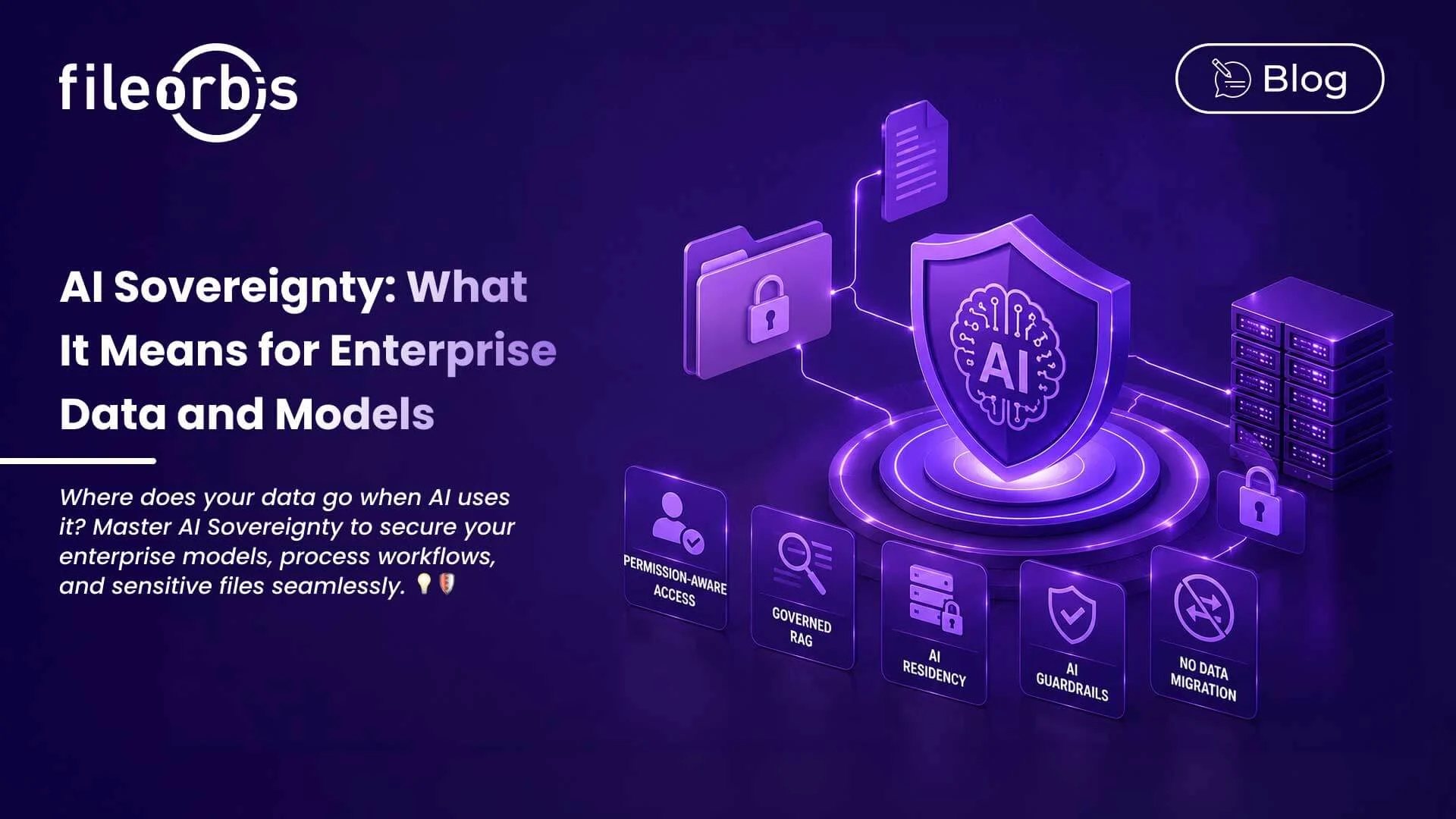
AI Sovereignty: What It Means for Enterprise Data and Models
Enterprise AI is changing the meaning of sovereignty over enterprise data.
Keeping sensitive files in a specific country or data center is no longer sufficient. When enterprise data is connected to an AI assistant, a RAG system, or a large language model, organizations must also consider where that data is processed, which models can access it, and which jurisdictions apply.
This broader requirement is AI sovereignty: maintaining control over the infrastructure, data, models, processing, governance, and jurisdiction involved in enterprise AI.
What is AI Sovereignty?
AI sovereignty is the ability of an organization to control how and where its AI systems, models, and underlying data operate.
For enterprises, this control covers the following areas:
- Infrastructure: Where are the models and AI services hosted?
- Data: What information can AI access?
- Models: Which models can process this data?
- Processing: Where do prompts, data retrieval, embedding, and extraction operations take place?
- Governance: What permissions and policies control AI access?
- Jurisdiction: What laws apply to the AI environment?
AI Sovereignty vs. Data Sovereignty
AI sovereignty, on the other hand, extends this control to the systems that process and use the data. Data sovereignty focuses on the control and jurisdiction over data.
A sensitive document may remain within the organization while its contents are sent to an external AI service. The original file was not moved, but its information crossed boundaries under the organization’s control.
Therefore, enterprises should ask these questions regarding AI workloads:
- Where is the source data stored?
- Where are embedded vectors and indexes stored?
- Where are the prompts and retrieved content processed?
- Which models are collecting sensitive information?
- Can AI activities be monitored?
Location is only one part of sovereignty. Control over processing is also important.
The Layers of Enterprise AI Sovereignty
Infrastructure Sovereignty
AI offers an infrastructure beyond traditional storage.
Vector databases, model endpoints, indexes, and orchestration services can contain or process enterprise information. Therefore, their location and ownership become part of the sovereign boundary.
Data Sovereignty
Organizations need to have control over which files, records, and enterprise data AI can use.
Sensitive information should be discovered and classified before entering AI workflows; AI access must respect permissions that protect the original data.
Model Sovereignty
Enterprises should determine which models can handle different workloads.
These may include the following:
- Local LLMs for highly sensitive data
- Private cloud models for controlled workloads
- Policy-based routing between models
- Public AI services for approved use cases
The goal is not to keep each model local, but to control which model retrieves which data.
Processing Sovereignty
A file can remain within the enterprise environment while its contents are processed elsewhere.
Prompts, embedding operations, extraction requests, and retrieved passages can reveal information beyond the original storage environment. Therefore, enterprises need to see not only where files are stored, but also where AI processing is taking place.
Governance Sovereignty
AI should not become a new way to bypass existing security controls.
For example, organizations need policies that define the following:
- Who can send queries to which information?
- Which models can process sensitive data?
- What content can be included in AI workflows?
- How are AI activities logged and monitored?
- When should information be blocked or restricted?
This connects AI sovereignty directly with enterprise data governance.
Jurisdiction Sovereignty
Where the AI infrastructure and processing take place can determine which laws and regulatory requirements apply.
Therefore, businesses need to understand where the information is processed, which providers are involved, and which jurisdictions may have jurisdiction over the AI environment.
Why Data Residency Alone Is Not Enough for AI
Traditional data placement asks the question:
“Where is the data stored?”
AI adds another question:
“Where does the data go when AI uses it?”
For example, an AI workflow can retrieve content, include it in a prompt, send it to a model, process it, and return a response while the original file remains in place.
Therefore, enterprises need governance over both stored data and data in the AI processing process.
How FileOrbis Helps
FileOrbis helps organizations gain control over which data AI can access, which models can process that data, and where the processing takes place by integrating enterprise data governance with AI workflows.
FileOrbis supports AI sovereignty in the following ways:
- Permission-aware AI access: AI access respects existing file permissions and helps prevent users from accessing information they are not authorized to access.
- Content-aware governance: Sensitive data can be discovered and categorized, so governance policies are integrated into AI workflows along with the content.
- Governed RAG: Enterprise RAG uses content-aware and permission-aware controls to determine what information can be retrieved for each user.
- AI residency: Local models can keep sensitive AI operations within controlled infrastructure when sovereignty requirements necessitate it.
- Data control: Enterprise files can remain within existing infrastructure instead of being moved to a new repository.
- AI guardrails: Controls can restrict prohibited prompts and reduce the risk of sensitive information being exposed through AI interactions.
In Summary
AI sovereignty is ultimately about control.
Enterprises need to control where sensitive data resides, which models can use it, where processing takes place, how AI access is governed, and which jurisdictions apply.
The goal is not just to keep AI local; it’s to ensure that enterprise data is governed wherever it’s used by AI.
Frequently Asked Questions
What is AI sovereignty?
AI sovereignty is an organization’s ability to control the data, models, infrastructure, governance, processing, and jurisdiction within its AI systems.
What is the difference between AI sovereignty and data sovereignty?
Data sovereignty focuses on control and jurisdiction over data. AI sovereignty, on the other hand, extends this control to models, data acquisition, prompts, embedding, infrastructure, and AI processing processes.
Does AI sovereignty require every AI model to run on on-premises servers?
No. Enterprises can use local, private cloud, and validated public models. The important thing is to control what data each model can process and where that processing takes place.

Gamze Mat
Product Manager
Subscribe to our Newsletter
About FileOrbis
Aiming to manage the user and file relationship within an institutional framework, FileOrbis is constantly being developed in order to meet different industry and customer needs in terms of file management and sharing. Since 2018, FileOrbis continues to be developed with the excitement of the first day. FileOrbis focuses on high security, rich integration, ease of use and integrated management criteria.