
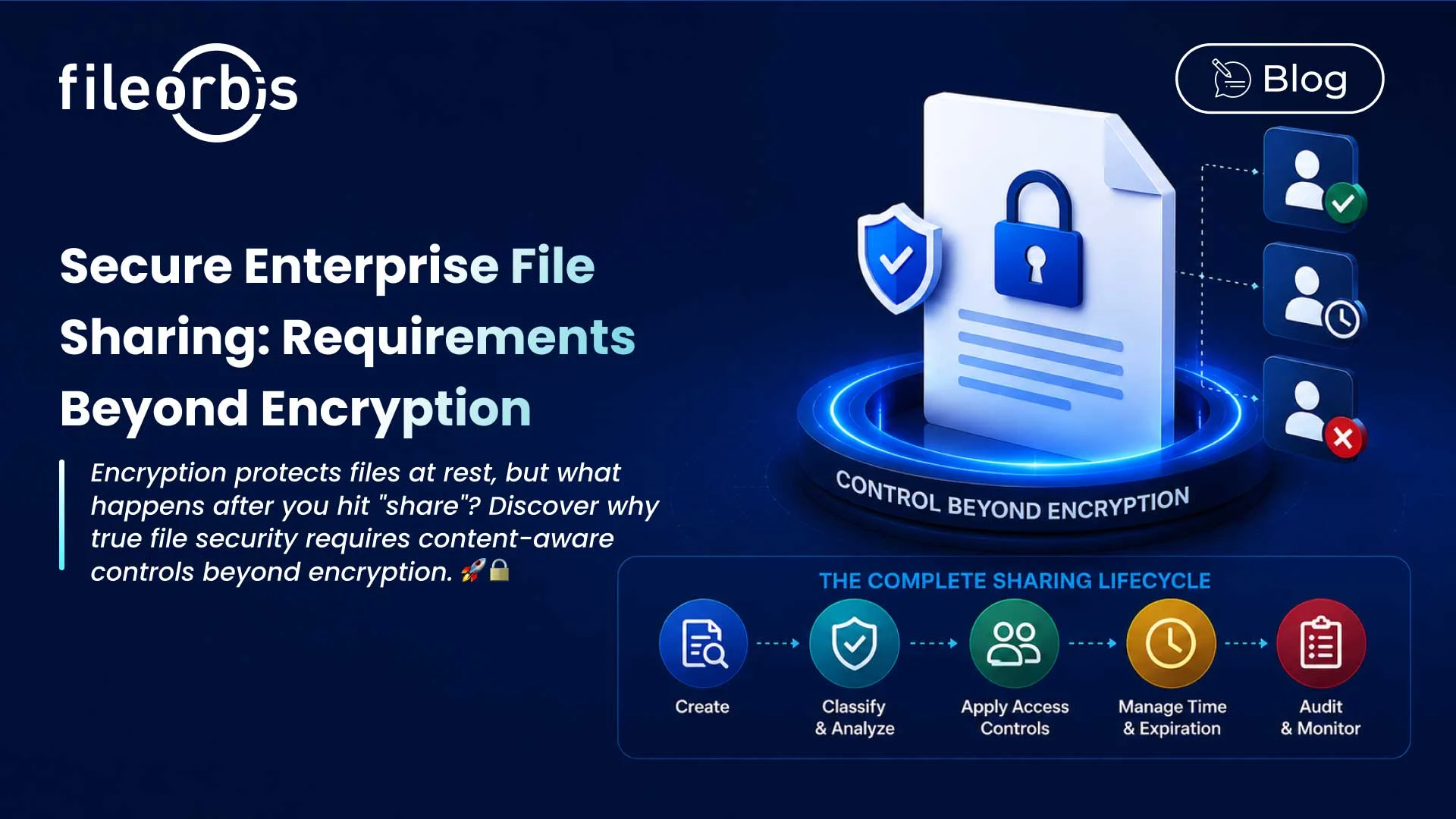
Secure Enterprise File Sharing: Requirements Beyond Encryption
Encryption is essential for securing enterprise file sharing, but it only provides protection while data is being stored or transmitted. It doesn’t decide whether a file should be shared, who should receive it, what they can do with it, or when access should end.
For enterprises processing sensitive or regulated data, secure sharing requires controls throughout the entire sharing lifecycle, from reviewing content before it leaves the organization to controlling and monitoring access afterwards.
Why Encryption Alone Is Not Enough
Even if a file is fully encrypted, it can still be safely delivered to the wrong person.
Encryption alone cannot determine the following:
- What happens after the file was shared
- Whether the file contains regulated or sensitive information
- Whether the recipient is authorized to receive the file
- Whether sharing requires approval
- Whether downloading needs to be restricted
- How long access should remain active
- Whether access can be revoked
Therefore, enterprise file sharing requires policy-driven and content-aware controls in addition to encryption.
What Secure Enterprise File Sharing Actually Requires
Pre-Sharing Content Inspection
Security decisions should look not only at the file name, folder, or location, but also at the file’s content.
Content inspection can identify sensitive information and automatically trigger appropriate action:
- Allow or block sharing
- Require approval
- Restrict access or download
- Add watermark
FileOrbis applies that sharing policies respond to the sensitivity of the information by implementing content-aware controls.
Recipient-Aware Sharing
Security also depends on who is receiving the file.
Sharing policies may differ for employees, partners, contractors, customers, or guests. The recipient’s location, identity, user role, and other contexts can help determine whether sharing should be allowed, restricted, or referred to higher management for approval.
Expiration and Revocation
External access should not remain open indefinitely.
Enterprise sharing should support following:
- Download limits
- Time-bound links
- Automatic expiration
- Instant revocation
FileOrbis supports time-bound and revocable sharing, helping organizations remove unnecessary access and prevent forgotten links from remaining active.
Download and Usage Controls
Access does not always have to mean unlimited downloads.
Organizations should be able to control, based on policy and risk, whether recipients can download or otherwise use sensitive content. These controls help ensure protection extends beyond the initial act of sharing.
Complate Auditability
Security teams need visibility into what happens throughout the sharing lifecycle.
Audit trails should show following:
- Who shared the file or who accessed the file?
- When did the access occur?
- What approvals or controls were applied?
- What actions were taken?
Complate auditability makes sharing activity verifiable for compliance, investigations, and regulatory reviews. FileOrbis uses controlled sharing and detailed audit trails to maintain visibility into sensitive file exchanges.
Sharing sensitive information should not be entirely dependent on individual judgment.
Policy-driven workflows may require automatic authorization before specific files are shared externally. Approval can be triggered based on content, recipient, classification, or other policy conditions, creating a controlled and logged decision-making process.
Dynamic Watermarking
Dynamic watermarking adds accountability to sensitive document sharing.
Watermarks can include recipient-specific information (such as email address, IP address, identity, or timestamp) and help prevent unauthorized redistribution and track exposed copies.
Consistent Policy Across Channels
A security policy is ineffective if users can bypass it through another sharing channel.
Organizations need consistent controls across enterprise file repositories, M365, external sharing workflows, and on-premises environments. Instead of treating each sharing channel as a separate security silo, FileOrbis supports centralized governance across existing enterprise file environments.
Enterprise Secure File Sharing Requirements Checklist
When evaluating a secure enterprise file-sharing platform, check if it has the following:
- Content control: Identify sensitive information before sharing.
- Recipient-aware controls: Evaluate who can access the file.
- Download controls: Limit how recipients can access content.
- Expiration and revocation: Automatically or on demand remove access.
- Encryption: Protect data at rest and in transit.
- Policy enforcement: Automatically allow, restrict, block, or escalate sharing.
- Approval workflows: Require authorization for sensitive transfers.
- Dynamic watermarking: Add accountability to shared documents.
- Audit trails: Track sharing, access, and policy actions.
- Cross-channel governance: Apply consistent controls across file media.
How FileOrbis Helps
FileOrbis helps enterprises secure file sharing beyond encryption by implementing content-aware and policy-driven controls before and after files are shared.
With FileOrbis, organizations can:
- Inspect sensitive content: Identify sensitive information and apply the appropriate sharing policy.
- Control external sharing: Use time-bound, revocable links and download restrictions.
- Maintain auditability: Track file access, downloads, sharing, and governance actions.
- Enforce consistent policies: Apply sharing controls across existing enterprise file environments.
- Automate approvals: Route sensitive sharing requests through policy-based approval workflows.
- Add dynamic watermarks: Add recipient-specific information to shared documents.
This allows organizations to control what, with whom, and under what conditions content can be shared, rather than relying solely on encryption. FileOrbis materials specifically support time-bound/revocable links, approval workflows, content-aware controls, watermarking, and audit trails.
In Summary
Encryption protects files during storage and transmission. Secure enterprise file sharing protects the decision to share and what happens afterward.
Therefore, enterprises need content control, revocation, recipient-centric controls, approvals, watermarking, access restrictions, and auditability, in addition to encryption.
The main question is not simply “Is this file encrypted?”, but “Should this file be shared with this recipient under these conditions?”
Frequently Asked Questions
Is encryption enough for secure enterprise file sharing?
No. Encryption protects data, but it does not determine whether sensitive content should be shared, whether the recipient is appropriate, or how access should be controlled afterward.
What should organizations look for in a secure file sharing platform?
Look beyond encryption context-aware policy enforcement, recipient controls, download restrictions, approval workflows, watermarking, expiration and revocation, auditability, and consistent governance across sharing environments should be considered.
How does FileOrbis secure enterprise file sharing?
FileOrbis combines context-aware policy enforcement with controlled external sharing, access restrictions, approvals, watermarking, revocation, and audit trails to govern sensitive file sharing throughout its lifecycle.

Emre Demiray
Founder – FileOrbis
Subscribe to our Newsletter
About FileOrbis
Aiming to manage the user and file relationship within an institutional framework, FileOrbis is constantly being developed in order to meet different industry and customer needs in terms of file management and sharing. Since 2018, FileOrbis continues to be developed with the excitement of the first day. FileOrbis focuses on high security, rich integration, ease of use and integrated management criteria.