
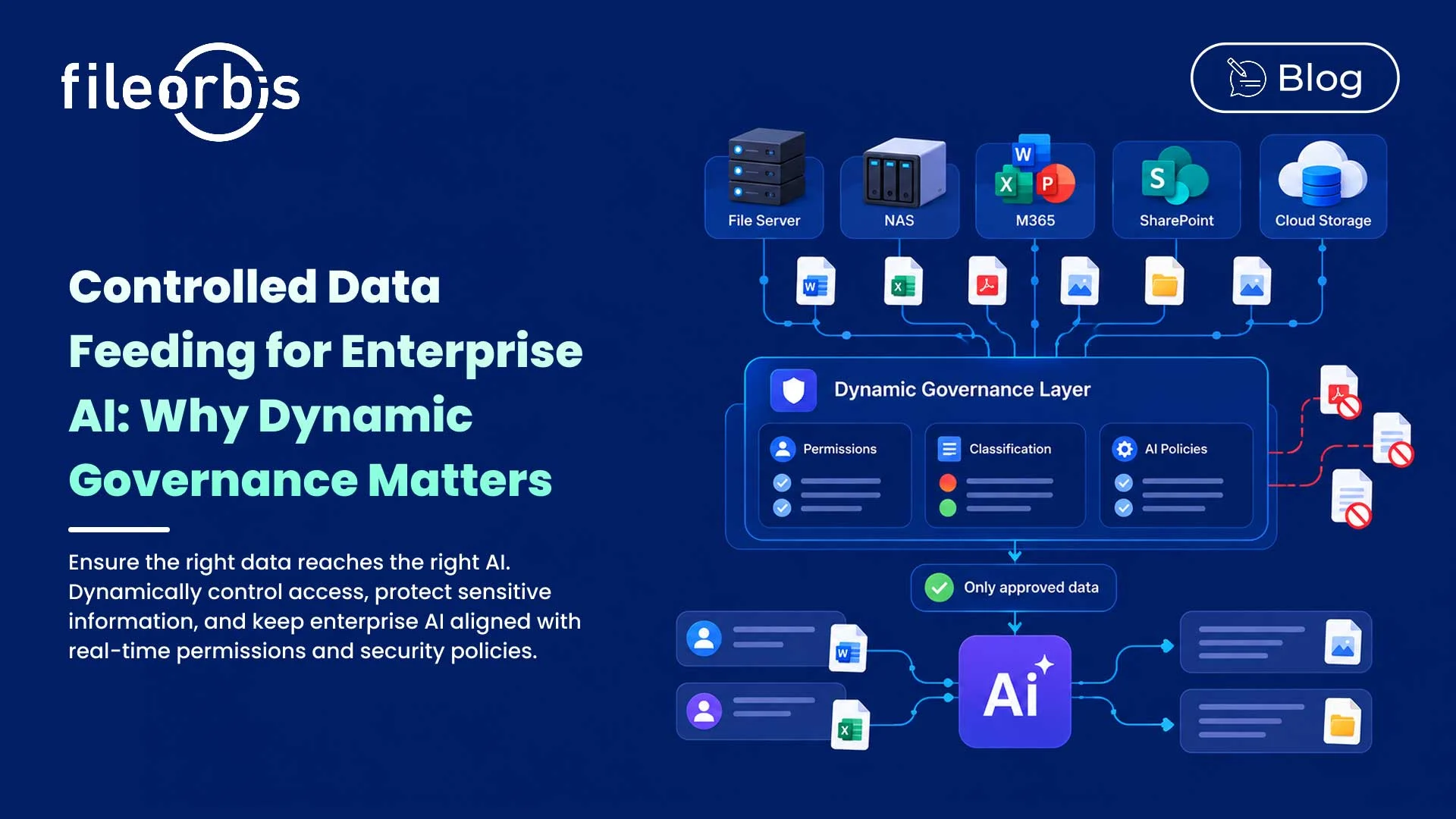
Controlled Data Feeding for Enterprise AI: Why Dynamic Governance Matters
Enterprise AI is only as reliable and secure as the data it can access.
As organizations connect file servers, NAS, M365, SharePoint, object storage, and other repositories to AI assistants and RAG systems, a critical question emerges: What data should actually be fed to corporate AI, and under what conditions?
Simply indexing enterprise content is not enough. Files, classifications, permissions, and user roles continuously change.
This makes controlled data feeding for AI a continuous governance requirement rather than a one-time ingestion task.
What Is Controlled Data Feeding for AI?
Controlled data feeding determines what enterprise information can enter an AI retrieval or processing workflow based on current governance and security policies.
Instead of giving AI unrestricted access to connected repositories, organizations can evaluate data according to:
User identity and existing permissions
- File and folder ACLs
- Data location and residency requirements
- Content sensitivity and classification
- Approved AI models and processing locations
- File status and lifecycle
The gole is simple: AI should receive only the information that is appropriate for the specific user, policy, request, and moment.
Why Static AI Knowledge Bases Create Risk
Enterprise data does not stand still.
A confidential document accessible to an employee yesterday may no longer be authorized today. A file may also be updated, reclassified, moved, or deleted while its older version remains available to an AI system.
Therefore, statically updated or periodically updated indexes can create a gap between the current state of business data and what artificial intelligence can perceive.
This can lead to:
- Retrieval of outdated information
- Use of files that have been deleted or archived
- Exposure of content after permissions change
- Retrieval that ignores updated sensitivity classifications
Keeping AI aligned with the source environment requires more than periodic ingestion.
Dynamic Data Feeding Keeps AI Aligned with Current Data
A governed AI architecture should continuously reflect changes in enterprise repositories.
Two areas are especially important:
Permission synchronization: Changes to users, ACLs, groups, and access rights should immediately affect what AI can retrieve for each user.
Content synchronization: New, moved, modified, and deleted content should be reflected in AI retrieval.
FileOrbis supports real-time synchronization of content and permissions so AI retrieval remains aligned with enterprise repositories and access controls.
This reduces the risk of the AI responding from outdated information or content that the user no longer has access to.
Permissions Alone Are Not Enough
Permissions answer an important question:
Can this user access this file?
But enterprise AI requires another question:
Should this content be processed by this AI?
A user may legally have access to a document containing personal information, intellectual property, financial records, or regulated data. This does not mean that the document should be automatically sent to every available AI model.
Before content enters an AI workflow, organizations should be able to:
- Discover sensitive information
- Block restricted content
- Classify files by content
- Restrict specific repositories or folders
- Mask or anonymize sensitive information
- Apply policies based on data sensitivity
This combines content-aware and permission-aware controls to determine not only what a user can access, but what AI is allowed to process.
The AI Model Should Be Part of the Policy Decision
Controlled data feeding should also determine which AI model can process specific data.
Different information may require different processing boundaries:
- Low-risk information may be processed by an approved cloud model.
- Confidential or regulated information may need to remain within private infrastructure.
- Internal information may require additional controls.
- Highly restricted content may be limited to local models.
Instead of routing every request to the same LLM, organizations can select models according to data classification, user context, residency requirements, and organizational policies.
Permission-Aware Retrieval Prevents AI from Becoming an Access Bypass
Connecting enterprise repositories to AI should never create a new path around existing access controls.
For each request, the retrieval layer should determine:
- Who is asking?
- Which relevant information is the user authorized to access?
- What information is relevant?
- Does policy allow that information to enter the AI workflow?
This is particularly important for shared repositories containing HR, legal, finance, executive, engineering, or customer information.
The principle is straightforward:
AI should not reveal corporate information that the user asking the question is not authorized to access.
This extends governance from what data AI receives to where and how that data is processed.
How Fileorbis Helps
FileOrbis extends enterprise file governance into AI workflows without requiring organizations to build a separate data environment for AI.
Enterprise files can remain where they already live while FileOrbis helps organizations:
- Discover and classify sensitive content
- Dynamically synchronize content and permission changes
- Enforce existing permissions during AI retrieval
- Filter or anonymize sensitive information
- Apply policies before data reaches AI
- Route information according to approved AI models
- Maintain audit logging over AI interactions
- Support local and cloud AI architectures
This creates a governed layer between enterprise repositories and AI while keeping existing file environments and access structures in place.
In Summary
Enterprise AI should not depend on a static, unrestricted pipeline to enterprise data.
As content, classifications, permissions, and policies change, the information available to AI needs to change with them.
Controlled dynamic data feeding helps ensure that the right data reaches the right AI for the right user under the right policy.
For enterprises adopting RAG, internal AI assistants, and copilots, this control is becoming a fundamental part of AI governance and security.

Gamze Mat
Product Manager
Subscribe to our Newsletter
About FileOrbis
Aiming to manage the user and file relationship within an institutional framework, FileOrbis is constantly being developed in order to meet different industry and customer needs in terms of file management and sharing. Since 2018, FileOrbis continues to be developed with the excitement of the first day. FileOrbis focuses on high security, rich integration, ease of use and integrated management criteria.