
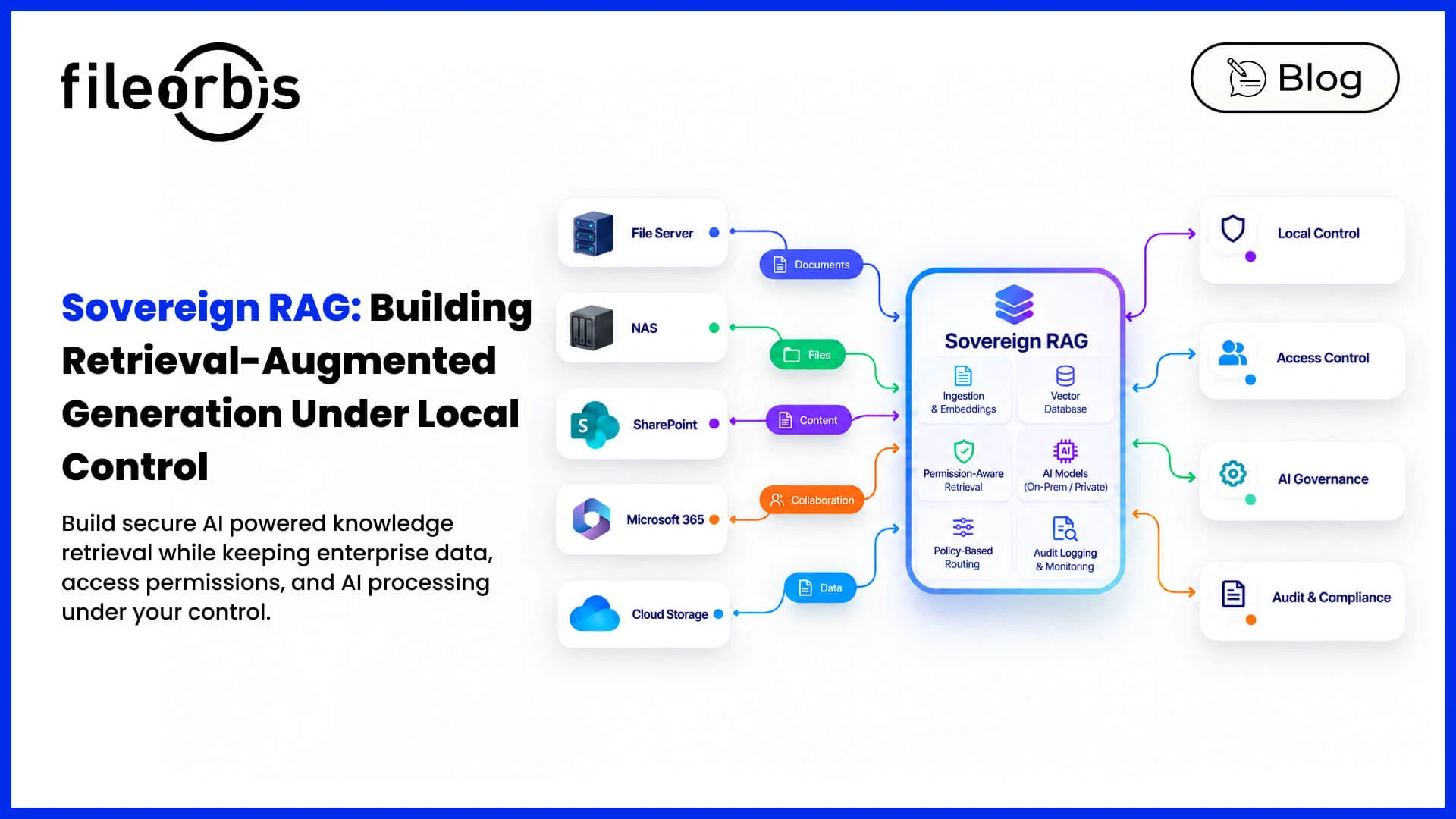
Sovereign RAG: Building Retrieval-Augmented Generation Under Local Control
Retrieval-Augmented Generation (RAG) enables enterprise AI to generate responses using internal documentation. However, sovereignty risks arise when embedded data, vector databases, or AI models operate outside of approved infrastructure.
Sovereign RAG addresses these risks by keeping enterprise data, AI processing, and access controls within defined enterprise or jurisdictional boundaries.
For regulated enterprises, this requires control over the entire data ingestion and generation pipeline, not just local model hosting.
What is Sovereign RAG?
Sovereign RAG is a Retrieval-Augmented Generation architecture that keeps enterprise information and AI processing within approved infrastructure, security policies, and jurisdictions.
A sovereign RAG architecture governs six critical components:
- Source data: Where enterprise documents are stored and accessed.
- Vector databases: Where embeddings, metadata reside, and document fragments.
- Embeddings: Where document content is converted into vector representations.
- AI models: Which models process enterprise content and where inference occurs.
- Identity and permissions: Who can retrieve specific information.
- Audit logs: Where AI interactions and access decisions are recorded.
It can operate on-premises, in a private cloud, or across approved hybrid environments.
Building a Sovereign RAG Architecture
A secure sovereign RAG architecture requires coordinated controls across six components.
Keep Source Data within Approved Infrastructure
Enterprise files often reside across file servers, NAS, SharePoint, and cloud storage.
Instead of moving sensitive documents to a separate AI repository, standalone RAG should maintain the following while connecting to existing storage:
- Existing file access permissions.
- Control over source data locations.
- Governance over data ingestion and retrieval.
- Restrictions on unauthorized repository access.
Control Embeddings and Vector Databases
RAG systems convert document content into embeddings and store them in vector databases for semantic retrieval.
Although embedded data are numerical representations, they can reveal sensitive information.
Sovereign RAG should ensure:
- Embedding generation occurs within approved boundaries.
- Document fragments and metadata follow residency policies.
- Vector databases remain in authorized locations.
- Index updates and deletions reflect changes in source repositories.
Keeping source files local is insufficient if embeddings or indexed content are processed elsewhere.
Enforce Permission-Aware Retrieval
A vector database identifies relevant information, but relevance does not establish authorization.
Without permission-aware access, AI assistants can expose restricted documents through generated responses.
Key controls include:
- Enforcement of file-level access control lists (ACLs).
- Integration with existing identity providers such as Active Directory.
- Permission revalidation when access rights change.
- Security trimming before content reaches the LLM.
- Least-privilege access to retrieved content.
This ensures AI responses use only information the requesting user is authorized to access.
Keep AI Models within Approved Boundaries
Model deployment determines where retrieved enterprise information is processed.
For sensitive workloads, organizations may require locally hosted LLMs or approved private cloud environments.
A sovereign RAG deployment should support:
- On-premises or private cloud model hosting.
- Controlled access to external AI services.
- Approved regional inference environments.
- Restrictions on unauthorized data transfers.
Not every AI request requires the same processing environment.
Policy-based model routing selects a model approved according to governance requirements, including:
- Data classification: Restricted content remains on authorized local models.
- Processing location: Requests stay within approved jurisdictions.
- User identity: Model access follows organizational permissions.
- Workload requirements: Models are selected according to task type.
For example, confidential financial records can be processed by a local model, while non-sensitive requests might utilize an approved cloud LLM.
This enables flexible AI deployment without bypassing sovereignty policies.
Maintain Audit Logging and Monitoring
Sovereign RAG requires visibility into how enterprise information is retrieved and processed.
The audit log should include:
- User queries and authentication events.
- Model selection and routing.
- Retrieved documents and access decisions.
- AI responses and processing locations.
- Policy violations and blocked requests.
Logs should remain within approved boundaries and integrate with existing SIEM platforms as needed.
How Sovereign RAG Works in Practice
A governed RAG workflow follows six steps:
- Authenticate: Verify the user’s identity.
- Authorize: Apply content policies and existing permissions.
- Retrieve: Search approved indexes for authorized content.
- Route: Select an AI model based on sensitivity and residency requirements.
- Generate: Produce an answer using permitted information.
- Audit: Record retrieval, model activity, and policy enforcement.
These controls must remain active throughout the RAG workflow, even when documents or permissions change.
How FileOrbis Helps
FileOrbis extends enterprise file governance into AI through content-aware security, permission-aware retrieval, and flexible deployment.
Key capabilities include:
- In-place governance: Connect existing repositories without data migration.
- Content-aware security: Classify sensitive information and apply AI access policies.
- Permission-aware RAG: Enforce existing Active Directory and NTFS permissions.
- Policy-based routing: Direct requests to approved AI models
- AI residency: Support local models and controlled vector database locations.
- Audit logging: Track AI interactions and access decisions.
FileOrbis helps organizations build governed enterprise RAG environments while maintaining their existing file infrastructure and access controls.
In Summary
Sovereign RAG requires control over the entire retrieval and generation pipeline, not just the AI model.
By governing data locations, embeddings, model routing, access permissions, and audit logging, enterprises can securely use AI-powered knowledge retrieval while keeping sensitive information within approved boundaries.
Frequently Asked Questions
What is sovereign RAG?
Sovereign RAG is an architecture that keeps enterprise data, access processes, and AI processing within approved organizational or jurisdictional boundaries.
How does permission-aware retrieval support sovereign RAG?
Permission-aware retrieval enforces existing file access rights before content reaches an AI model, preventing unauthorized information from appearing in AI-generated responses.
Does sovereign RAG require on-premises AI models?
No. It can use on-premises, approved regional models or private cloud, provided they meet organizational security and residency requirements.

Hammam Abunaser
Sales Director, MEA
Subscribe to our Newsletter
About FileOrbis
Aiming to manage the user and file relationship within an institutional framework, FileOrbis is constantly being developed in order to meet different industry and customer needs in terms of file management and sharing. Since 2018, FileOrbis continues to be developed with the excitement of the first day. FileOrbis focuses on high security, rich integration, ease of use and integrated management criteria.