
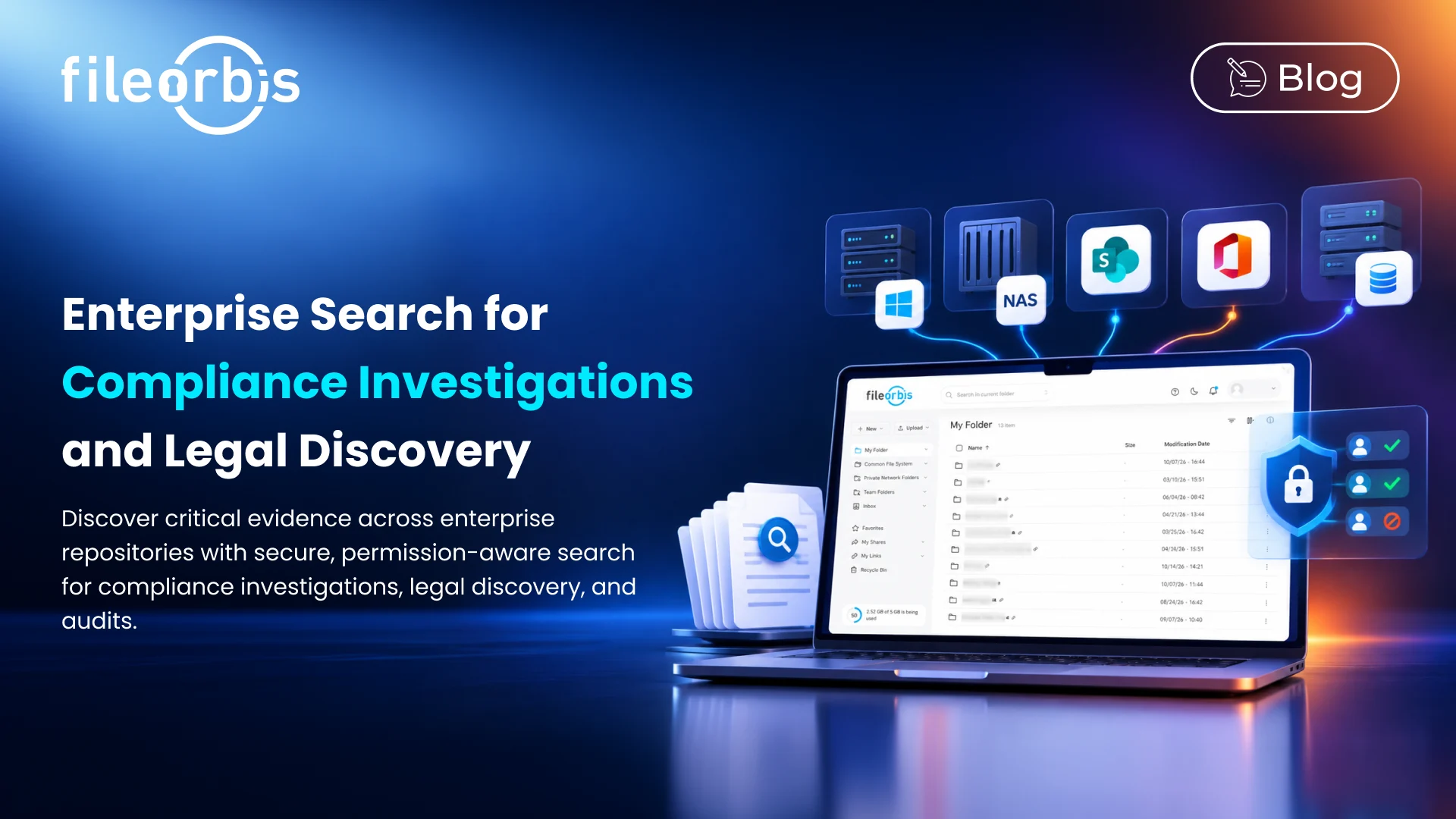
Enterprise Search for Compliance Investigations and Legal Discovery
When compliance investigations, regulatory audits, or legal discovery requests arise, organizations should quickly locate relevant documents across distributed file environments.
However, evidence may be scattered across file servers, NAS systems, M365, SharePoint, and cloud storage. Searching these environments individually increases manual effort and complicates evidence collection.
Enterprise file search helps organizations locate relevant documents across existing repositories while maintaining access controls and supporting defensible investigations.
What is Enterprise File Search for Compliance?
Enterprise file search enables organizations to locate documents across multiple repositories using file content, advanced search criteria, and metadata.
For legal and compliance teams, governed search provides:
- Unified discovery: Search connected repositories through a central interface.
- Permission-aware access: Display results according to existing file permissions.
- Advanced filtering: Narrow results by date, file type, owner, or classification.
- Controlled evidence processing: Manage access to sensitive investigation materials.
- Auditability: Maintain records of relevant file activities.
These capabilities help teams identify relevant records without compromising enterprise security policies.
Essential Enterprise File Search Features for Investigations
Unified Search Across Enterprise Storage
Documents relevant to an investigation are rarely found in a single location.
Unified enterprise file search enables teams to discover content across on-premises file servers, NAS, M365, SharePoint, and connected cloud storage.
This reduces the need to search each environment individually and allows organizations to maintain their existing storage infrastructure.
Full-Text and Content Pattern Search
Relevant information can be found within the document itself, not just in the file name.
Full-text search helps investigators find specific terms and phrases within supported document formats.
Content pattern searches can identify potentially sensitive information, including:
- Personal identification information
- Customer or employee identification information
- Financial account numbers
- Contract references
Combined with data classification, content-aware search helps teams locate records that require further investigation.
Advanced Metadata and Date Filtering
Investigators can determine when a document was modified or who managed it, even if the file name is unknown.
Advanced filters help narrow search results using:
- Owner: Document owner or responsible department.
- Date: Creation or modification periods.
- File type: Spreadsheets, contracts, reports, or other formats.
- Repository: Storage location or folder.
- Classification: Sensitivity labels or privacy levels.
Combining these criteria reduces irrelevant results and accelerates document identification.
Maintaining Chain of Custody and Evidence Integrity
Locating evidence is only the first step. Organizations should also document how records are preserved, transferred, and accessed.
A defensible chain of custody requires appropriate controls throughout the processing of evidence.
Key measures include:
- Legal holds: Prevent deletion of records subject to preservation obligations.
- Access restrictions: Limit evidence handling to authorized personnel.
- Integrity verification: Use cryptographic hashes or other suitable methods during evidence collection.
- Version tracking: Identify changes and preserve relevant document versions.
- Audit logging: Record relevant access, download, modification, and sharing activities.
Search activity alone does not establish a complete chain of custody. Documented protection and transmission procedures are essential.
Permission-Aware Search and Controlled Evidence Export
Compliance investigations often involve confidential financial information, legally privileged documents, and employee records.
Permission-aware search uses security trimming to ensure users can only find content permitted by their current access rights.
However, locating authorized documents does not automatically mean they should be freely exported or shared.
Evidence collection workflows should include:
- Approval workflows for sensitive transfers.
- Least-privilege access and role-based permissions.
- Encryption and recipient validation.
- Download and external-sharing restrictions.
- Audit logging of evidence exports.
These safeguards help organizations share investigation materials with authorized auditors, legal counsel, and regulators.
Enterprise File Search Use Cases
Compliance Investigations
Security and compliance teams can locate documents related to policy violations, sensitive data handling, or suspected unauthorized exposure.
Metadata and content searches help narrow the investigation scope and identify records for review.
Legal Discovery and Regulatory Response
Legal teams can identify potentially responsive documents based on custodians, keywords, dates, and repository locations.
Search results can support downstream preservation, review, and production workflows. Formal eDiscovery still requires appropriate legal procedures and dedicated review processes where necessary.
Audit Preparation
Auditors may request policies, approvals, financial documents, and supporting records from multiple departments.
Centralized search reduces manual collection efforts and helps teams efficiently access relevant documents.
How FileOrbis Helps
FileOrbis combines enterprise search with file governance capabilities, helping organizations discover and manage information across existing storage environments without migrating data.
Key capabilities include:
- Federated Enterprise Search: Locate documents across connected on-premises and cloud storage.
- Full-Text and Metadata Search: Search document contents and filter results using available metadata.
- Secure File Sharing: Control access and external collaboration through governed sharing policies.
- Permission-Aware Results: Apply security trimming based on existing access rights.
- Retention and Legal Hold: Support record protection and lifecycle management.
- AI-Based Data Classification: Identify sensitive information and enrich content visibility.
- Audit Log and Version History: Support investigation traceability and document activity reviews.
By governing data where it already lives, FileOrbis helps compliance, security, and legal teams find relevant information while maintaining enterprise access controls.
Discover how FileOrbis can simplify governed enterprise search.
In Summary
Enterprise file search is an important foundation for compliance investigations, legal discovery, and audit preparation.
Combining federated discovery, permission-aware access, advanced filtering, and controlled evidence handling helps organizations reduce manual investigation efforts and strengthen information governance.
FileOrbis brings these capabilities together across existing enterprise repositories, supporting secure and efficient evidence discovery without requiring data migration.

Gamze Mat
Product Manager
Subscribe to our Newsletter
About FileOrbis
Aiming to manage the user and file relationship within an institutional framework, FileOrbis is constantly being developed in order to meet different industry and customer needs in terms of file management and sharing. Since 2018, FileOrbis continues to be developed with the excitement of the first day. FileOrbis focuses on high security, rich integration, ease of use and integrated management criteria.