
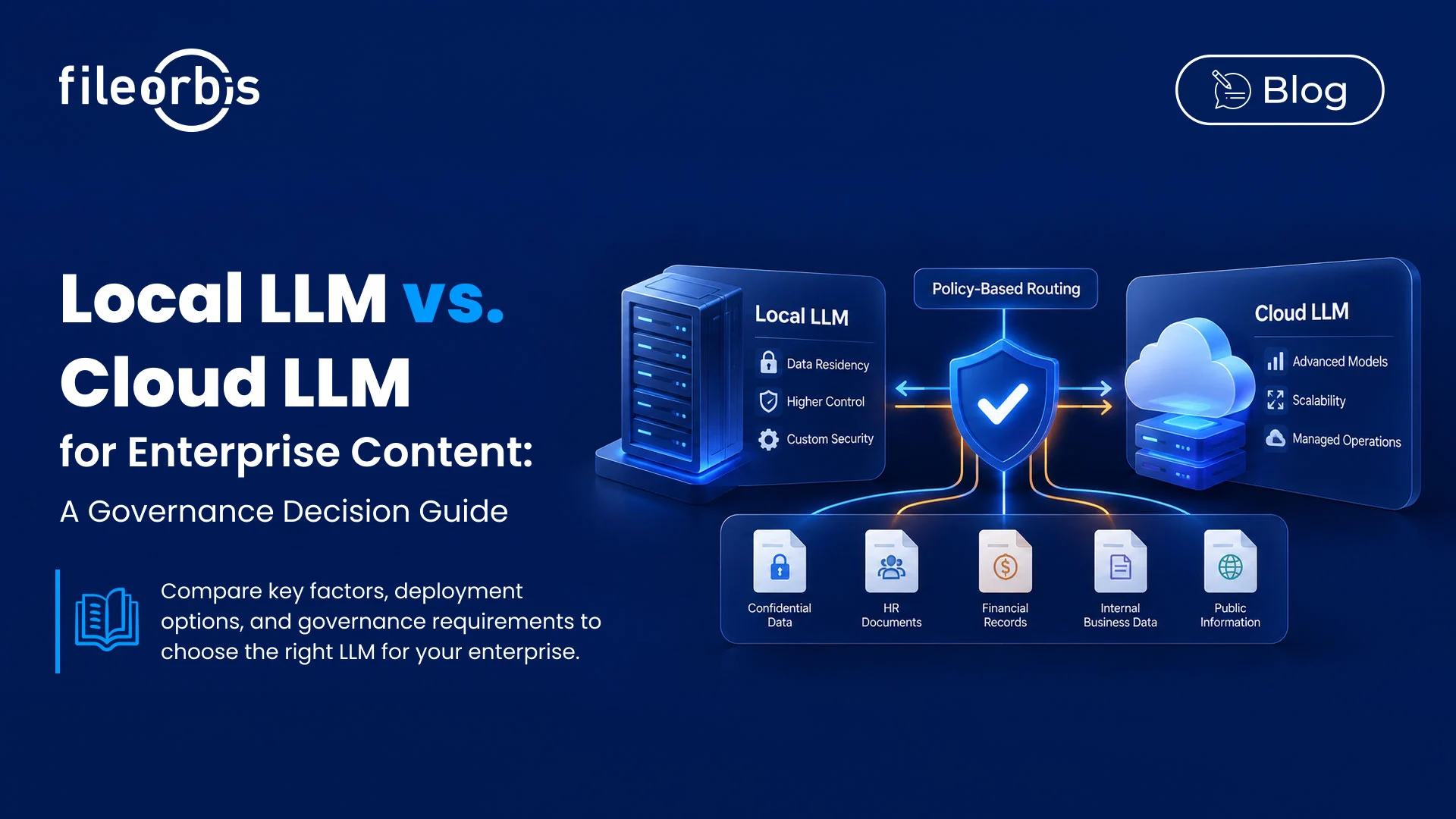
Local LLM vs. Cloud LLM for Enterprise Content: A Governance Decision Guide
As businesses adopt large language models (LLMs), choosing between local and cloud-based deployment becomes a critical security and governance decision.
On-premises LLMs provide greater control over data processing, while cloud LLMs offer scalability and access to advanced models. The right approach depends on data sensitivity, performance, residency requirements, and operational costs.
Local LLM vs. Cloud LLM: What’s the Difference?
A local LLM runs within an organization’s controlled infrastructure, typically on-premises or in a private environment. A cloud LLM operates through infrastructure managed by an external provider.
Both can support document analysis, retrieval-augmented generation (RAG), and enterprise search but offer different advantages.
Local LLM: Greater Control Over Enterprise Data
- Data residency: Keep processing within required geographic boundaries.
- Data control: Process sensitive information within approved infrastructure.
- Infrastructure independence: Reduce reliance on external AI providers.
- Security customization: Apply organization-specific controls and configurations.
Local deployment requires computing resources, ongoing maintenance, and technical expertise.
Cloud LLM: Scalability and Operational Flexibility
- Model availability: Access advanced models and capabilities.
- Scalability: Adjust processing capacity to workload demand.
- Managed operations: Reduce internal infrastructure responsibilities.
- Lower upfront costs: Avoid purchasing dedicated AI infrastructure.
Cloud deployment requires careful evaluation of provider security, retention policies, data handling.
7 Factors to Consider When Choosing a Local or Cloud LLMS
Data Residency and Compliance
Local deployment provides direct control over processing locations. Cloud deployment requires evaluating provider regions, cross-border transfers, and sub processors.
The key question is: Where can enterprise data legally and operationally be processed?
Data Sensitivity and Confidentiality
Local LLMs may be preferable for confidential documents, regulated information, and intellectual property. Cloud LLMs may be suitable when appropriate security measures are established.
The key question is: Which data classifications can be processed externally?
Infrastructure and Operating Costs
Local LLMs include hardware and maintenance costs. Cloud LLMs, on the other hand, typically use consumption-based pricing that varies depending on usage.
The key question is: Which model offers a better total cost of ownership?
Performance and Latency
Local LLM performance depends on available computing resources. Cloud LLMs provide managed computing capacity, but this depends on connectivity and provider performance.
The key question is: Which deployment meets the response time requirements?
Model Choice and Flexibility
Cloud services offer managed model options, while local deployment provides greater control over model configuration and updates.
The key question is: Which models meet business and technical requirements?
Scalability and Workload Demand
Cloud LLMs manage fluctuating demand more easily. Local environments require capacity planning and infrastructure expansion.
The key question is: How quickly can AI workloads grow?
Operational Management
Local LLMs need internal expertise for maintenance, monitoring, and updates. Cloud providers manage a large portion of the infrastructure.
The key question is: What level of operational responsibility can internal teams support?
Hybrid LLM Deployment: Combining Local and Cloud AI
A hybrid LLM architecture allows enterprises to select processing environments based on workload requirements, rather than committing to a single deployment model.
For example:
- Internal business data: Use approved models according to organizational policies.
- Restricted data: Process confidential financial records and HR documents locally.
- Specialized workloads: Select models based on capabilities and cost.
- Public information: Use cloud LLMs for suitable general-purpose tasks.
This flexibility requires a consistent approach to managing AI processing.
Policy-Based LLM Routing: Applying Governance to Model Selection
Policy-based LLM routing automatically selects approved models based on predefined enterprise rules.
Routing decisions may consider:
- Data residency: Keep processing within approved locations.
- Data classification: Match processing environments to content sensitivity.
- User permissions: Respect existing file access rights.
- Cost policies: Optimize processing expenses.
- Task requirements: Select models with suitable capabilities.
For example, a confidential financial report might be routed to a local LLM, while a general marketing request uses an approved cloud model.
Effective routing evaluates both the request and the received enterprise content to generate a response.
How FileOrbis Helps
FileOrbis enables enterprises to connect existing file repositories to local and cloud LLMs without migrating data.
AI Governance and AI Sovereignty capabilities help organizations:
- Orchestrate multiple LLMs: Apply policy-based routing across approved local and cloud models.
- Protect sensitive content: Use AI-based classification, masking, filtering, and anonymization.
- Maintain access controls: Extend existing AD/NTFS permissions to content-aware and permission-aware RAG.
- Maintain audit logging: Record AI interactions and content access for oversight.
- Control processing locations: Support data residency requirements through approved AI environments.
FileOrbis combines enterprise file governance with flexible AI deployment while keeping data in existing repositories.
In Summary
Local and cloud LLMs serve different enterprise requirements:
- Choose local LLMs when transaction control and data localization are priorities.
- Choose cloud LLMs when scalability and managed infrastructure are more important.
- Use policy-based guidance to align model selection with enterprise governance requirements.
- Consider hybrid deployment when workloads have different security and operational needs.
The goal is not to choose a single deployment model for each workload, but to apply appropriate controls wherever AI processes enterprise content.

Gamze Mat
Product Manager
Subscribe to our Newsletter
About FileOrbis
Aiming to manage the user and file relationship within an institutional framework, FileOrbis is constantly being developed in order to meet different industry and customer needs in terms of file management and sharing. Since 2018, FileOrbis continues to be developed with the excitement of the first day. FileOrbis focuses on high security, rich integration, ease of use and integrated management criteria.