
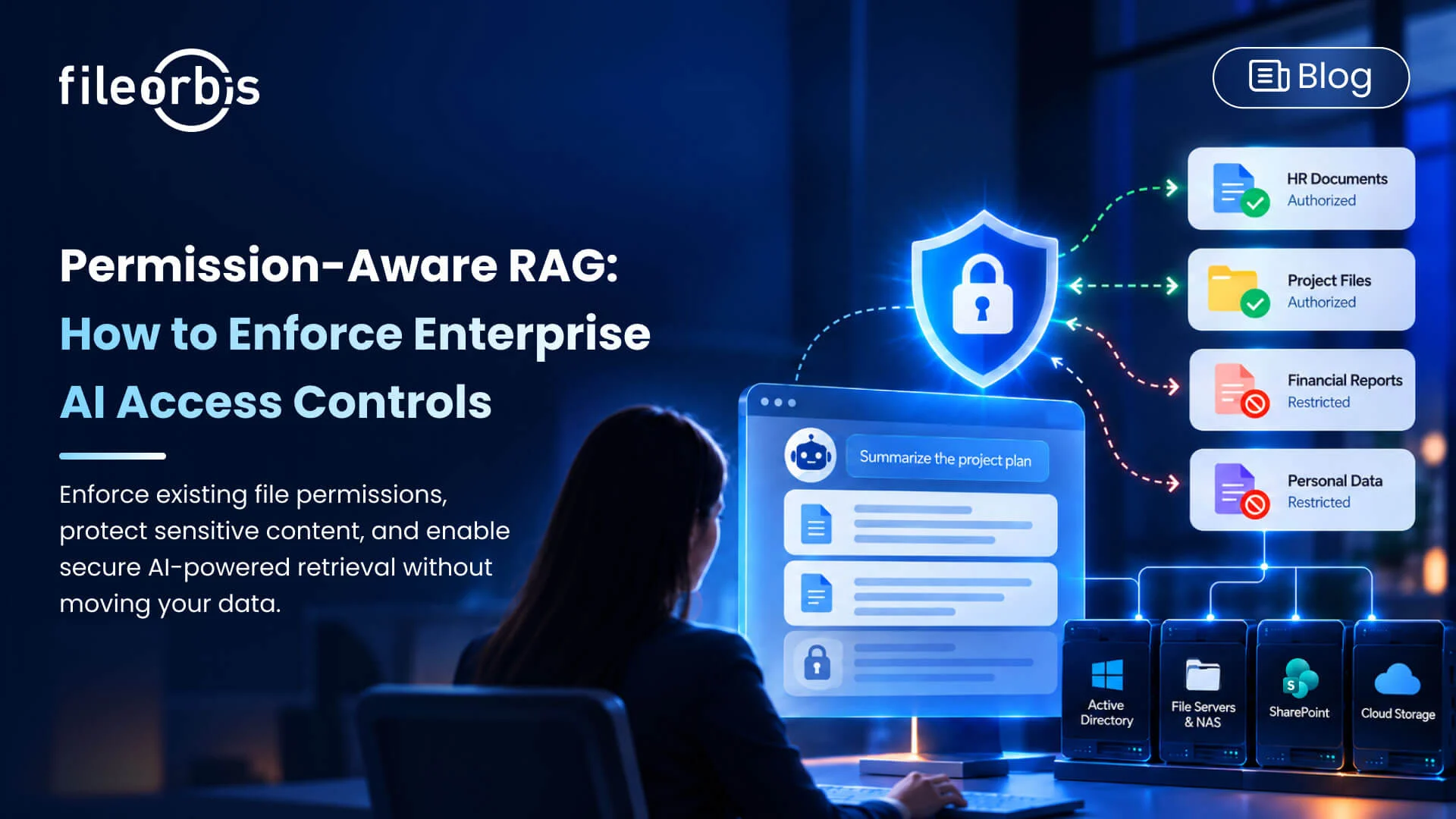
Permission-Aware RAG: How to Enforce Enterprise AI Access Controls
Enterprise AI assistants are increasingly using Retrieval-Augmented Generation (RAG) to answer queries based on internal documents. However, connecting AI to enterprise file repositories presents a critical security challenge: ensuring users only access information they are authorized to access.
Permission-aware RAG solves this challenge by enforcing existing file access rights during AI data retrieval and response generation.
For organizations adopting enterprise AI, secure data access and AI governance are crucial components.
What is Permission-Aware RAG?
Permission-aware RAG is an approach to Retrieval-Augmented Generation (RAG) approach that restricts AI’s access to enterprise content based on each user’s existing permissions.
Instead of retrieving all potentially relevant documents, the system checks which information the requesting user is authorized to access.
A permission-aware RAG architecture should:
- Verify user identity: Authenticate users through enterprise identity systems.
- Reflect permission changes: Update access decisions when source permissions change.
- Enforce file permissions: Respect existing access control lists (ACLs) and user privileges.
- Control AI responses: Prevent restricted content from being included in generated answers.
- Filter retrieved content: Exclude unauthorized documents and content from AI context.
This allows enterprises to use existing knowledge repositories without creating a separate, unrestricted information layer for AI.
Why Traditional RAG Creates Enterprise Security Risks
Traditional RAG architectures often prioritize semantic relevance over access authorization. A document might be relevant to a user’s query but not accessible to that user.
This creates several security risks:
- Unauthorized exposure: AI responses may reveal information from restricted files.
- Disclosure of sensitive data: Confidential or regulated information may enter AI-generated responses.
- Outdated access controls: Changes to file permissions may not be reflected in retrieval indexes.
- Excessive permissions: Broad access rights can expose more content than users require.
- Limited accountability: Inadequate audit logging can make AI access difficult to investigate.
Permission-aware retrieval reduces these risks by making authorization a part of the retrieval process, rather than simply relying on instructions given to the AI model.
How Permission-Aware RAG Works
A secure enterprise RAG architecture connects AI-based access to existing identity, storage, and management controls.
Connecting Existing Enterprise Repositories
The system connects to file servers, NAS, and other enterprise content sources without requiring organizations to move documents to a separate repository.
Maintaining Resource Permissions
Existing access control lists, including NTFS permissions and Active Directory, are mapped to indexed content.
Filtering Content During Retrieval
When a user submits a query, the system identifies the relevant content and applies authorization checks before providing it to the AI model.
Enforcing Content-Aware Security Policies
While permissions determine who can access a document, content-aware controls assess whether sensitive information requires additional protection.
Depending on policy, content may be excluded, anonymized or masked.
Maintaining Governance of Data Changes
Changes to files, permissions, and security policies should be reflected in the retrieval environment to reduce the risk of outdated access decisions.
Permission-Aware RAG vs. Content-Aware RAG
Both approaches contribute to enterprise AI security, but they address different requirements.
- Permission-aware RAG: Determines whether a user has permission to access specific information.
- Content-aware RAG: Assesses the sensitivity of the information and applies additional protection policies.
For example, an employee might have permission to open a document containing personal information. Content-aware controls can still restrict how this information is used in the AI response.
Combining these approaches provides more granular control over enterprise AI access.
How FileOrbis Helps
FileOrbis AI Governance extends existing enterprise file security controls to AI-powered retrieval and responses.
Instead of requiring data migration or replacing established permission models, FileOrbis governs enterprise content where it already lives.
Key capabilities include:
- Existing permission enforcement: Extend Active Directory and NTFS access controls to RAG and enterprise AI.
- Permission-aware retrieval: Filter AI-accessible content according to the requesting user’s authorization.
- Content-aware protection: Apply policy-based filtering, anonymization and masking.
- AI-based data classification: Identify sensitive information across enterprise repositories.
- Continuous synchronization: Reflect file and permission changes to the AI retrieval environment.
- Flexible deployment: Support enterprise AI environments using local or cloud-based language models.
- Audit logging: Record AI access activities to support security investigations and governance.
FileOrbis combines permission-aware and content-aware RAG, helping organizations protect their established security boundaries while exposing their enterprise knowledge to AI.
In Summary
Permission-aware RAG helps enterprises adopt AI without bypassing existing file access rights. When combined with content-aware controls, it reduces unauthorized access and supports secure access to corporate information.
FileOrbis AI Governance brings these controls together by extending sensitive data protection, existing permissions, and audit logs to enterprise AI without requiring data migration.
Request a demo to see how FileOrbis supports secure, permission-driven enterprise AI.

Faris Suleiman
Presales Manager, KSA & Egypt
Subscribe to our Newsletter
About FileOrbis
Aiming to manage the user and file relationship within an institutional framework, FileOrbis is constantly being developed in order to meet different industry and customer needs in terms of file management and sharing. Since 2018, FileOrbis continues to be developed with the excitement of the first day. FileOrbis focuses on high security, rich integration, ease of use and integrated management criteria.