
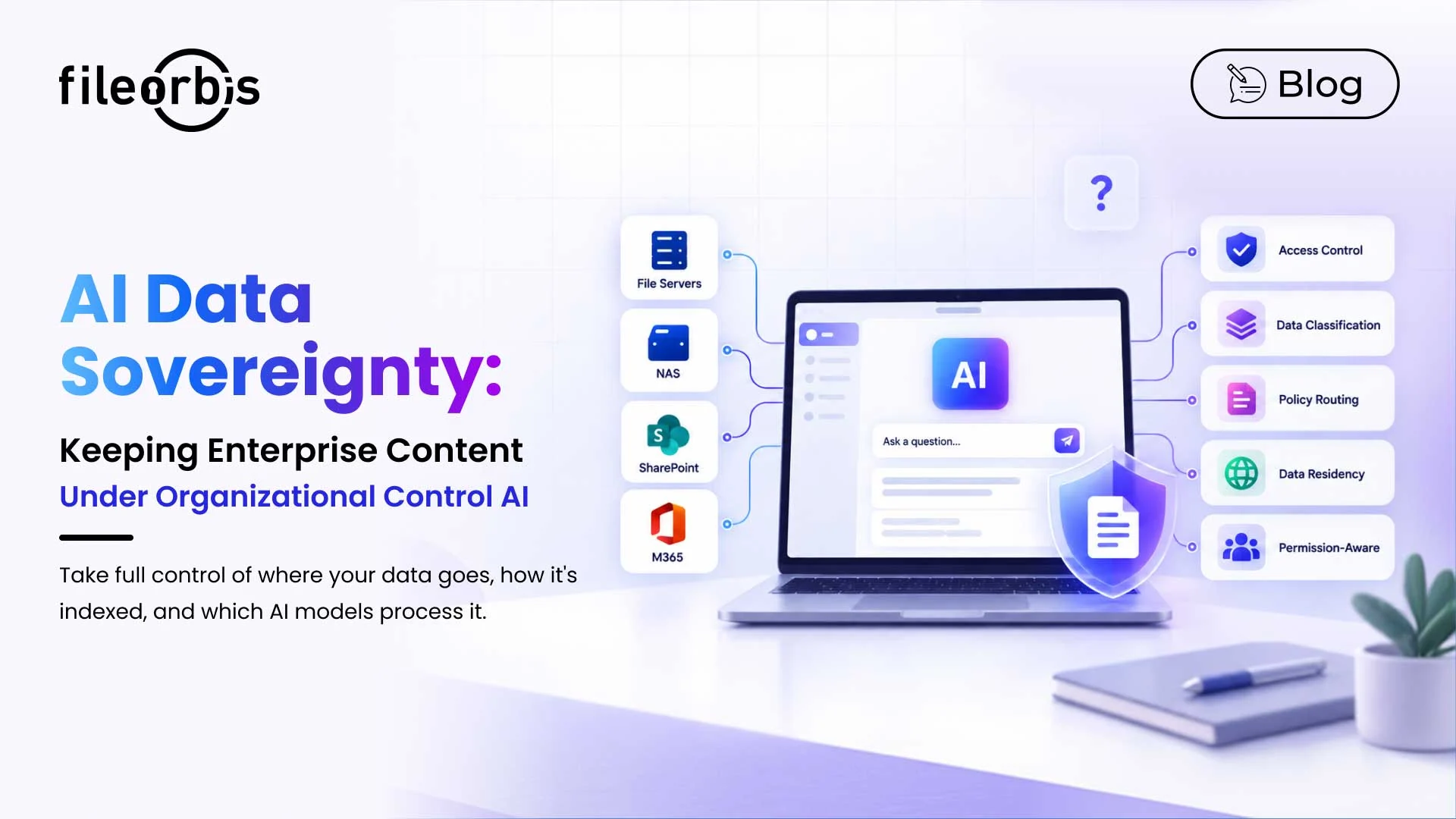
AI Data Sovereignty: Keeping Enterprise Content Under Organizational Control AI
Enterprise AI is creating new challenges for data sovereignty. A file may reside on an internal file server, SharePoint, or private cloud while its contents are being indexed, converted into embedded files, retrieved via RAG, or sent to an AI model.
Therefore, AI data sovereignty requires organizations to control not only where enterprise files are located, but also how information is accessed and processed along the AI pipeline.
What is AI Data Sovereignty?
AI data sovereignty is the ability to control where corporate information is stored, processed, indexed, retrieved, and used by AI.
Organizations need visibility into:
- Which repositories AI can access
- Which models can process sensitive data
- Where AI processing takes place
- Where indexes and embedded files are stored
- Which users can access specific content
- Whether data exceeds jurisdictional boundaries
- Whether existing file permissions continue to be enforced
In addition, this extends traditional data sovereignty to AI retrieval and processing.
Control Which Repositories AI Can Access
Enterprise AI should not automatically access every available repository.
First, organizations should first identify approved AI data sources; these include:
- File servers and NAS systems
- M365 and SharePoint
- Object storage
- Private cloud storage
- Departmental file shares
Then, policies can specify which repositories, file types, folders, classifications, or sensitive data categories AI can use.
As a result, organizations can reduces the risk of restricted or inappropriate content entering AI workflows.
Keep Vector Data Within the Sovereign Boundary
RAG architectures offer another data layer: embedded vectors and vector indexes.
Althought, embedded vectors are not original files, they come from enterprise information. Therefore, organizations should control:
- Where embedded vectors are created
- Where vector indexes are stored
- Which content can be indexed
- Who can access them
- How organizations remove outdated or deleted content
For sensitive environments, local or organization-controlled vector databases can help keep AI retrieval within approved boundaries.
Route Data to Models According to Policy
AI data sovereignty does not require every workload to use the same model.
Instead, organizations can implement policy-based model routing based on data sensitivity and processing needs:
- Highly sensitive data -> on-premises LLM
- Internal non-sensitive data -> approved cloud model
- Regulatory data -> approved private model
- Public information -> external AI service
The goal is to control which data reaches which model and where that processing takes place.
Controlling Cross-Border AI Processing
Storage location alone does not determine sovereignty.
Therefore, organizations should know where each part of the AI workflow runs; including:
- Source files
- Vector databases
- Embedding and indexing services
- Model endpoints
- RAG orchestration
- Retrieved context
- AI activity logs
This visibility helps organizations determine when corporate information can cross organizational, geographic, or legal boundaries.
Enforcing Permissions During Data Retrieval with AI
AI should not be another way to bypass existing access controls.
For example, if a user cannot access a document in a resource repository, they should not be able to retrieve their information via AI either.
Permission-aware RAG should do the following:
- Validate identity during querying
- Obtain security-trimmed retrieval results for each user
- Respect existing ACLs and repository permissions
- Keep permission changes in sync with the AI environment
- Block unauthorized content before it reaches the model
As a result, these controls help prevent unauthorized data exposure through AI-generated answers, quotes, or summaries.
AI Data Sovereignty Checklist
Before connecting enterprise content to AI, ensure the architecture provides:
- Sensitive data discovery and classification
- Approved repository controls
- Controlled indexing and vector storage
- Permission-aware retrieval
- Policy-based model routing
- Cross-border processing controls
- Defined AI processing locations
- Audit logging
Together, these controls create a governed path from enterprise content to AI.
How FileOrbis Helps
FileOrbis extends enterprise file governance to AI and RAG workflows. at the sam time, it enables organizations to govern data where it already resides.
FileOrbis helps organizations:
- Discover and classify sensitive content in enterprise file environments
- Enforce existing file permissions during retrieval
- Control indexing and retrieval systems
- Apply content-aware and permission-aware controls to AI and RAG
- Route workloads between approved local and cloud models
- Maintain visibility and audit logs in AI interactions
As a result, FileOrbis helps organizations create controlled AI access without the need for repository migration, while protecting unstructured data.
In Summary
AI data sovereignty extends control beyond file storage to the entire AI data path.
Therefore, organizations need governance over approved repositories, embedded files, retrieval permissions, vector databases, processing location, model selection, and cross-border data movement. By extending existing file governance to AI workflows, businesses can adopt AI without losing control of sensitive information.
Frequently Asked Questions
Is data residency enough for enterprise AI?
No. While data residency addresses where data is stored. However, AI data sovereignty also considers where enterprise information is indexed, processed, retrieved.
Why are permissions important for AI data sovereignty?
Permission-aware retrieval ensures that users can only retrieve content for which they have permission in the source repository.
Does AI data sovereignty require local AI models?
Not always. Organizations can use private cloud, local, and approved external models. However, policies should control which data each model can process and where that processing takes place.

Gamze Mat
Product Manager
Subscribe to our Newsletter
About FileOrbis
Aiming to manage the user and file relationship within an institutional framework, FileOrbis is constantly being developed in order to meet different industry and customer needs in terms of file management and sharing. Since 2018, FileOrbis continues to be developed with the excitement of the first day. FileOrbis focuses on high security, rich integration, ease of use and integrated management criteria.