
Why is it Important to Approve Sensitive Content Before Sharing with Third Parties?
Enterprise collaboration requires files to cross organizational boundaries. Contracts go to suppliers, customer information to partners, financial documents to auditors, and technical files to contractors.
However, sensitive content should not leave the organization simply because a user has permission to access or share the file.
Approving sensitive content before sharing establishes a critical control point. By evaluating the file’s content, where it’s going, and whether additional authorization is needed, it helps organizations reduce the risk of unauthorized access, inappropriate external sharing, and policy violations.
This is where context-aware sharing and approval workflows become important.
Access Permission Does Not Mean Sharing Authorization
Traditional file permissions primarily determine whether a user can access a file. Third-party sharing raises a different question:
Should this user be allowed to share this particular content with a third party?
A file may contain:
- Personally identifiable information (PII)
- Contracts and legal documents
- Customer or financial data
- Employee records
- Confidential technical information
- Intellectual property
- Other regulated or business-sensitive content
It may be legitimate for an employee to access this information for their work. This does not necessarily mean the information should be shared with an external recipient.
Approval provides additional control between access to sensitive information and its external distribution.
Content Sensitivity Should Determine Next Steps
Not every file requires the same level of protection.
A publicly available product brochure and a spreadsheet containing customer records should not follow the same sharing process.
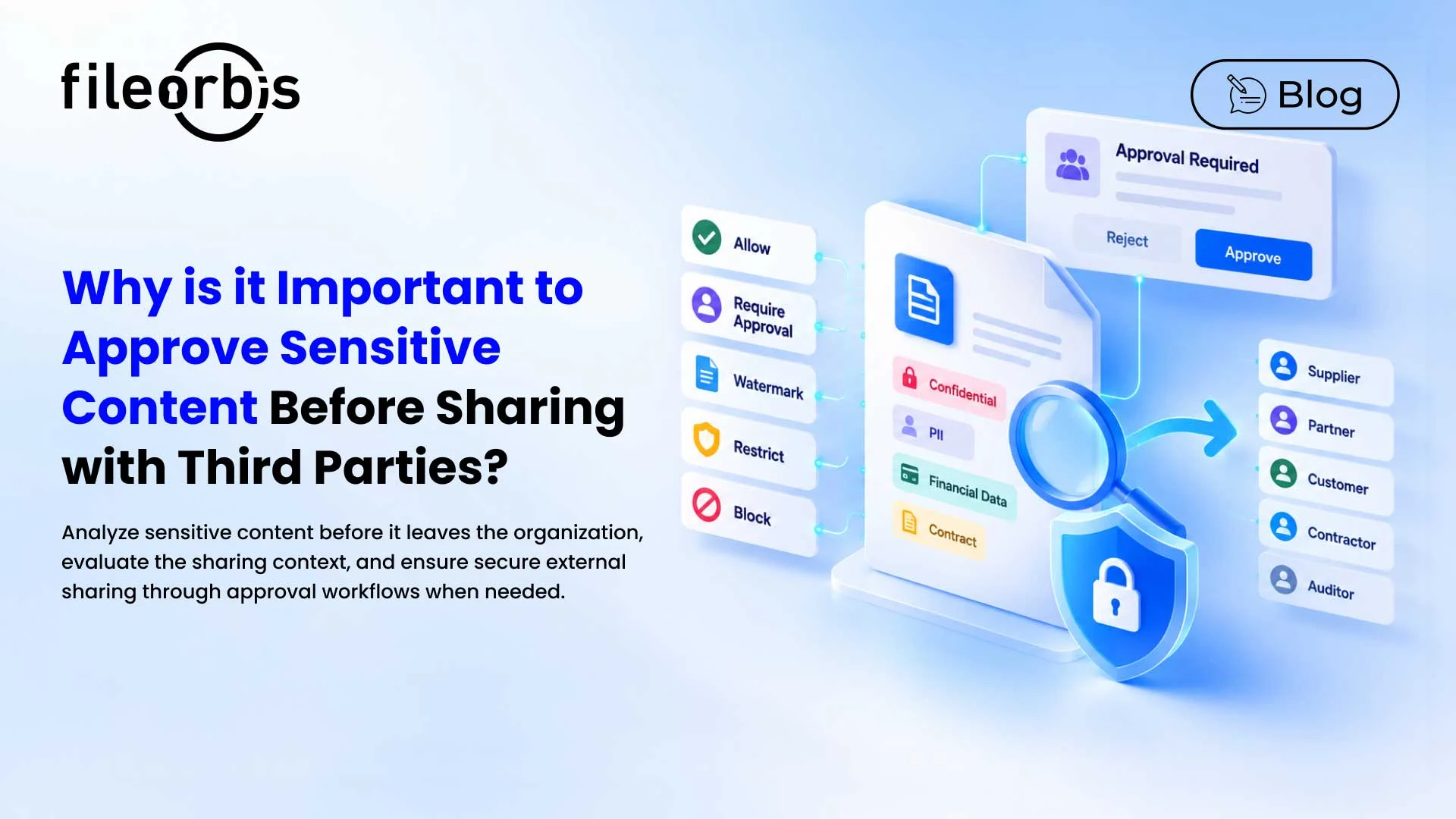
With content-aware sharing, organizations can evaluate the content and context of a file before deciding what to do. Depending on policy, a sharing request might be:
- Allowed
- Restricted
- Routed for Approval
- Watermarked
- Blocked
This allows for stronger controls to be applied when sensitive information is identified, rather than treating every file the same way.
When Should Content Require Approval?
Organizations can define approval requirements based on their security, governance, and business policies.
Approval may be appropriate when:
- Personally identifiable information (PII), financial data, or other sensitive information is detected.
- Confidential HR, Finance, Legal, or R&D content is shared.
- A file has a sensitive classification or label.
- The destination does not meet the policy defined for the content.
- The recipient is an external user, supplier, contractor, or guest.
- A specific department or document type requires authorization.
- The sharing action conflicts with predefined data processing rules.
The goal is not to require approval for every file, but to identify sharing activities where the content or context poses additional risk.
How Content-Aware Approval Works
A content-aware approval process can add a direct security control point to the sharing workflow:
- A user initiates a third-party sharing request.
- The file is inspected for sensitive content.
- Relevant security and governance policies are applied.
- Classification, user, metadata, recipient, and sharing context are evaluated.
- Sensitive or policy-matched content is routed to the appropriate approver.
- The file is shared after the necessary authorization is granted.
- The approval decision and sharing activity are logged.
This makes approval a part of the sharing process, rather than a separate manual control that can easily be overlooked.
Move the Decision to the Point of Sharing
Sensitive data protection is most effective when controls are applied before information leaves the corporate environment.
Content-aware controls directly link the sharing decision to the sensitivity of the information.
For example:
- Public content: Allow sharing
- Sensitive content: Require approval
- Internal content: Apply standard sharing controls
- Restricted content: Block third-party sharing
This creates a direct connection between content sensitivity, corporate policy, and the final sharing decision.
How FileOrbis Helps
FileOrbis brings together content inspection, approval workflows, policy enforcement, and secure sharing.
Organizations can define approval policies based on:
- File content
- User or department
- Classification and metadata
- Sensitive data
- Sharing destination
- File location
- External recipient
- Organizational policy
When predefined conditions are met, FileOrbis can initiate an approval workflow before a file is shared. Approval can also work in conjunction with controls such as watermarking, policy-based blocking, sharing restrictions, and audit logging.
This helps organizations control not only who can access information, but also whether sensitive content should be shared and who should approve it first.
In Summary
Approving sensitive content before sharing provides organizations with a critical control point before information leaves the corporate environment.
Instead of relying only on file access permissions, enforce appropriate policies, content-aware sharing allows organizations to assess what is being shared, and require approval when additional authorization is needed.
With FileOrbis, sensitive content can be inspected, approved, governed, and logged before sharing, helping organizations maintain control without applying unnecessary approval requirements to every file.
Frequently Asked Questions
Why is approval important before sharing sensitive content?
Approval establishes a security and governance control point before sensitive information leaves the organization. It allows the content and sharing context to be evaluated against defined policies before external distribution is authorized.
Does every file need to be approved before sharing?
No. Approval can be triggered based on content sensitivity, classification, destination, recipient, or other policy conditions. Lower-risk content can go through standard sharing processes.
What is content-aware approval?
Content-aware approval evaluates factors such as file content, sensitive data, user, metadata, classification, recipient, and sharing destination to determine whether authorization is required before a file is shared.

Faris Suleiman
Presales Manager, KSA & Egypt
Subscribe to our Newsletter
About FileOrbis
Aiming to manage the user and file relationship within an institutional framework, FileOrbis is constantly being developed in order to meet different industry and customer needs in terms of file management and sharing. Since 2018, FileOrbis continues to be developed with the excitement of the first day. FileOrbis focuses on high security, rich integration, ease of use and integrated management criteria.