
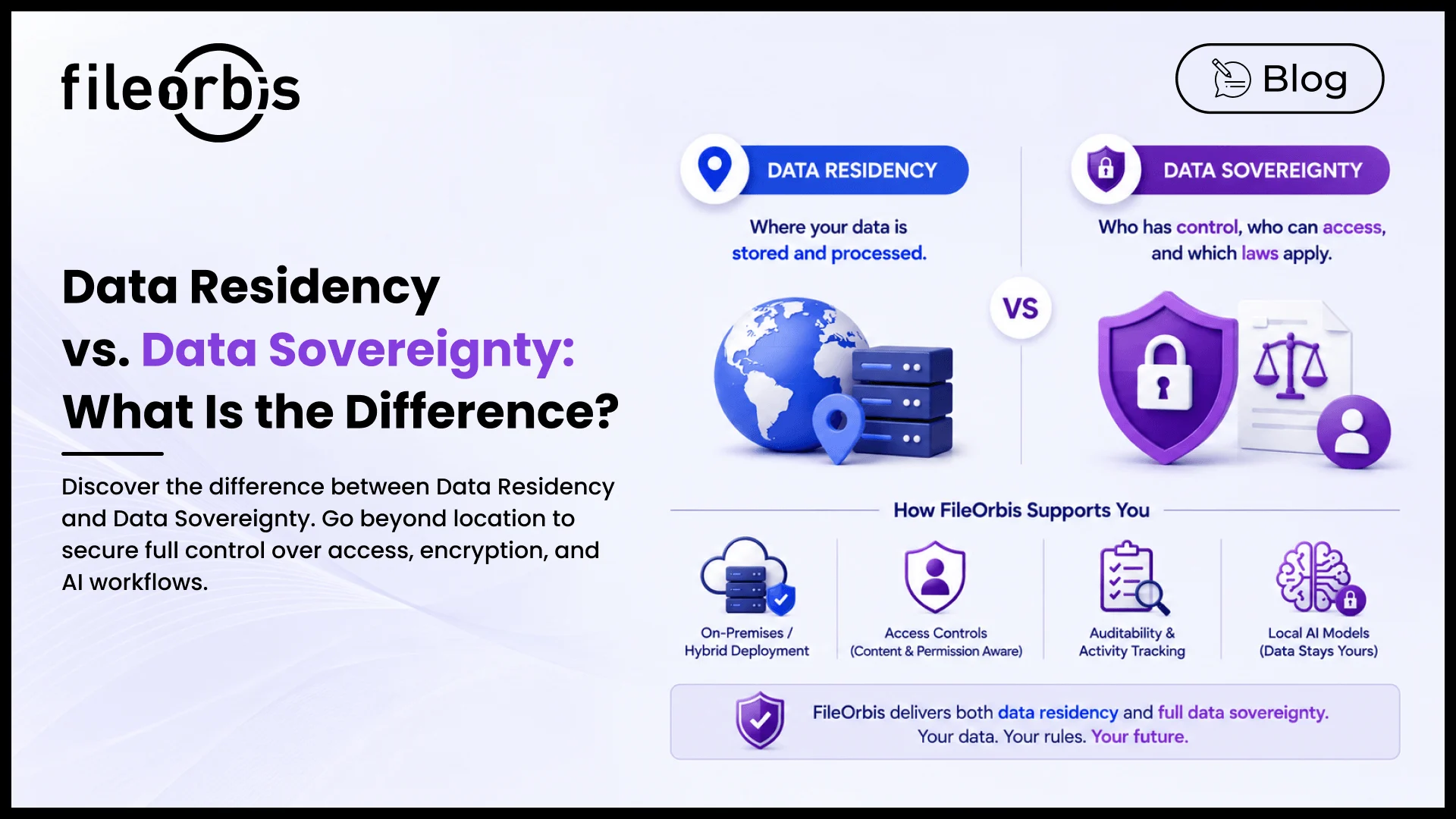
Data Residency vs Data Sovereignty: What is the Difference?
For enterprise IT and cybersecurity teams, data residency vs data sovereignty is an important distinction. Both affect compliance, cloud architecture, vendor selection, and data governance, but they address different questions.
The simplest distinction is:
- Data residency: Where is the data stored and processed?
- Data sovereignty: Which laws apply to the data, and who ultimately controls it?
An organization can meet a residency requirement by keeping data within a specific country or region while still facing sovereignty concerns around provider jurisdiction, access, encryption keys, or external processing.
Data Residency vs. Data Sovereignty at a Glance
- Focus: Residency is about geographic location; sovereignty is about jurisdiction and control.
- Requirement: Residency typically determines where data must remain. Sovereignty addresses who can access, govern, and process it.
- Infrastructure: Residency may be addressed with region-pinned hosting or local data centers. Sovereignty can require stronger control through on-premises or private infrastructure and customer-controlled governance.
- Evidence: Residency requires proof of location. Sovereignty requires broader evidence of location, access, processing, and control.
In short: residency is about where; sovereignty is about where, who, and under which laws.
What Is Data Residency?
Data residency refers to where an organization’s data is geographically stored or processed.
Organizations may need to keep sensitive information within the EU, Saudi Arabia, UAE, Canada, UK, or another required jurisdiction. Some may need to keep it entirely on-premises.
But residency is not only about the primary file. Enterprises should also understand where these elements reside:
- Metadata and backups
- Audit logs and search indexes
- Encryption keys
- Automated processing
This is particularly important for financial services, government, healthcare, and critical infrastructure organizations operating under strict regulatory or contractual requirements.
What Is Data Sovereignty?
Data sovereignty goes beyond physical location. It concerns which laws govern the data and whether the organization maintains effective control over it.
Enterprises therefore need to ask:
- Who operates the infrastructure?
- Which jurisdiction applies to the provider?
- Who can administratively access the data?
- Who controls encryption keys?
- Where are metadata and logs maintained?
- Can these controls be demonstrated to auditors?
A file can therefore reside in the required country without necessarily providing the level of sovereign control a regulated organization needs.
Common Misconceptions
“If data stays in-country, we have sovereignty.”
Not necessarily. Provider jurisdiction, administrative access, encryption keys, and processing locations can still matter.
“Selecting a cloud region solves residency.”
Not always. Organizations should verify whether content, metadata, backups, logs, and processing remain within the required boundary.
“Data sovereignty means everything must be on-premises.”
No. Depending on regulatory requirements, on-premises, single-tenant private cloud, region-pinned, and hybrid architectures can all play a role. The objective is the required level of location, jurisdiction, access, and governance control.
What About Enterprise AI?
Enterprise AI makes the distinction even more important.
A sensitive file may remain on-premises, but if its content is sent to an external AI model, processing may occur outside the organization’s controlled environment.
This introduces AI residency: keeping AI processing within the required infrastructure or jurisdiction.
FileOrbis supports permission-aware and content-aware enterprise RAG with local-model options, helping organizations keep sensitive AI workloads within controlled environments.
When Is Residency Enough and When Is Sovereignty Necessary?
Residency may be sufficient when:
- Requirements primarily specify geographic boundaries.
- Provider jurisdiction and access are acceptable.
- Data location can be demonstrated to auditors.
Broader sovereignty controls may be necessary when:
- Government, financial, or critical infrastructure data is involved.
- Foreign legal access represents a risk.
- Customer-controlled encryption is required.
- Sensitive data or AI processing must remain within organizational boundaries.
The more regulated the workload, the less sufficient “our data is hosted in this region” becomes.
How FileOrbis Supports Data Residency and Sovereignty
FileOrbis helps enterprises control both where sensitive files live and how they are governed through:
- On-premises, private-cloud, and hybrid deployment
- In-place governance without forcing file-server migration
- Content-aware and permission-aware controls
- Auditable file activity
- AI residency with local-model options
This allows organizations to combine data-location requirements with broader governance and sovereignty controls.
The Takeaway
For enterprise IT and security teams, data location should be the starting point, not the end of the assessment. A strong governance strategy should also evaluate jurisdiction, administrative access, encryption-key control, auditability, and AI processing.
For regulated organizations, the goal is to ensure sensitive data remains both appropriately located and demonstrably under organizational control.
Frequently Asked Questions
Does data residency guarantee data sovereignty?
No. Local storage does not automatically address provider jurisdiction, access, encryption keys, or external processing.
Does data sovereignty require on-premises deployment?
Not always. Private-cloud, region-pinned, and hybrid architectures may also meet sovereignty requirements depending on the organization’s regulatory and risk requirements.
How does FileOrbis support data residency and sovereignty?
FileOrbis supports data residency with on-premises, private-cloud, and region-specific deployment options that help keep sensitive data within required geographic boundaries. For data sovereignty, it adds content-aware governance, permission-aware access, audit trails, and customer-controlled deployment options, giving enterprises greater control over where data resides, who can access it, and how it is governed.

Gamze Mat
Product Manager
Subscribe to our Newsletter
About FileOrbis
Aiming to manage the user and file relationship within an institutional framework, FileOrbis is constantly being developed in order to meet different industry and customer needs in terms of file management and sharing. Since 2018, FileOrbis continues to be developed with the excitement of the first day. FileOrbis focuses on high security, rich integration, ease of use and integrated management criteria.