
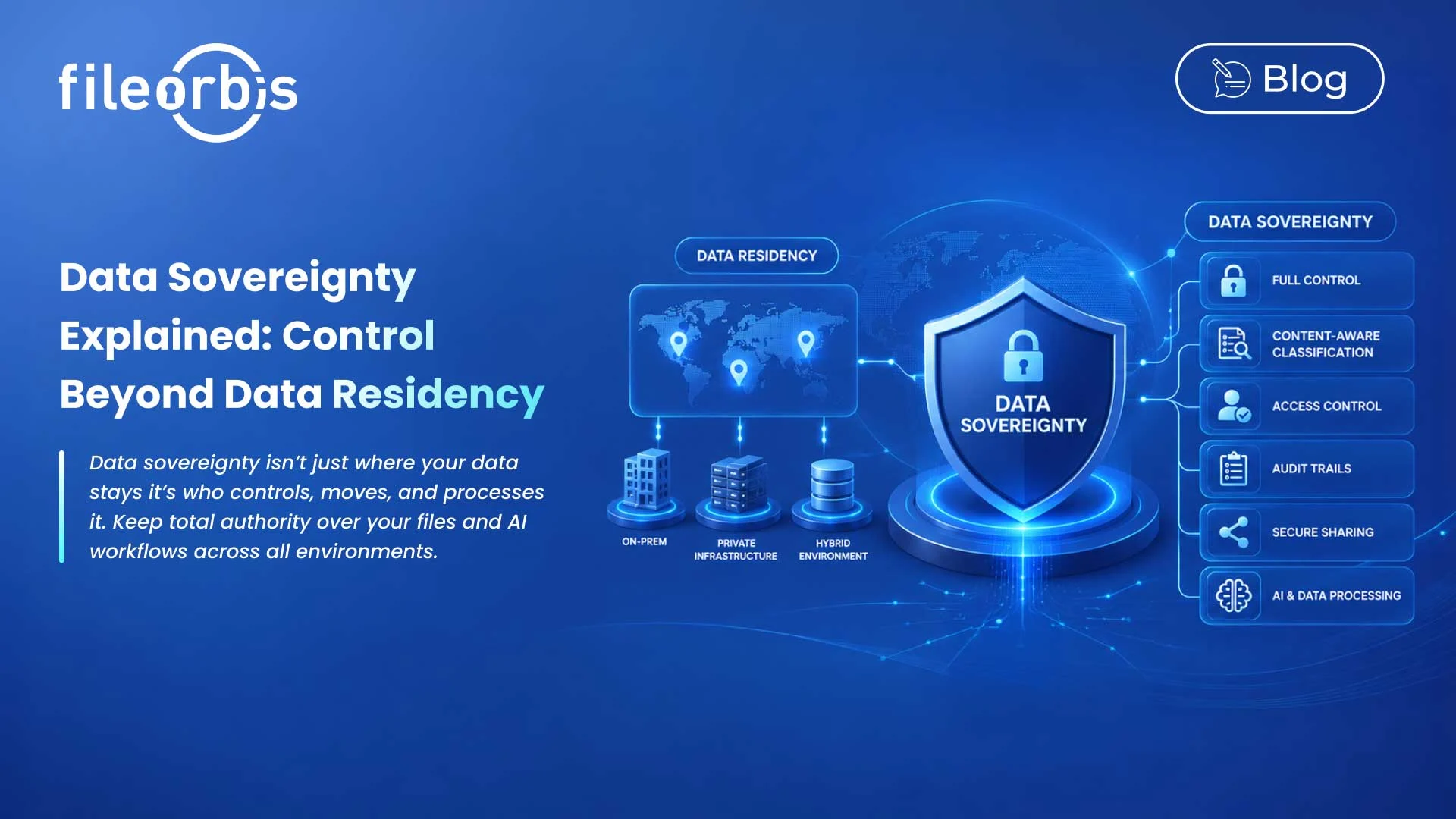
Data Sovereignty Explained: Control Beyond Data Residency
Knowing where enterprise data is stored is important. However, location alone does not determine who can access the data, what laws apply, where it can be processed, or whether it can be moved beyond its intended scope.
Therefore, data sovereignty extends beyond where the data resides. For enterprises, sovereignty means maintaining control over data throughout its entire lifecycle, including storage, access, processing, sharing, transportation, and increasingly, AI workloads.
What Is Data Sovereignty?
Data sovereignty refers to the principle that data should be govern to applicable legal jurisdictions but remain under defined institutional control.
For enterprise data, this means being able to identify and implement the following:
- Where the data is stored
- Where and how the data is processed
- Who can access it
- Which jurisdiction applies
- Whether it can be shared or transferred
- Which governance and security policies are in place
- How access and movement are controlled
Data Sovereignty vs. Residency, Ownership, Localization, and Jurisdiction
Although these terms are related, they describe different aspects of enterprise data control.
- Data sovereignty: Control over the access, processing, location and movement of data.
- Data residency: Where data is stored physically or logically.
- Data ownership: Who has rights and responsibilities regarding the data.
- Data localization: The requirement to keep specific data within a particular geographical boundary.
- Data jurisdiction: Which legal or regulatory authorities can apply rules to data.
A company can fulfill the residency requirement by storing data in a specific region; however, it may not have complete sovereignty over how the data is accessed or processed.
Why Data Location Alone Is Not Enough
Choosing the right country or cloud region answers the question: Where is the data stored?
It does not automatically answer a few other questions:
- Can administrators or third parties outside the region access the data?
- Where are metadata, logs, indexes, and backups stored?
- Where is the data processed by applications or AI models?
- Can users move sensitive files to another location?
- Which organizations control the encryption keys?
- Can the organization prove who accessed, modified, or shared the data?
Therefore, data sovereignty requires control that goes beyond the location of storage.
The Meaning of Data Sovereignty for Enterprise Files
Enterprise files make file sovereignty particularly challenging because unstructured data is distributed across file servers, NAS systems, M365, private clouds, and other repositories.
Therefore, effective sovereignty requires control at various levels:
- Location and processing control: Controlling where sensitive data is located and processed.
- Permission control: Ensure access complies with identity, role, and minimum privilege requirements.
- Movement control: Manage downloads, external sharing, and cross-media transfers.
- Content-aware governance: Identify sensitive information and enforce policies based on file content.
- Auditability: Make it visible who accesses, shares, moves, or modifies information.
Data Sovereignty in Hybrid Infrastructure
Enterprise data is typically distributed across file servers, Microsoft 365, private cloud, and other storage environments. Instead of centralizing everything, organizations need consistent governance across these environments
A hybrid strategy focused on sovereignty should provide the following:
- Centralized visibility into distributed enterprise files
- Consistent policies across on-premises and cloud environments
- Content-aware classification and policy enforcement
- Permission-aware access based on existing identity structures
- Unified auditability across repositories
- Controlled file sharing
Extending Data Sovereignty to AI
Enterprise AI also raises another sovereign question: Where is the data being processed?
Even if files remain in an approved prompts, location, placements, or file contents may be processed elsewhere. Therefore, organizations need to have control over:
- Where AI models operate
- Which enterprise files AI can access
- Where embedded vectors and indexes are stored
- Which users can access information via AI
- Whether sensitive content crosses corporate or judicial boundaries
Therefore, data sovereignty should extend from storage to AI processing.
How FileOrbis Helps Enterprises Maintain Data Sovereignty?
FileOrbis helps enterprises transform data sovereignty from a location requirement into a viable governance model. It provides control over where enterprise files reside, who can access them, how they are shared and processed, and how these activities are monitored across on-premises, hybrid, and private cloud environments.
Key capabilities include the following:
- Distribution and location control: Deploy FileOrbis on-premises, in a private cloud, or in hybrid environments to keep sensitive files within the necessary infrastructure and authorization levels.
- On-premise governance: Govern existing file servers and repositories without moving sensitive data to a new cloud or storage location.
- Content-aware governance: Discover and classify sensitive data, then apply security and governance policies based on file content.
- Lifecycle governance: Apply retention, archiving, deletion, and moving policies consistently throughout the file lifecycle.
- Permission-aware access: Apply existing identity and permission structures to ensure users can only access files for which they are authorized.
- Controlled data transfer: Govern external sharing, file transfers, and downloads with policy-based controls, approvals, and revocable access.
- Centralized auditability: Monitor file access, changes, sharing, and governance actions to provide visibility and demonstrate control.
- Governed AI access: Extend content-aware and permission-aware controls to enterprise AI and RAG, while also supporting local AI processing where sovereignty requirements necessitate.
In Summary
Data sovereignty isn’t just about location; it’s about control. Enterprises need governance over where data resides, who can access it, how it moves, and where it’s processed, including within hybrid infrastructure and AI workflows.
Frequently Asked Questions
Are data sovereignty and data residency the same thing?
No. Data residency defines where data is stored. Data sovereignty, on the other hand, is broader and encompasses legal jurisdiction and organizational controls over how data is stored, accessed, moved, and processed
Why is data residency alone insufficient?
Because location alone does not control access, movement, processing, or the use of AI. Data sovereignty controls it.
How can businesses protect data sovereignty in hybrid environments?
By implementing consistent permission, content, location, movement, and audit controls across on-premises and cloud repositories, rather than relying on where each file is stored.

Gamze Mat
Product Manager
Subscribe to our Newsletter
About FileOrbis
Aiming to manage the user and file relationship within an institutional framework, FileOrbis is constantly being developed in order to meet different industry and customer needs in terms of file management and sharing. Since 2018, FileOrbis continues to be developed with the excitement of the first day. FileOrbis focuses on high security, rich integration, ease of use and integrated management criteria.