
Governance Meets Immutable Storage: Protecting Business-Critical Records Beyond the Application Layer
Organizations create, share, and manage millions of documents every day. While many of these files support routine business operations, others become critical business records that must be preserved for legal proceedings, internal investigations, regulatory audits, or compliance requirements. In these situations, organizations must ensure that records remain complete, authentic, and unaltered throughout their required retention period.
Most enterprise content management and file-sharing platforms address this challenge through user permissions, delete restrictions, or retention policies. These controls are highly effective for everyday operations, but they typically enforce protection only at the application layer. If an administrator has direct access to the storage infrastructure, or if a storage configuration is accidentally modified, application-level controls alone may not be sufficient to guarantee record integrity.
True Protection Starts at the Storage Layer
The strongest approach to protecting business-critical records is to extend protection beyond the application and enforce it directly within the storage infrastructure.
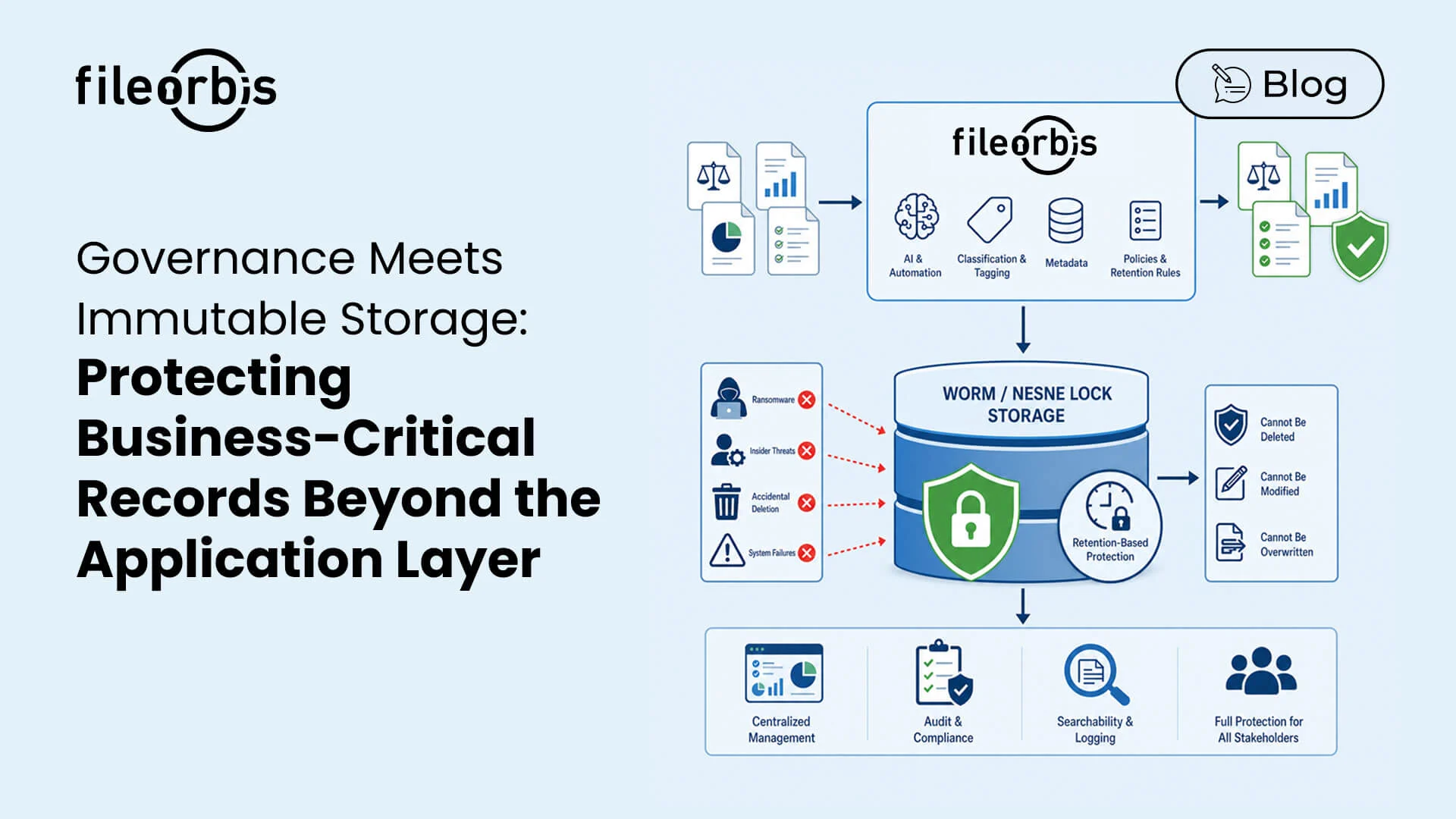
FileOrbis Governance follows this principle by allowing organizations to identify sensitive or business-critical content through governance policies, metadata, AI-driven classification, or manual labels.
For example, organizations can automatically protect:
- Documents related to legal proceedings
- Internal audit records
- Financial reports
- Board meeting documents
- Regulatory records
- Compliance archives
- Digital evidence and investigation files
Once classified, these records are managed through centralized governance policies without requiring manual intervention.
From Governance Policies to Immutable Storage
Identifying critical records is only the first step.
FileOrbis Governance continuously evaluates content against predefined policies and automatically applies additional protection when required. Through integration with enterprise immutable storage platforms, FileOrbis can automatically place selected records onto WORM (Write Once Read Many) or immutable storage that prevents unauthorized modification or deletion.
At this point, the file is no longer protected solely by the application—it becomes protected by the storage platform itself.
This means the protected record:
- Cannot be deleted
- Cannot be modified
- Cannot be overwritten
- Remains protected until the configured retention period expires
Unlike traditional permission-based controls, these restrictions are enforced directly by the underlying immutable storage platform, providing storage-level protection rather than relying solely on application-level controls.
Why Immutable Storage Matters
Immutable storage is designed for organizations that require tamper-resistant preservation of critical business records.
Using technologies such as WORM (Write Once Read Many) or Object Lock, immutable storage ensures that protected files remain unchangeable throughout their defined retention period. Once a file is committed to immutable storage, neither standard users nor privileged administrators can modify or remove it until the retention period expires.
This provides a significantly stronger level of protection than application-only controls and helps organizations satisfy demanding regulatory, governance, and legal preservation requirements while maintaining the integrity of critical business information.
When combined with FileOrbis Governance, organizations benefit from intelligent policy-driven classification together with storage-enforced immutability.
Additional Protection Against Human Error and Administrative Risks
Cyberattacks are not the only threat to enterprise data. Organizations also face risks from accidental deletions, administrative mistakes, misconfigured retention policies, and insider threats.
Storage-level immutability dramatically reduces these risks by ensuring that protected records cannot be altered, even when privileged administrative access exists.
This approach is particularly valuable for:
- Preserving evidence during legal proceedings
- Protecting internal and external audit documentation
- Retaining financial records for regulatory compliance
- Securing forensic logs and digital evidence following cybersecurity incidents
- Preserving official government and public-sector records
- Protecting business-critical information against ransomware and malicious deletion attempts
Centralized Governance with End-to-End Traceability
Protection involves more than simply preventing deletion.
FileOrbis Governance enables organizations to centrally manage:
- Which records require immutable protection
- The policies that trigger protection
- Retention periods
- Classification rules
- Audit and compliance workflows
Every protection event is recorded through comprehensive audit logging, providing full traceability for compliance reviews, regulatory audits, and internal governance processes.
A Layered Protection Strategy
The combination of FileOrbis Governance and enterprise immutable storage creates a layered protection model.
FileOrbis determines what should be protected through intelligent governance policies, while the underlying immutable storage platform determines how those records are protected by enforcing immutability at the storage layer.
This separation of responsibilities provides organizations with greater flexibility, stronger security, and significantly higher resilience against both operational mistakes and malicious activity.
Conclusion
Protecting critical records requires more than restricting user permissions or preventing file deletion within an application. True resilience is achieved when governance policies are reinforced by immutable storage technologies.
By combining FileOrbis Governance with enterprise immutable storage, organizations can automatically identify sensitive records and ensure they are preserved on storage specifically designed to prevent unauthorized modification or deletion.
The result is a comprehensive protection strategy that safeguards business-critical information against human error, privileged administrative actions, cyber threats, and infrastructure-level risks—while supporting long-term compliance, audit readiness, and enterprise information governance.

Gamze Karslı
Head of Marketing
Subscribe to our Newsletter
About FileOrbis
Aiming to manage the user and file relationship within an institutional framework, FileOrbis is constantly being developed in order to meet different industry and customer needs in terms of file management and sharing. Since 2018, FileOrbis continues to be developed with the excitement of the first day. FileOrbis focuses on high security, rich integration, ease of use and integrated management criteria.