
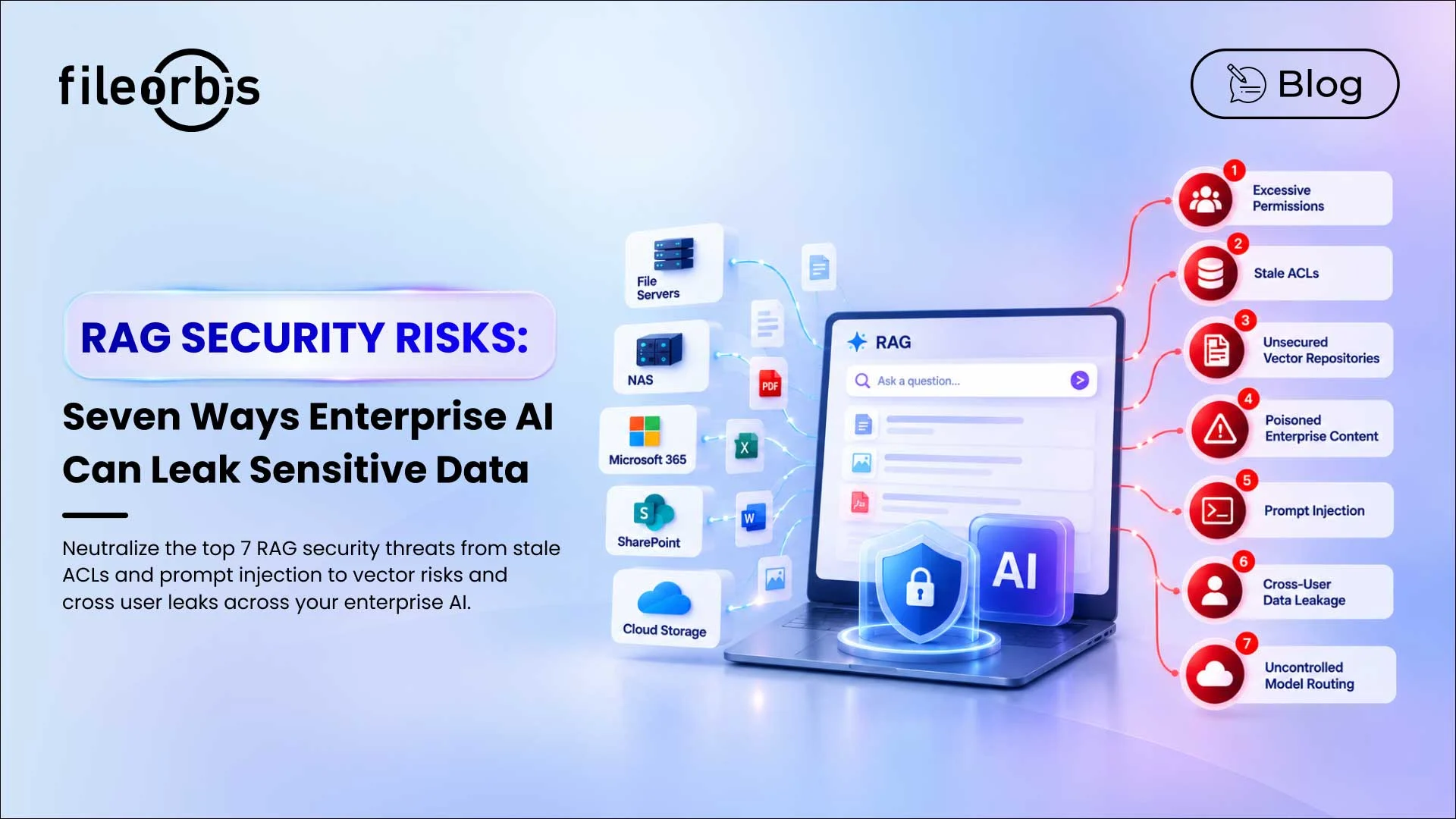
RAG Security Risks: Seven Ways Enterprise AI Can Leak Sensitive Data
Retrieval-Augmented Generation (RAG) allows enterprise AI systems to answer queries using internal documents, file shares, NAS, SharePoint, and other repositories.
However, connecting AI to enterprise content also creates a new security problem: the model could retrieve or expose information that the requesting user shouldn’t see.
Therefore, effective RAG security requires controls throughout the entire content access path, from source repositories and permissions to data retrieval, models, prompts, and responses.
Here are seven RAG security risks that enterprises need to address.
Excessive Permissions
RAG can amplify existing access problems in enterprise repositories.
If very large groups have access to sensitive files, AI can make this information much easier to discover.
Control goal: Apply the principle of least privileged access before enterprise content is presented to AI.
Practical measures:
- Identify sensitive files with excessive access
- Review users, groups, and inherited permissions
- Prioritize remediation for sensitive and broadly accessible data
- Remove unnecessary access
RAG should not turn existing permission weaknesses to create faster access routes to sensitive information.
Stale ACLs
A user might lose access to a file while the AI index still reflects an outdated permission status.
This creates a dangerous gap between the resource store and the RAG system.
Control goal: Keep AI access consistent with current resource permissions.
Practical measures:
- Synchronize ACL changes with the access layer
- Apply security trimming at query time
- Maintain resource permissions at indexing time
- Update or remove indexed content when access changes
Authorization should reflect the permissions existing when the user submitted the query, not when the document was first indexed.
Insecure Embedded Data and Vector Repositories
Enterprise documents are often converted into fragments and embedded data for semantic access.
These derived assets may still contain or represent sensitive information and should not be treated as harmless technical data.
Control goal: Protect vectorized content with appropriate controls to the source information.
Practical measures:
- Restrict access to vector repositories
- Separate sensitive datasets if necessary
- Protect permission and classification metadata
- Encrypt stored embedded vectors
- Restrict access to retrieval and embedding services
If derived AI data remains widely accessible, protecting the original document is not enough.
Poisoned Enterprise Content
RAG systems rely on the quality and integrity of source content.
Compromised, malicious, or manipulated documents can enter the search pipeline and influence AI-generated responses.
Control goal: Ensure only trusted and governed enterprise content enters the RAG knowledge base.
Practical measures:
- Limit content retrieval to approved repositories
- Classify and validate content before indexing
- Scan uploaded files
- Monitor unexpected content changes
- Track document source, provenance, and ownership
Prompt Injection Through Retrieved Content
Malicious instructions can then be embedded within documents retrieved by the RAG system.
The model may interpret these instructions as commands rather than corporate content.
Control goal: Treat retrieved documents as untrusted data, not as executable instructions.
Practical measures:
- Review prompts and retrieve content
- Identify suspicious or hidden instructions
- Apply AI guardrails
- Separate system instructions from retrieved data
- Validate responses before returning them
User-to-User Data Leakage
A RAG system might retrieve the correct document for a question but the wrong document for the person asking the question.
This can expose restricted content across users, business units, departments, or tenants.
Control goal: Enforce the authorization of the requesting user during the retrieval process.
Practical measures:
- Authenticate the requesting user
- Filter retrieval results according to valid permissions
- Prevent unauthorized filenames, metadata, code snippets, and quotes from appearing
- Protect tenant and organization boundaries
- Control which sources contributed to each response
The authorization decision should be made before the restricted content model is reached.
Uncontrolled Model Routing
Enterprise AI architectures can utilize multiple cloud, private or on-premises models.
Without routing controls, sensitive content could be sent to a model or processing environment unapproved for that data.
Control goal: Control which AI services can process different categories of enterprise information.
Practical measures:
- Identify approved models and providers
- Restrict access to sensitive data from unauthorized external models
- Route content according to classification
- Support private or local models where necessary
- Log model targets and AI interactions
- Apply masking or anonymization where appropriate
A Practical RAG Security Model
A secure enterprise RAG should implement controls throughout the entire data path:
- Enterprise Repositories
- Discovery
- Classification
- Access Controls
- Secure Retrieval
- AI Security Controls
- Approved Model
- Governed Response
Organizations should be able to answer the following questions:
- Which enterprise content can AI access?
- Are source permissions still valid?
- Who can retrieve each document?
- Where are embedded files stored?
- Can the retrieved content model be manipulated?
- Which models can process sensitive data?
- Can AI responses be traced back to their sources?
How FileOrbis Helps
FileOrbis extends file management controls to enterprise AI environments without requiring organizations to migrate their existing repositories.
Organizations can:
- Discover and classify sensitive enterprise files
- Identify and remediate over access
- Apply content-aware controls to sensitive information
- Enforce existing file permissions during AI ingestion
- Keep retrieval aligned with existing access rights
- Govern AI access in existing enterprise repositories
This ensures that AI access follows the same security context as enterprise content by combining file management with content-aware and permission-aware RAG.
In Summary
RAG security is fundamentally about enterprise content access.
Securing the model alone is not enough. Organizations must govern what content AI can access, how derived data is protected, who can access it, and where sensitive information can be processed.
The goal is simple: AI should never reveal enterprise information that the requesting user does not have access authorization to.

Emre Demiray
Founder – FileOrbis
Subscribe to our Newsletter
About FileOrbis
Aiming to manage the user and file relationship within an institutional framework, FileOrbis is constantly being developed in order to meet different industry and customer needs in terms of file management and sharing. Since 2018, FileOrbis continues to be developed with the excitement of the first day. FileOrbis focuses on high security, rich integration, ease of use and integrated management criteria.