
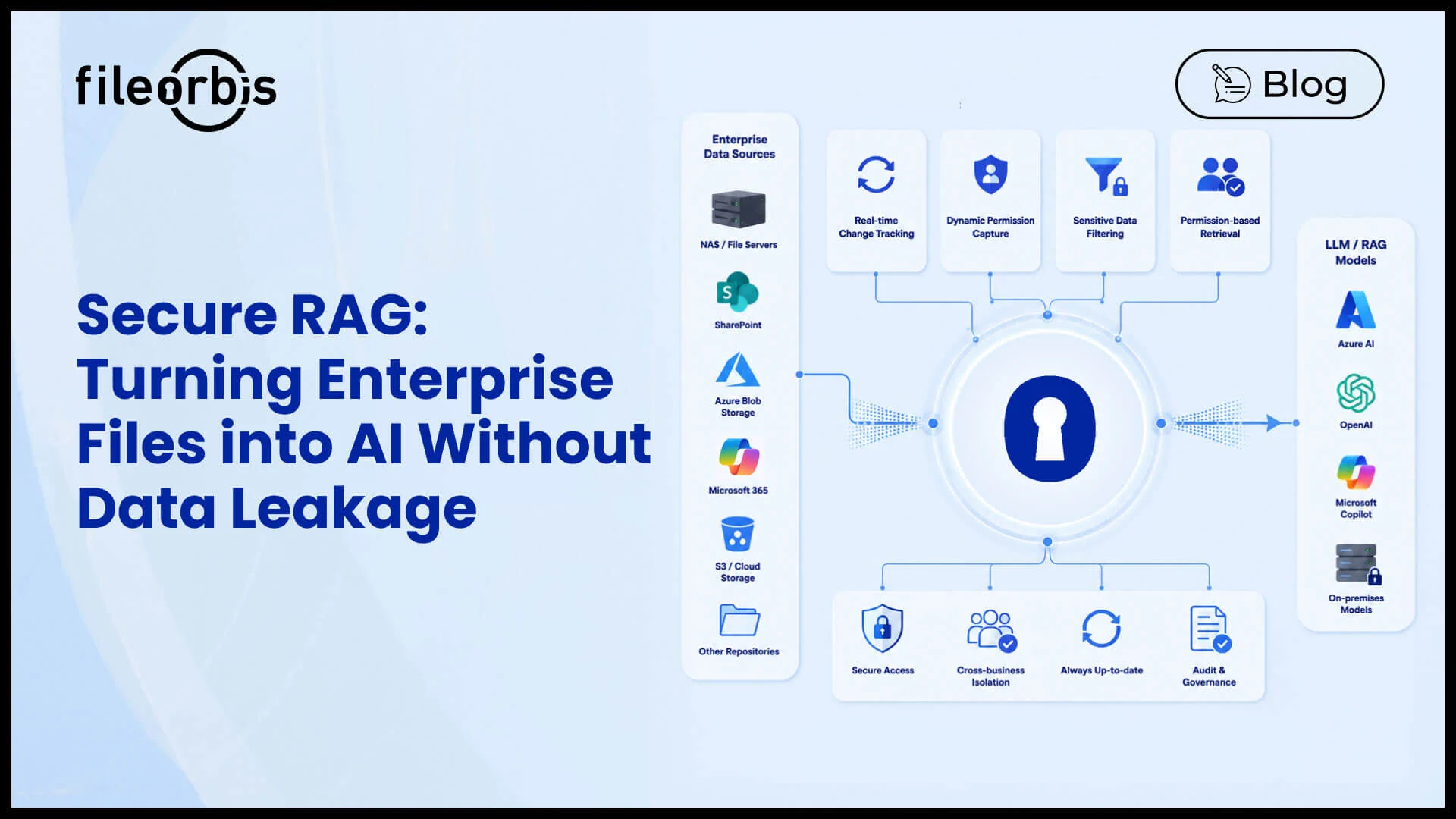
Secure RAG: Turning Enterprise Files into AI without Data Leakage
Every enterprise wants the same thing from AI: a system that can answer questions using its own documents, contracts, reports, and shared drives. The technology to do this, Retrieval-Augmented Generation (RAG), is no longer the hard part. Capable models are everywhere, and connecting one to a vector database is a weekend project.The hard part is doing it without quietly turning your file estate into a data breach.
The Problem Isn’t the Model. It’s the Copy.
A typical RAG pipeline works by copying your files somewhere else: extracting text, splitting it into chunks, generating embeddings, and storing all of it in a vector index that the AI can search. The moment that copy is created, three things tend to go wrong at once:
- Permissions are lost: The folder structure, the NTFS ACLs, and the team folder boundaries that took years to get right do not survive the trip into a generic vector store. The AI can now retrieve a sentence from a board pack or an HR file for any user who asks the right question.
- Sensitive data goes along for the ride: National IDs, account numbers, salary figures, and unreleased financials get embedded and indexed with no filter in between.
- The copy goes stale: The source file changes, a permission is revoked, an employee leaves, but the embedded version keeps answering as if nothing happened.
For a regulated organization, that combination is unacceptable. It is also entirely avoidable.
A Governed Feeder, Not a One-Time Dump
FileOrbis approaches enterprise AI from the file-governance side rather than the model side. Instead of bulk-exporting your data into an unmanaged index, it continuously feeds AI pipelines from the source and carries the governance along with the content.
This governed feeding process is built upon key capabilities:
- Real-time change feeding: Keeps the AI’s knowledge current. As files are created, modified, or moved across your integrated systems, including Windows file servers, NAS, S3, Azure Blob, SharePoint, and SFTP, those changes are reflected without a manual re-index.
- Dynamic permission capturing: When a file’s permissions change, that change is captured too, so access decisions stay aligned with the source of truth rather than a snapshot from last quarter.
- Sensitive-data filtering: A filter sits in the path before content is ever exposed to a model. Content that matches your sensitive-data templates or custom patterns can be masked, anonymized, or excluded outright, so the AI works with the meaning of a document without ever surfacing the raw secret inside it.
Retrieval That Respects Who’s Asking
The most important property of a secure RAG system is also the one most pipelines skip: the answer a user gets should never contain anything that user couldn’t already open.
- Permission-trimmed retrieval: Because FileOrbis already understands the permission model of every connected file system, it can filter candidate content against the requesting user’s actual access rights at query time. Two employees can ask the same question and correctly receive different answers, because the platform knows what each of them is allowed to see.
- Overcoming oversharing: While systems like M365 Copilot inherit a tenant’s oversharing problems, FileOrbis evaluates access against governed, deliberately maintained permissions rather than years of accumulated drift.
- Tenant and unit isolation: Deployments can be isolated per business unit or per customer, with role-based access control enforced end to end, so a multi-tenant AI service never leaks context across boundaries.
Bring Your Own Model
Secure RAG shouldn’t lock you into one provider. FileOrbis connects to the AI services you already use or plan to adopt, including Azure AI, OpenAI, and Microsoft Copilot, and can sit in front of self-hosted or private models for organizations that need data to stay entirely on premises. The governance layer stays the same regardless of which engine answers the question.
The Takeaway
Enterprise AI fails on data, not on intelligence. An assistant that occasionally exposes the wrong salary figure or the wrong M&A memo will be switched off no matter how good its answers are the rest of the time.
The goal is an AI that knows exactly what each user is allowed to know, and nothing more. That is what a governed feeder, content-aware filtering, and permission-trimmed retrieval deliver: the productivity of RAG, without handing your file estate to a system that doesn’t understand it.
Want to enable AI on your enterprise content without losing control of it? Talk to FileOrbis about a governed AI deployment.

Gamze Karslı
Head of Marketing
Subscribe to our Newsletter
About FileOrbis
Aiming to manage the user and file relationship within an institutional framework, FileOrbis is constantly being developed in order to meet different industry and customer needs in terms of file management and sharing. Since 2018, FileOrbis continues to be developed with the excitement of the first day. FileOrbis focuses on high security, rich integration, ease of use and integrated management criteria.