
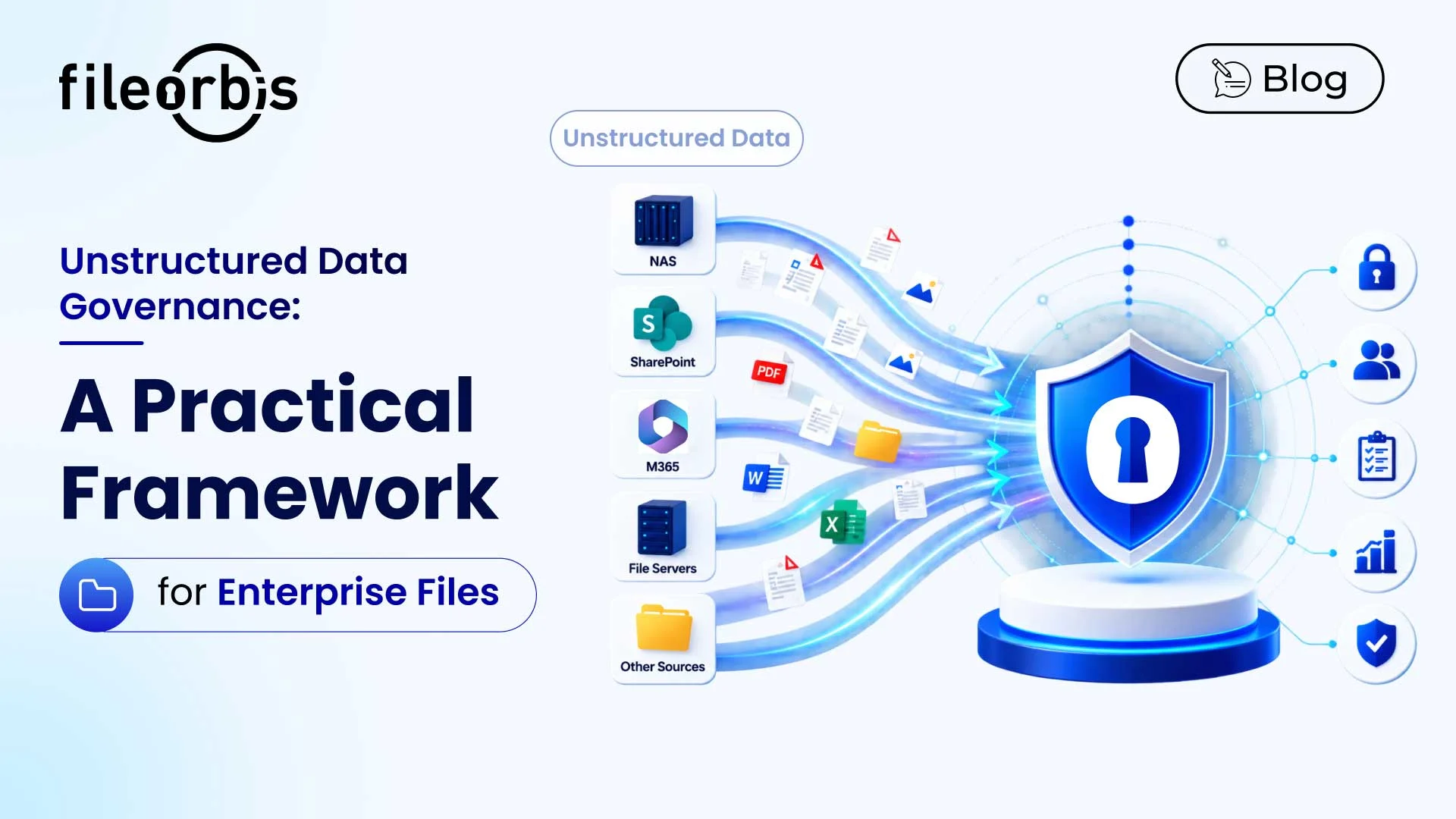
Unstructured Data Governance: A Practical Framework for Enterprise Files
Enterprise files are spread across file servers, object storage, NAS, M365, SharePoint, and cloud repositories, each with different policies, permissions, and audit capabilities.
As these environments expand, organizations may lose visibility into where sensitive data is located, who has access to it, and whether it is being managed consistently.
Unstructured data governance provides a framework for ownership, visibility, transparency, access control, lifecycle management, and responsibility for enterprise files, wherever they are stored.
What Is Unstructured Data Governance?
Unstructured data governance is a set of policies, processes, and controls used to manage corporate records throughout their lifecycle.
It helps organizations with the following:
- Identify where files and sensitive information are located
- Control who can access, modify, or share files
- Classify data based on sensitivity level and business context
- Determine ownership and responsibility
- Enforce retention, deleting, and archiving policies
- Maintain audit trails for compliance and security.
- Correct excessive permissions and risky data placements
The goal here is not only to be aware of the existence of data, but also to ensure that it can be managed throughout the entire process, from its creation to its destruction.
Why Is Enterprise File Governance Becoming Fragmented?
Enterprise storage environments change over time. File servers support existing workloads. NAS systems host departmental data. Object-based storage manages large volumes of data, while M365, SharePoint, and cloud repositories support collaboration.
This situation creates the following fragmented risks:
- Limited Visibility: Teams lack an integrated view of enterprise files.
- Unclear ownership: Identifying who owns sensitive or legacy files can be difficult.
- Inconsistent classification: Sensitive data may be identified in one repository, it may not be identified elsewhere.
- Inconsistent lifecycle policies: Rules regarding data retention and deletion vary across platforms.
- Fragmented auditing: Activity logs are fragmented across different systems.
- Permission distribution: Over time, inherited permissions and excessive access rights accumulate.
Governance becomes a process carried out separately for each data repository, rather than a control model applied across the entire organization.
A Practical Framework for Unstructured Data Governance
Organizations can build an effective unstructured data governance framework around centered on seven key areas.
Discover
Ensure visibility into enterprise file assets.
Identify files on file servers, NAS devices, object storage, M365, SharePoint, and cloud repositories. The process should provide contex such as permissions, ownership, risk, age, and location.
Classify
Not all files require the same level of protection.
Classify content based on sensitivity, business value, legal requirements, or internal policies. Existing tags, pattern matching, and AI-based content analysis can help identify information that requires stricter oversight.
Determining Ownership
Good governance requires accountability.
Determine which departments, users, or business functions are responsible for key datasets. Clearly defining ownership enables better decision-making regarding access, correction, retention, and disposal.
Govern Access
Sensitive data should only be provided to users who need it.
Review permissions regularly to identify:
- Excessive or inherited access
- Excessively authorized sensitive files
- Unnecessary external sharing
- Access that conflicts with data sensitivity
- Former users and groups
This helps organizations maintain the principle of least privileged access without disrupting legitimate business use.
Monitor the Data Lifecycle
Unstructured data shouldn’t remain indefinitely just because storage space is available.
Storage, transfer, archiving, and deletion policies may consider the following:
- Classification
- Ownership
- Repository or location
- Last access
- File age
- Regulatory requirements
Lifecycle management reduces unneeded data growth while keeping essential information accessible.
Remediate the Risk
Governance must go beyond simply identifying problems.
When organizations identify excessive permissions, misplaced sensitive files, unclaimed content, or dark data, solutions may include tightening permissions, moving files, archiving information, encrypting content, quarantining data, or securely deleting information.
Maintain Auditability
Governance actions should be traceable.
Organizations need records of file access, sharing, permission changes, lifecycle operations, policy enforcement, and remediation processes. Centralized audit record supports investigations, compliance reporting, and ongoing governance.
Unstructured Data Governance without Data Migration
Better governance doesn’t require moving each file to a new repository.
For large enterprises, the migration can increase cost and complexity. The governance layer provides consistent controls while keeping files in their current locations.
How FileOrbis Helps
FileOrbis provides a unified governance layer across existing file servers, NAS, object storage, M365, SharePoint, and cloud reporsitories, helping organizations achieve consistent governance practices without disrupting data migration.
FileOrbis combines the following capabilities:
- Unified discovery and visibility: Find sensitive data in data repositories.
- AI-based classification: Understand content sensitivity and governance policies.
- Permissions analysis: Identify risks of excessive access and permissions.
- Policy enforcement: Implement consistent governance controls.
- Content-aware lifecycle management: Control storage, archiving, and deletion processes.
- Centralized auditability: Track file activities and governance processes.
When organizations identify excessive permissions, misplaced sensitive data, or improper storage, FileOrbis DSPM Remediate helps remediate these risks across existing data environments.
Learn more about FileOrbis DSPM Remediate →
In Summary
Unstructured data governance is not a one-off classification project or permissions review. It is a process of discovering data, controlling access, understanding its sensitivity and ownership, managing its lifecycle, maintaining auditability and remediating risk.
For enterprises with files distributed across on-premises, cloud, and M365 environments, a unified governance layer helps enforce controls regardless of where the data resides.
Frequently Asked Questions
What is unstructured data governance?
Unstructured data management is the process of applying policies and controls to enterprise files throughout their lifecycles. It encompasses discovery, ownership, access, classification, retention, remediation, and auditability in distributed storage environments.
Why is governing unstructured data so difficult?
Unstructured data is typically distributed across file servers, NAS, object storage, M365, SharePoint, and cloud repositories. Different permissions, ownership models, policies, and control systems make consistent governance difficult.
What are the core components of an unstructured data governance framework?
A practical framework should encompass seven areas: discovery, classification, ownership, access governance, data lifecycle management, remediation, and auditability. Together, these help organizations move from simply identifying data to controlling its risk.

Gamze Karslı
Head of Marketing
Subscribe to our Newsletter
About FileOrbis
Aiming to manage the user and file relationship within an institutional framework, FileOrbis is constantly being developed in order to meet different industry and customer needs in terms of file management and sharing. Since 2018, FileOrbis continues to be developed with the excitement of the first day. FileOrbis focuses on high security, rich integration, ease of use and integrated management criteria.