
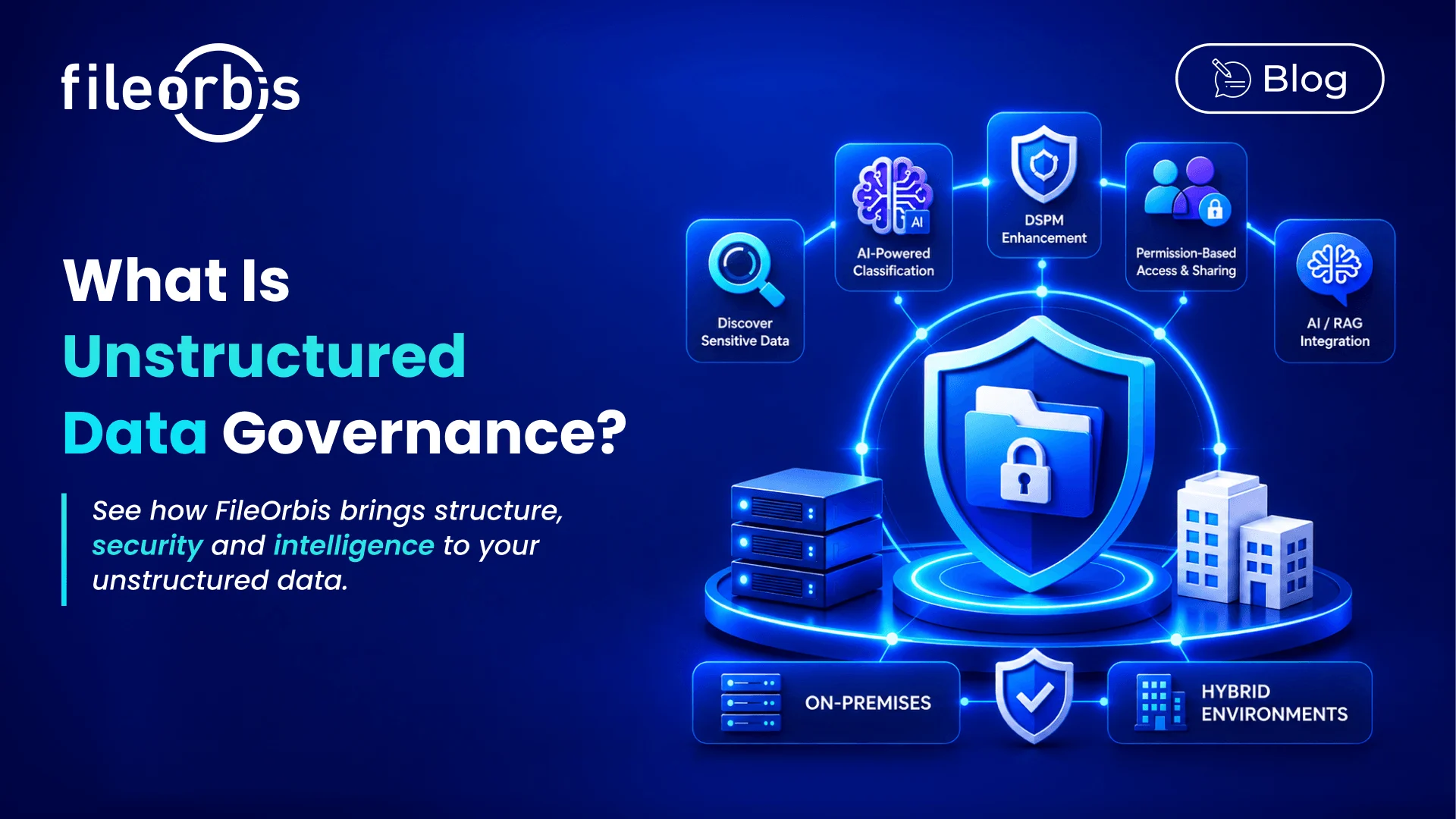
What Is Unstructured Data Governance?
Enterprise files are spread across file servers, NAS systems, M365, cloud repositories, and hybrid environments. Organizations need consistent control over how data is classified, accessed, shared, retained, moved, and used throughout its lifecycle.
This is the role of unstructured data governance.
Unstructured data governance is the set of policies, processes, and technical controls used to manage enterprise files according to their content, sensitivity, permissions, location, lifecycle, and business requirements.
Rather than asking only “Where is sensitive data?”, governance asks: What should happen to this data based on what it contains, who can access it, where it resides, and how it is used?
What Does Unstructured Data Governance Cover?
In practice, effective governance connects visibility with control across the file lifecycle. Its core responsibilities include:
- Classification: Identify sensitive, regulated, and business-critical content.
- Access governance: Maintain appropriate, least-privilege permissions.
- Sharing governance: Control internal and external file sharing.
- Lifecycle management: Define when to retain, archive, move, or delete files.
- Location governance: Keep sensitive data in approved repositories and jurisdictions.
- Policy enforcement: Apply governance rules based on content and context.
- Auditability: Maintain evidence of file activity and policy decisions.
- AI governance: Ensure AI and RAG respect existing classifications and permissions.
Ultimately, the goal is to continuously enforce what should and should not happen to enterprise data.
Why Traditional File Management Is Not Enough
Traditional file management focuses on storing, organizing, and providing access to files. However, governance determines whether that access, location, sharing, and retention are appropriate according to security, compliance, and business policies.
An organization may store a confidential document correctly, but important questions remain:
- Do too many users have access?
- Can users share it externally?
- Does the organization store it in an approved location?
- Does the organization still need to retain it?
- Can enterprise AI access its content?
As a result, governance connects these decisions under consistent policies rather than treating them as separate administrative tasks.
The Unstructured Data Governance Lifecycle
In practice, governance must be continuous because users constantly create, modify, copy, share, and delete enterprise files.
A practical lifecycle follows six stages:
- Discover: Identify files and sensitive information.
- Classify: Determine content sensitivity and business context.
- Assess: Evaluate permissions, location, sharing, ownership, and risk.
- Enforce: Apply policies for access, sharing, DLP, and retention.
- Remediate: Correct excessive permissions, inappropriate storage, and other risks.
- Monitor: Track changes, access, violations, and governance posture.
Unstructured Data Governance vs. DSPM
Unstructured data governance and Data Security Posture Management (DSPM) overlap, but serve different purposes.
Governance defines and enforces how enterprise data should be managed, including classification, permissions, sharing, location, retention, and auditability.
In contrast, DSPM focuses on identifying and reducing sensitive-data exposure, including:
- Excessive permissions
- Inappropriate data locations
- Orphaned or unmanaged files
- Overexposed sensitive information
togwether, governance establishes how data should be handled, while DSPM provides deeper visibility into exposure and supports remediation. They move organizations from finding sensitive data to continuously reducing its risk.
What Should an Unstructured Data Governance Platform Provide?
Key enterprise capabilities include:
- Content-aware discovery and classification
- Permission and exposure analysis
- Policy-based access and external sharing
- Automated retention and lifecycle management
- Data location and sovereignty controls
- DSPM and remediation
- Complete audit trails
- On-premises, cloud, M365, and hybrid coverage
- Permission-aware and content-aware AI governance
More importantly, these capabilities should work together. Classification should influence access and sharing, permissions should influence AI retrieval, retention policies should trigger lifecycle actions, and identified risks should lead to remediation.
Unstructured Data Governance for Enterprise AI
Enterprise AI and RAG increasingly use internal files as knowledge sources. However, without governance, AI can become another route to restricted information.
Effective governance should ensure:
- AI retrieves only authorized information.
- Sensitive classifications remain applicable to AI workflows.
- Permission changes are reflected in AI access.
- RAG indexing should not make restricted content accessible.
Therefore, governance needs to extend from storage and collaboration into AI consumption.
How FileOrbis Approaches Unstructured Data Governance
FileOrbis combines sensitive data discovery, AI-based classification, permission analysis, policy enforcement, DSPM and remediation, lifecycle controls, secure external sharing, auditing, and permission-aware enterprise AI/RAG across existing enterprise file environments.
As a result, organizations can govern existing file servers and hybrid environments without requiring data migration. Classification can drive security policies, while DSPM extends visibility into exposure detection and remediation.
The Takeaway
Unstructured data governance is not simply about knowing what files an organization has. Instead, it focuses on continuously deciding and enforcing what should happen to them.
By connecting classification, permissions, sharing, location, lifecycle, remediation, audit, and AI access, organizations can move from fragmented file administration to continuous, policy-driven governance.
Frequently Asked Questions
What is unstructured data governance?
Unstructured data governance applies consistent policies and controls to enterprise files based on their content, sensitivity, permissions, location, lifecycle, and use.
How does unstructured data governance differ from data management?
Data management focuses on storing, organizing, accessing, and maintaining files. In contrast, governance determines how organizations should control those files according to security, compliance, lifecycle, and business policies.
How does unstructured data governance differ from DSPM?
Governance defines and enforces how organizations should manage enterprise files. DSPM identifies and helps remediate sensitive-data exposure. Together, they turn data visibility into continuous risk reduction.
Why is unstructured data governance important for enterprise AI?
Governance helps ensure AI and RAG respect existing classifications and permissions, preventing users from retrieving restricted information they could not access directly.
How does FileOrbis govern unstructured data?
FileOrbis applies content-aware and permission-aware policies throughout the file lifecycle. Organizations can classify files, control access and sharing, enforce approval and retention policies, manage data location, and maintain auditable activity across existing on-premises and hybrid environments without migration. FileOrbis extends the same governance context to enterprise AI and RAG, so classifications and permissions continue to determine how corporate information can be accessed and used.

Gamze Karslı
Head of Marketing
Subscribe to our Newsletter
About FileOrbis
Aiming to manage the user and file relationship within an institutional framework, FileOrbis is constantly being developed in order to meet different industry and customer needs in terms of file management and sharing. Since 2018, FileOrbis continues to be developed with the excitement of the first day. FileOrbis focuses on high security, rich integration, ease of use and integrated management criteria.