
Governing Files Across Any Storage: A Layer That Sits Over Your Infrastructure
Walk into any enterprise data center and you won’t find one storage vendor. You’ll find several. A Huawei array here, Dell or NetApp there, a NAS that’s been running for years, object storage in S3 and Azure Blob, a SharePoint estate, an SFTP server nobody wants to touch. Each was the right choice at the time. Together they form a reality that no single-vendor management story accounts for.
That heterogeneity is exactly why file governance shouldn’t depend on what’s underneath it.
The Trap of Storage-Tied Governance
When governance lives inside the storage platform, you inherit its boundaries:
- Fragmented governance: Each array or service governs its own contents in its own way, with its own permission model, its own logs, and its own admin console.
- Lack of visibility: The more diverse your infrastructure, the more fragmented your governance becomes. The harder it gets to answer a simple cross-estate question like “where is all our sensitive customer data, regardless of which box it’s sitting on?”
- Vendor lock-in: Refreshing storage hardware or adding a new platform means re-solving governance for the new vendor, because the controls were tied to the old one.
A Governance Layer That Is Storage-Agnostic
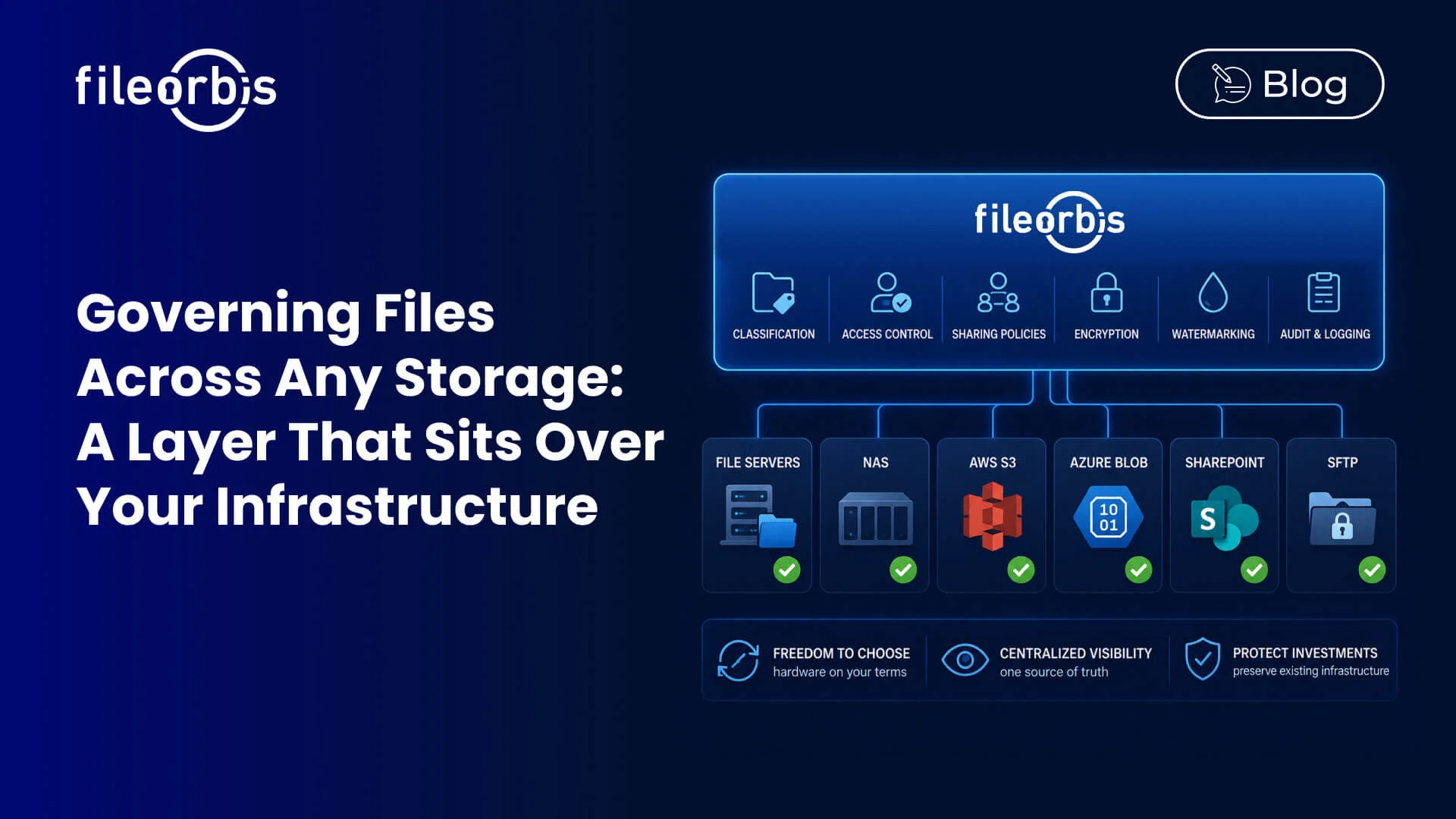
The more durable model separates governance from storage. FileOrbis acts as a control layer that sits over your infrastructure, unifying file servers, NAS, S3, Azure Blob, SharePoint, and SFTP into a single governed view, regardless of the brand of the disk underneath.
- Consistent policies: Classification, access control, sharing policy, watermarking, encryption, lifecycle, and audit are applied consistently across all of it.
- Storage-independent governance: A sensitive file is governed the same way whether it lives on a Huawei array or in an Azure container, because the policy belongs to the governance layer, not to the storage.
- Validated integrations: This is also why partnerships at the storage level matter and why they are additive rather than exclusive. Validated integrations, such as the work FileOrbis has done alongside Huawei storage, mean the governance layer runs cleanly on that foundation while the same layer continues governing everything else in the estate.
Why This Is Strategically Valuable
Freedom in storage decisions: When governance is independent of the storage brand, you can choose, mix, and refresh hardware on its own merits, including price, performance, capacity, and vendor relationships, without turning it into a governance project. The control layer stays constant while the infrastructure underneath evolves.
- One truth across the estate: Cross-estate questions about sensitive data, access, and activity have one answer from one place instead of requiring a reconciliation exercise across multiple vendor consoles.
- Investment protection: Existing storage keeps its value. There’s no need to consolidate onto one vendor to get unified governance, because the governance never depended on the vendor in the first place.
The Takeaway
Real enterprises run mixed storage, and they always will. It is the rational outcome of making good decisions over many years. The mistake is letting that heterogeneity fragment governance.
A storage-agnostic governance layer turns a diverse infrastructure from a management headache into a non-issue: govern files consistently across every system, keep your freedom to choose what sits underneath, and get one coherent view of the whole estate no matter how many vendors built it.
Running mixed storage? Talk to FileOrbis about governance that sits over all of it.

Gamze Mat
Product Manager
Subscribe to our Newsletter
About FileOrbis
Aiming to manage the user and file relationship within an institutional framework, FileOrbis is constantly being developed in order to meet different industry and customer needs in terms of file management and sharing. Since 2018, FileOrbis continues to be developed with the excitement of the first day. FileOrbis focuses on high security, rich integration, ease of use and integrated management criteria.