
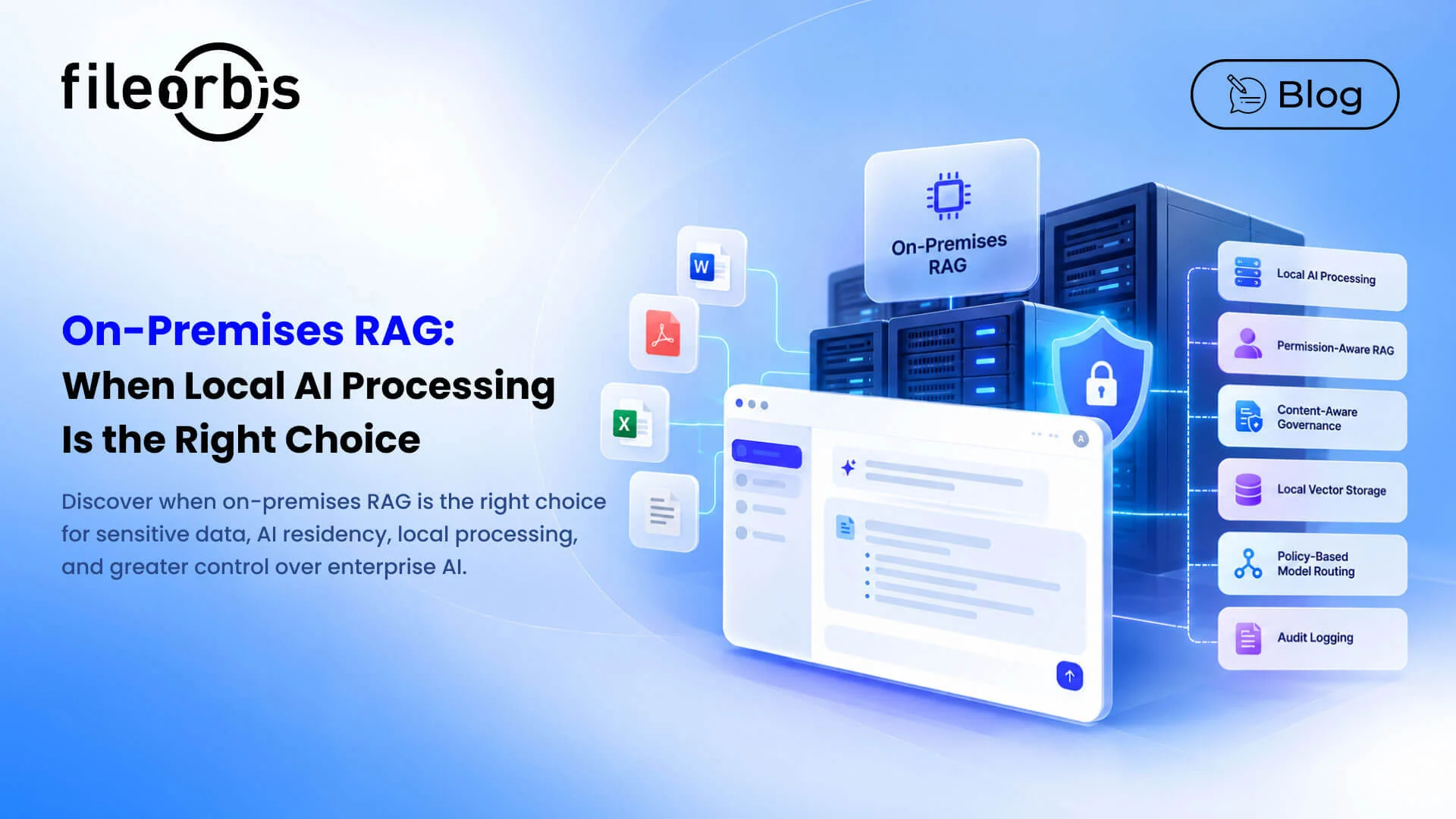
On-Premises RAG: When Local AI Processing Is the Right Choice
Retrieval-Augmented Generation (RAG) enables users to receive answers based on corporate information by connecting AI models to enterprise documents and repositories.
So, where should data retrieval and AI processing take place?
Cloud AI provides flexibility and access to powerful models. However, sensitive data, latency, jurisdictional requirements, or disconnected environments may make on-premises RAG more suitable.
The decision depends on which AI workloads require local control and whether the organization is prepared to manage the infrastructure behind them.
What is On-Premise RAG?
On-premise RAG is a RAG architecture where enterprise data and core AI components run within infrastructure controlled by the organization.
This may include:
- Source files and repositories
- Document extraction and chunking
- Vector databases
- Retrieval services
- Embedding generation
- Prompts and AI activity logs
- Language models
Keeping source files on-premise does not mean AI processing is local. Retrieved content or prompts can still be sent to an external model. Therefore, organizations should evaluate the entire RAG pipeline.
When is On-Premise RAG the Right Choice?
When AI Uses Regulated or Sensitive Content
Enterprise RAG can retrieve financial records, customer information, legal documents, intellectual property, or other sensitive data.
On-premise RAG reduces the need to send sensitive content to external AI services by keeping data retrieval and AI processing within controlled infrastructure.
This may be particularly relevant for financial services, critical infrastructure, government, healthcare, and defense.
When Jurisdiction and AI Residency Matter
Data residency is not just about where the original file is stored. Embedding, retrieved content, prompts, and AI processing can occur elsewhere.
Organizations need to understand:
- Where vector indexes are stored
- Where AI logs are stored
- Where prompts are processed
- Where retrieve occurs
- Which models receive enterprise content
On-premises RAG provides greater control over where these activities occur.
When Organizations Need Greater Model Control
On-premises RAG allows organizations to select models based on data sensitivity, hardware capacity, performance, and internal policies.
Sensitive workloads can use local models, while approved lower-risk workloads can use external models.
When Low Latency is Operationally Important
Remote AI services introduce network dependency. Local processing can be useful when enterprise repositories are already on-premises, connectivity is limited, or AI supports time-sensitive operations.
However, on-premises deployment does not automatically guarantee lower latency. Performance also depends on model size, retrieval architecture, GPU capacity, and concurrent usage.
When AI Must Work in Disconnected Environments
Some defense, critical infrastructure, industrial, and research environments cannot be constantly dependent on external connectivity.
In these cases, retrieval, inference, indexing, and logging operations may need to run locally; making local RAG a practical architectural choice.
On-Premises RAG Systems Still Require Data Governance
Keeping AI processing local doesn’t automatically prevent unauthorized access.
If a user has excessive access to enterprise files, a local RAG system could still retrieve information the user shouldn’t see.
Key controls include:
- Content-aware controls
- Permission-aware access
- Least-privilege access
- Permission synchronization
- AI guardrails
- Audit logging
Therefore, RAG security depends on both where the AI processing occurs and what each user is allowed to retrieve.
The Tradeoffs of On-Premises RAG
Greater control brings greater operational responsibility.
Things organizations need to consider:
- Infrastructure: Compute, storage, vector databases, GPUs, capacity, monitoring, and backup.
- Model lifecycle: Model evaluation, performance monitoring, vulnerability management, updates, and rollback processes.
- Skills: Infrastructure, security, data engineering, AI operations, and integration.
These requirements should be included in the business plan before deploying RAG locally.
On-Premise, Cloud, or Hybrid RAG?
The decision doesn’t have to be binary.
- On-Premise RAG: Best suited for sensitive data, disconnected environments, strict jurisdiction requirements, and workloads requiring greater model control.
- Cloud RAG: Suitable for organizations that prioritize scalability, managed infrastructure, and access to a broad range of AI models.
- Hybrid RAG: Useful when organizations have different data sensitivities, AI workloads, and jurisdiction requirements.
A hybrid architecture can keep sensitive workloads on-premise while allowing approved workloads to use cloud models.
The goal is to make processing location a policy decision rather than a fixed architectural assumption.
Questions to Ask Before Choosing On-Premises RAG
Before investing in local AI infrastructure, ask yourself these questions:
- Does sensitive content need to remain within our infrastructure?
- Are there jurisdiction or AI residency requirements?
- Can the retrieved content be sent to external models?
- Can retrieval enforce existing file permissions?
- Do we need AI in disconnected environments?
- Can different workloads be routed to different models?
- Do we have sufficient compute and GPU capacity?
- Is AI activity monitorable and auditable?
How FileOrbis Helps
FileOrbis extends enterprise file governance to RAG and AI workflows while allowing files to remain in existing repositories.
Key capabilities include:
- Local AI processing
- Content-aware governance
- Permission-aware RAG
- Local vector storage
- Policy-based model routing
- Governance without data migration
- AI activity controls and audit logging
Organizations can apply different AI processing approaches depending on data sensitivity, security policy, and jurisdiction.
In Summary
On-premises RAG can be the right choice when regulated data, latency, jurisdiction requirements, disconnected environments, or model control make local AI processing necessary.
The tradeoff is operational responsibility. For organizations with mixed requirements, a governed hybrid approach can keep sensitive workloads local while using approved cloud models where appropriate.
Frequently Asked Questions
What is on-premises RAG?
On-premises RAG keeps enterprise content and core data retrieval and AI processing components within the organization’s own infrastructure.
When should organizations use on-premises RAG?
It is particularly important when sensitive data needs to remain local, when AI deployment requirements apply, when local processing is critical, or when AI needs to operate without constant external connectivity.
What are the main disadvantages of on-premises RAG?
Organizations take on greater responsibility for infrastructure, security, specialized skills, GPU capacity, monitoring, and model lifecycle management.

Gamze Mat
Product Manager
Subscribe to our Newsletter
About FileOrbis
Aiming to manage the user and file relationship within an institutional framework, FileOrbis is constantly being developed in order to meet different industry and customer needs in terms of file management and sharing. Since 2018, FileOrbis continues to be developed with the excitement of the first day. FileOrbis focuses on high security, rich integration, ease of use and integrated management criteria.