What is Shadow AI? Risks, Security Challenges, and How to Prevent It
Artificial intelligence is becoming part of everyday business operations. Employees use AI tools to summarize documents, analyze information, and automate tasks. However, the growing use of Shadow AI, where AI tools operate without organizational approval or oversight, can introduce significant security risks.
Understanding these risks is essential for organizations seeking to adopt AI securely while maintaining control over enterprise information.
What is Shadow AI?
Shadow AI refers to the use of AI tools, services, or applications without formal approval or oversight from an organization’s IT and security teams.
Common examples include:
- Sharing customer records or financial information through AI prompts.
- Uploading confidential documents to unapproved AI chatbots.
- Connecting third-party AI applications to enterprise data repositories.
- Analyzing internal documents through unauthorized AI services.
Unlike traditional software applications, AI tools can process and generate information from submitted content, creating additional data security concerns.
What are the Main Shadow AI Risks?
Unauthorized Information Access
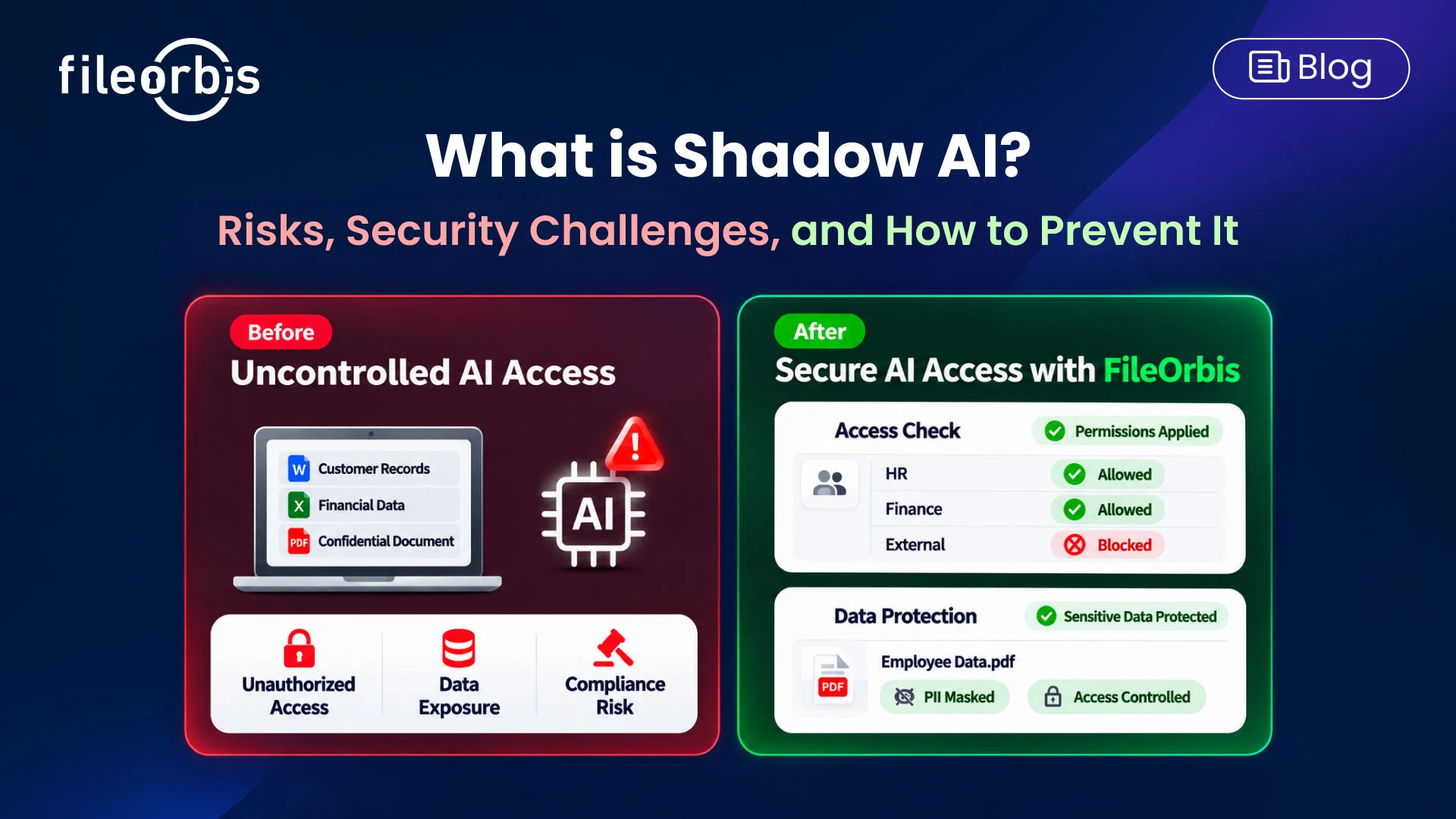
AI integrations that do not enforce existing file permissions may retrieve restricted documents and expose information to unauthorized users.
Sensitive Data Exposure
Employees may unknowingly share personally identifiable information (PII), confidential documents, or intellectual property with external AI platforms. Depending on provider policies, the submitted information may be retained or processed outside of approved environments.
Compliance and Data Sovereignty
Unapproved AI services may create challenges related to GDPR, industry regulations, data residency requirements, and internal security policies.
Limited Visibility and Auditability
Without appropriate monitoring, security teams may struggle to identify which AI services employees are using and what corporate information they are sharing.
Shadow AI vs. Shadow IT: What’s the Difference?
Shadow IT involves unauthorized software, devices, or cloud services used within an organization.
Shadow AI is a specific form of Shadow IT that introduces additional risks through AI-powered data processing and content generation.
For example, an unauthorized cloud storage application might expose uploaded files, while an unapproved AI assistant could analyze those files and generate responses containing sensitive information.
How Can Organizations prevent Shadow AI?
Effective Shadow AI prevention requires a combination of security policies, data governance, and approved AI solutions.
Organizations should focus on five key measures:
- Discover and classify sensitive data: Identify confidential information in enterprise repositories.
- Apply content-aware protection: Use data masking, anonymization, and policy-based controls during AI interactions.
- Enforce access permissions: Ensure AI applications respect existing user permissions.
- Monitor AI usage: Provide visibility into AI applications and data access activities.
- Provide secure AI alternatives: Offer employees approved solutions for accessing enterprise knowledge.
How FileOrbis Helps
FileOrbis extends enterprise data governance and security policies into supported AI workflows, helping organizations protect corporate information while enabling secure AI adoption.
With FileOrbis, organizations can:
- Discover and classify sensitive data: Identify confidential information across distributed repositories.
- Protect sensitive content: Use content-aware inspection, masking, and anonymization.
- Enforce permission-aware AI access: Apply existing user permissions to AI-powered document retrieval processes.
- Govern AI interactions: Enforce policies across supported prompts, file uploads, and retrieval workflows.
- Enable AI without data migration: Connect existing file environments to AI workflows without moving source files.
- Maintain auditability: Monitor governed access activities and security decisions.
By applying governance at the data layer, FileOrbis helps reduce the risks associated with uncontrolled AI access to enterprise information.
In Summary
Shadow AI highlights the importance of extending existing security controls to AI environments. Organizations need a governance approach that protects sensitive information without limiting the productivity benefits of AI.
Combining data security with approved AI workflows helps organizations manage these risks while supporting responsible AI adoption.
FileOrbis supports this approach through content-aware data classification, permission-aware access controls, and policy-driven governance, helping organizations reduce Shadow AI risks while maintaining control over enterprise information.
Frequently Asked Questions
What is the difference between Shadow AI and generative AI?
Generative AI refers to technology that creates content, while Shadow AI describes AI tools used without corporate approval or oversight. Approved generative AI applications are not necessarily Shadow AI.
Can Shadow AI cause data breaches?
Yes. Employees can submit confidential information to unapproved AI services, potentially exposing sensitive data through unauthorized processing, storage, or sharing.
How does FileOrbis help organizations manage Shadow AI risks?
FileOrbis helps organizations secure their enterprise AI workflows through permission-aware access, content-aware protection, policy enforcement, and sensitive data classification. These capabilities reduce the risk of unauthorized information exposure during governed AI interactions.

Gamze Karslı
Head of Marketing
Subscribe to our Newsletter
About FileOrbis
Aiming to manage the user and file relationship within an institutional framework, FileOrbis is constantly being developed in order to meet different industry and customer needs in terms of file management and sharing. Since 2018, FileOrbis continues to be developed with the excitement of the first day. FileOrbis focuses on high security, rich integration, ease of use and integrated management criteria.