
AI-Based Permission Analysis: Detect and Remediate Excessive File Access
AI-based permissions analysis helps organizations manage increasingly complex file permissions as employee roles change, departments share resources, and access rights accumulate across file servers, NAS devices, and cloud storage.
Over time, sensitive documents may remain accessible to users who no longer need them. Traditional permission controls often struggle to identify these risks in distributed environments.
By identifying excessive file permissions, prioritizing remediation, and assessing access risks organizations can strengthen data security and enforce least-privileged access.
What is AI-Based Permission Analysis?
AI-based permission analysis uses intelligent analysis techniques to evaluate file access rights, support least-privilege access, and identify risky permission configurations.
Unlike traditional permission reviews that primarily examine access control lists (ACLs), advanced approaches correlate permissions with file ownership, data sensitivity, and exposure context.
Common permission risks include:
- Excessive Permissions: Users or groups with broader access than necessary.
- Stale Access: Permissions that remain active after responsibilities change.
- Permission Creep: Access rights accumulated through role changes or internal transfers.
- Sensitive Data Exposure: Confidential files accessible to overly broad user groups.
- Inherited Permission Risks: Unnecessary access inherited from parent folders.
Why Traditional Permission Audits Fall Short
Enterprise permission structures often involve thousands of users, inherited access rules, and nested security groups.
Manual reviews and basic ACL reporting introduce several challenges:
- Complex Group Membership: Nested groups make effective access difficult to evaluate.
- Limited Context: Permission reports do not indicate whether accessible files contain sensitive information.
- Remediation Backlogs: Corrective actions may remain incomplete because they require significant administrative effort.
- Manual Investigation: Security teams must review large volumes of permission findings.
In conclusion, organizations need a more contextual and automated approach to permission risk management.
How AI-Based Permission Analysis Works
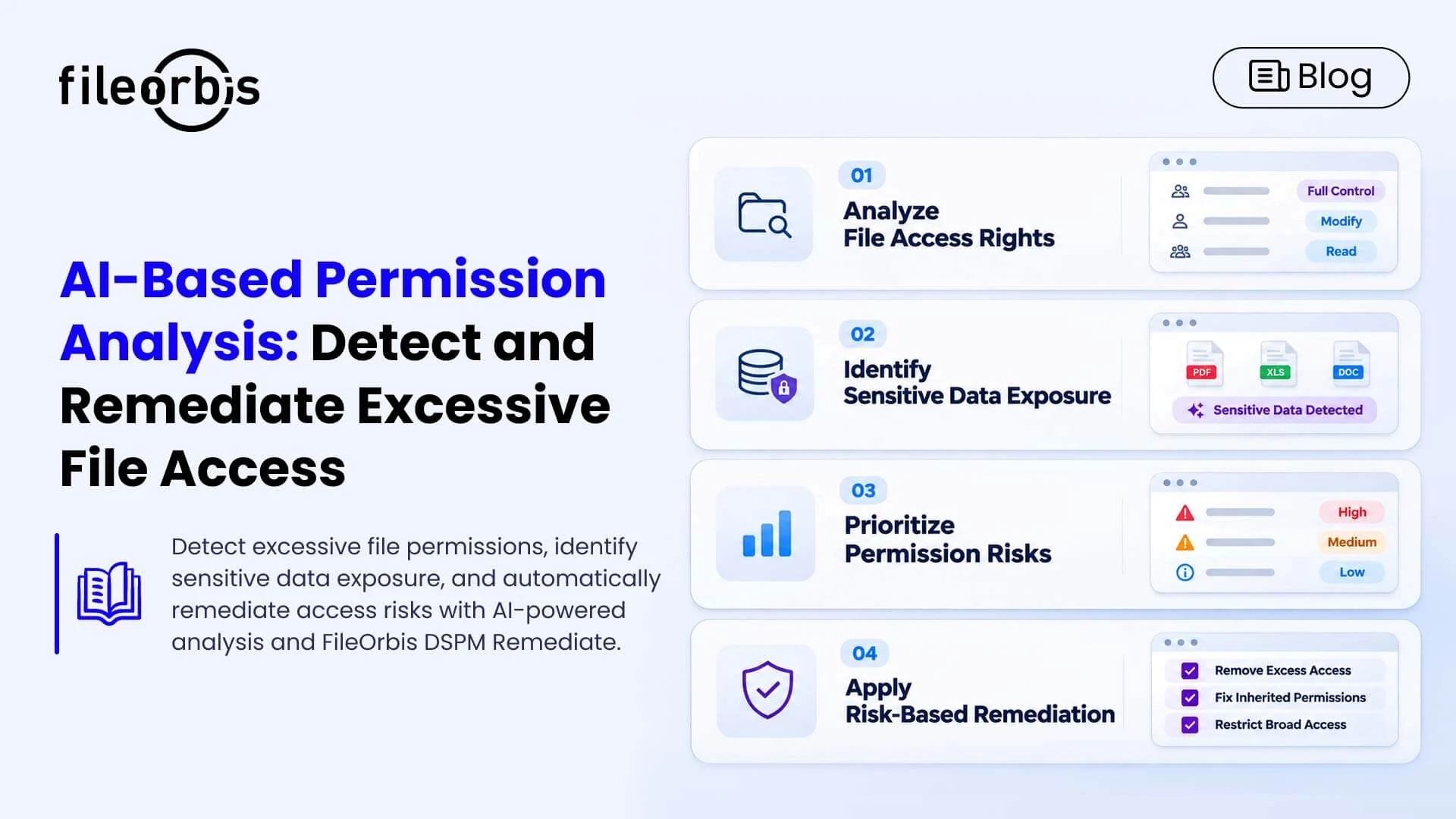
Analyze File Access Rights
Evaluate user permissions, inherited access rights, and group memberships to identify overly permissive configurations across enterprise repositories.
Identify Sensitive Data Exposure
Combine permission findings with AI-based data classification to determine which accessible files contain personal information, confidential business data, or financial records.
Prioritize Permission Risks
Evaluate findings based on the following factors:
- Data sensitivity and business criticality
- File location and sharing exposure
- Permission levels and inherited rights
- Number of users with access
- Ownership and file age
This helps security teams prioritize the most significant risks instead of treating every permission finding equally.
Apply Risk-Based Remediation
Use policy-driven corrective actions to remove unnecessary permissions, address inherited misconfigurations, and restrict broad access.
Approval workflows and audit logging help ensure accountability throughout the remediation process.
How FileOrbis Helps
FileOrbis DSPM Remediate helps organizations move from identifying excessive file permissions to correcting security risks through automated, policy-driven remediation.
By combining permission analysis with sensitive data classification, FileOrbis provides contextual visibility into file exposure across existing enterprise storage environments.
Key capabilities include:
- Permission Exposure Analysis: Identify over-permissioned files, inherited permission risks, and broad group access.
- AI-Based Data Classification: Discover sensitive information and correlate classification results with access rights.
- Automated Permission Remediation: Correct unnecessary access rights through policy-driven actions.
- Batch Remediation: Apply corrective actions across multiple files to reduce manual effort.
- Risk Scoring: Prioritize exposure based on sensitivity, sharing behavior, permissions, and file age.
- Approval Workflows: Maintain administrative control over sensitive permission changes.
- Audit Logging: Track remediation activities and permission modifications for security reviews.
FileOrbis supports remediation across existing file servers, NAS, and supported cloud storage without requiring data migration.
In Summary
AI-based permission analysis helps organizations uncover access risks that traditional permission controls might overlook.
However, effective permission governance requires more than visibility. By connecting intelligent analysis with automated remediation, organizations can reduce unnecessary access, improve their data security posture, and enforce least-privilege policies.
FileOrbis DSPM Remediate supports this approach by combining permission risk analysis, policy-driven remediation, and AI-based data classification to identify and correct excessive file access across enterprise environments.
Learn more about FileOrbis DSPM Remediate.
Frequently Asked Questions
- What is AI-based permission analysis?
AI-based permission analysis evaluates file permissions and security context to identify excessive access rights, potential data exposure, and inherited permission risks.
- How does AI-based permission analysis support least-privilege access?
It identifies unnecessary permissions and helps security teams prioritize corrective actions, so users retain only the access required for their responsibilities.
- How does FileOrbis automate permission remediation?
FileOrbis DSPM Remediate combines permission risk analysis, AI-based classification, policy-driven batch remediation, and risk scoring to identify and correct excessive access rights across enterprise file environments.

Gamze Karslı
Head of Marketing
Subscribe to our Newsletter
About FileOrbis
Aiming to manage the user and file relationship within an institutional framework, FileOrbis is constantly being developed in order to meet different industry and customer needs in terms of file management and sharing. Since 2018, FileOrbis continues to be developed with the excitement of the first day. FileOrbis focuses on high security, rich integration, ease of use and integrated management criteria.