File DLP: How to Protect Sensitive Data with Content-Aware Controls
File DLP (Data Loss Prevention) helps organizations protect sensitive information within enterprise files, including employee documents, financial records, confidential contracts, and customer information. As these files move between internal teams and external partners, traditional access controls alone may not prevent unauthorized disclosure.
By reviewing file contents and enforcing security policies during file transactions, File DLP helps organizations reduce the risk of sensitive data disclosure.
Unlike traditional access controls that focus on user permissions, content-aware File DLP considers data sensitivity when determining whether files can be accessed, transferred, or shared.
What is File DLP?
File DLP is a data security approach that identifies sensitive information within enterprise files and applies protection policies to prevent unauthorized access, transfer, or sharing.
It focuses on unstructured data stored in documents, PDFs, spreadsheets, and other file formats.
Common types of protected information include:
- Personally Identifiable Information (PII): National identification numbers, personal records, and addresses.
- Financial Data: Bank account numbers, credit card details, and transaction records.
- Confidential Business Information: Contracts, proprietary documents, and intellectual property.
- Protected Health Information (PHI): Medical information and Patient records.
By identifying sensitive content, File DLP allows organizations to apply security controls based on actual data sensitivity rather than file names or storage locations.
Why Traditional File Security Is Not Enough
Traditional file security primarily determines who can access a document. However, authorized access doesn’t necessarily mean unrestricted sharing should be allowed.
For example, an employee might legitimately access a customer report but accidentally send it to an external recipient.
Several limitations make additional file-level protection necessary:
- Unclassified information: Sensitive content may remain hidden inside ordinary documents.
- Permission-based limitations: Access rights don’t always restrict external distribution.
- Limited content visibility: Security teams can know which files were transferred without knowing whether they contained sensitive information.
- Inconsistent policies: Different storage environments may apply different sharing restrictions.
Modern DLP approaches extend beyond traditional security controls by combining content inspection with context-aware policy enforcement.
How Content-Aware File DLP Works
Effective File DLP combines classification, sensitive data detection, and automated security actions.
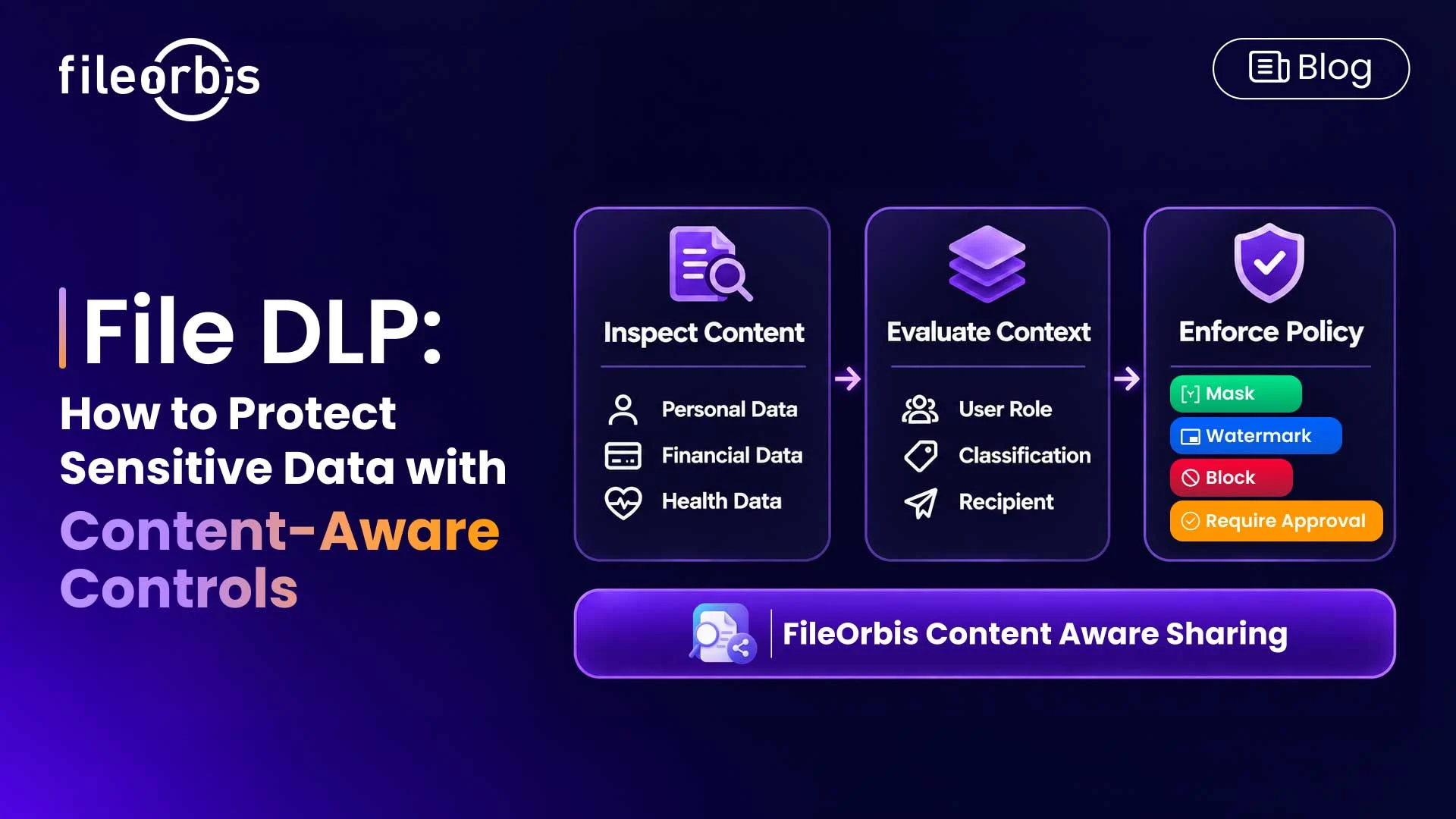
Inspect File Content
Content inspection identifies sensitive information within documents using predefined patterns, classification technologies, and custom rules.
Evaluate Content and Context
After identifying sensitive information, File DLP evaluates additional conditions, including:
- User roles and departments
- Existing sensitivity labels
- File locations and sharing destinations
- Internal or external recipients
Combining these conditions helps organizations distinguish legitimate collaboration from potentially risky file transfers.
Enforce File-Level Security Policies
Based on the inspection results, organizations can automatically:
- Mask sensitive information before sharing.
- Block unauthorized file transfers.
- Require approval for high-risk file operations.
- Apply watermarks to confidential documents.
- Restrict downloads or provide view-only access.
- Log security decisions for audit and investigation.
These controls enable organizations to protect sensitive information without unnecessarily interrupting legitimate business workflows.
How FileOrbis Helps
FileOrbis Content Aware Sharing extends file-level protection through real-time content inspection and policy-based enforcement.
Rather than relying exclusively on file permissions or existing classification labels, FileOrbis analyzes document content and applies security controls during file operations.
Its capabilities include:
- Advanced Classification Integration: Combine content analysis with Microsoft Purview (MIP) and Titus classification labels.
- Real-Time Content Inspection: Detect sensitive information during file uploads, downloads, and editing.
- Automated Policy Enforcement: Apply blocking, watermarking, masking, and approval workflows based on defined conditions.
- Hybrid Storage Support: Extend policies across existing file servers, NAS, cloud storage, and SFTP environments without data migration.
- Content-Aware Sharing: Control external file exchanges based on document sensitivity and recipient context.
- Audit Logging: Record file activities and policy decisions to support security monitoring and compliance reporting.
Through these capabilities, FileOrbis helps organizations introduce content-aware File DLP while maintaining their existing storage infrastructure.
In Summary
File DLP strengthens enterprise data protection by making security decisions based on the content of files, not just who can access them.
Combining content inspection, classification, and automated enforcement helps organizations reduce accidental data disclosure while maintaining controlled collaboration.
For businesses managing sensitive information in distributed storage environments, content-aware File DLP provides an important additional layer of protection.
Frequently Asked Questions
What is the difference between File DLP and traditional DLP?
Traditional DLP can protect information across networks, endpoints, and cloud applications. File DLP focuses specifically on sensitive information within files, using content inspection and file-level policies to control sharing and transfers.
Can File DLP protect files without blocking collaboration?
Yes. Content-aware File DLP can apply watermarking, masking, approval workflows, or view-only restrictions instead of blocking every sensitive document.
How does FileOrbis help File DLP across existing storage systems?
FileOrbis provides classification integration, real-time content inspection, and automated policy enforcement across supported on-premises and cloud storage environments without requiring data migration.

Emre Demiray
Founder – FileOrbis
Subscribe to our Newsletter
About FileOrbis
Aiming to manage the user and file relationship within an institutional framework, FileOrbis is constantly being developed in order to meet different industry and customer needs in terms of file management and sharing. Since 2018, FileOrbis continues to be developed with the excitement of the first day. FileOrbis focuses on high security, rich integration, ease of use and integrated management criteria.