
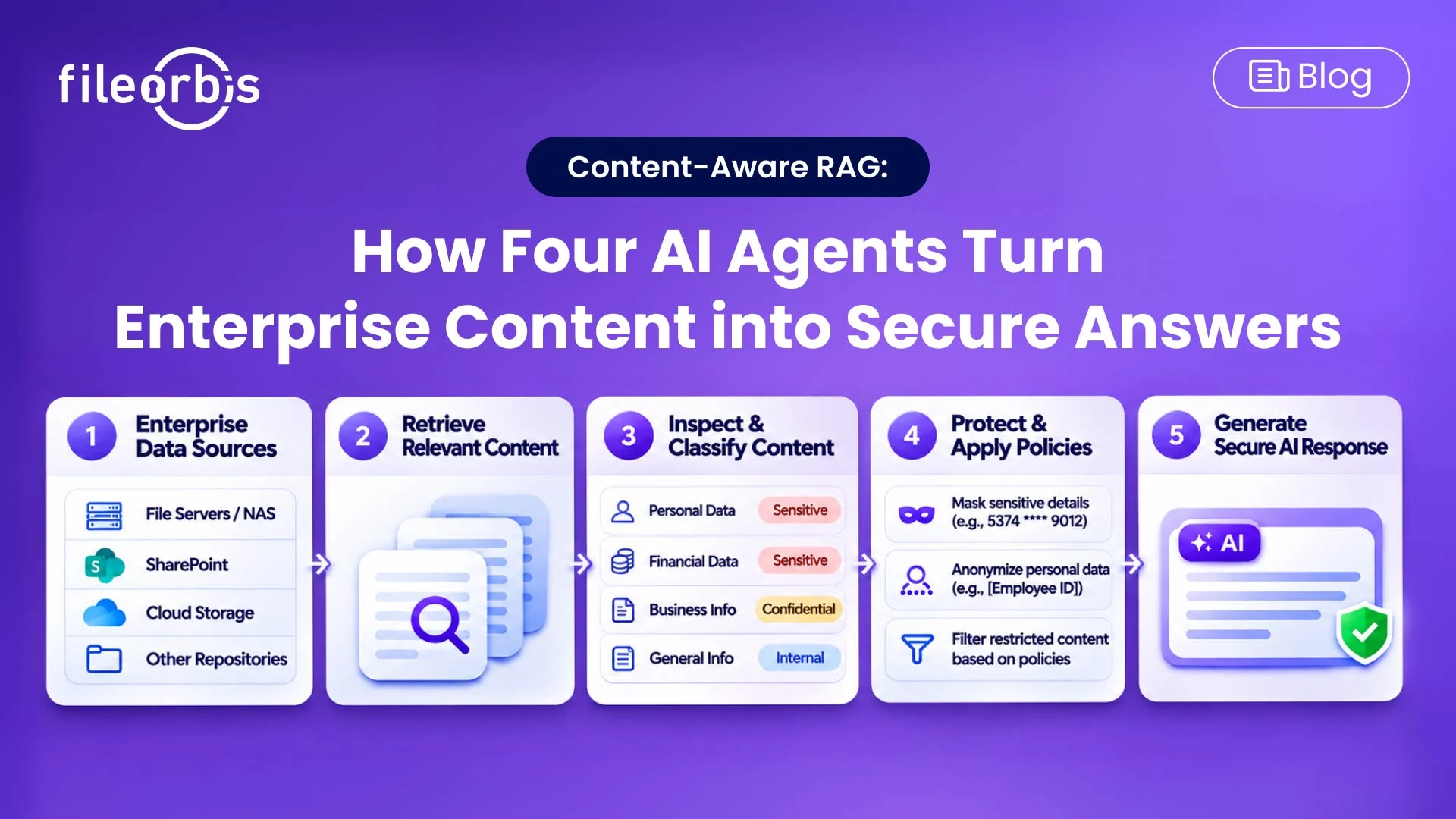
Content-Aware RAG: How Four AI Agents Turn Enterprise Content into Secure Answers
Retrieval-Augmented Generation (RAG) enables enterprise AI systems to generate responses using information from corporate documents and repositories. However, retrieving relevant information doesn’t mean every detail is appropriate for AI processing or disclosure. Enterprise files may contain personal data, confidential business information, and financial records. Content-aware RAG helps organizations protect this information by applying content-level security controls throughout AI retrieval workflows.
What is Content-Aware RAG?
Content-aware RAG extends traditional Retrieval-Augmented Generation (RAG) by evaluating the sensitivity of enterprise information before it is provided to a language model.
It offers several capabilities:
- Content discovery: Identifying sensitive information within corporate documents.
- Data classification: Categorizing information based on sensitivity and business requirements.
- Masking and anonymizing: Protecting sensitive details where full disclosure is unnecessary.
- Policy-based filtering: Determining which content can be processed by AI.
This approach enables organizations to use enterprise information in AI applications while maintaining greater control over sensitive content.
Why Traditional RAG Creates Data Security Risks
Traditional RAG systems primarily focus on retrieving information relevant to the user’s question. However, relevance alone is not a sufficient security criterion.
For example, an HR document might contain both general workplace policies and confidential employee information. Retrieving the document without evaluating its content can lead to the introduction of unnecessarily sensitive data into the AI workflow.
This creates three key challenges:
- Regulatory risk: Personal or regulated information may be processed without appropriate safeguards.
- Information disclosure: Confidential details may appear in AI-generated responses.
- Limited visibility: Organizations may not have sufficient records of the content used during AI interactions.
These challenges highlight the importance of evaluating information before it reaches an AI model.
Content-Aware RAG vs. Permission-Aware RAG
Content-aware RAG and permission-aware RAG provide complementary security controls.
- Content-aware RAG assesses whether sensitive information in accessible files requires additional protection.
- Permission-aware RAG determines which files a user can access based on existing access rights, including NTFS permissions and access control lists (ACLs).
For example, a user might have permission to access a financial report, while company policies might require customer identifiers to be masked before the content is processed by AI.
Together, these approaches provide both user-level access restrictions and content-level protection.
Essential Security Controls for Content-Aware RAG
Organizations implementing content-aware RAG should focus on controls that run throughout the entire data retrieval process.
- Automatic classification: Identify sensitive content in enterprise repositories.
- Pre-modeling data protection: Filter, mask, or anonymize restricted information before AI processing.
- Contextual policy enforcement: Apply security rules based on data sensitivity and enterprise requirements.
- Access validation: Verify that retrieved files comply with existing user permissions.
- Audit logging: Maintain records of content access and related AI activity.
These controls help security teams establish consistent governance over enterprise information used by AI applications.
How FileOrbis Helps
FileOrbis AI Governance enables organizations to connect enterprise AI applications to their existing file infrastructure without the need for source file migration.
It brings together content-aware and permission-aware RAG across enterprise storage, including file servers, NAS, SharePoint, and cloud storage.
FileOrbis supports this approach with:
- AI-based classification to identify sensitive enterprise content.
- Enforcement of existing permissions to align AI access with established file access rights.
- Local and cloud LLM integration to support different enterprise AI deployment requirements.
- Content inspection and protection to implement policy-based filtering, masking, and anonymization.
- FileOrbis AI Assistant uses a four-agent AI architecture in which specialized agents work together to find relevant enterprise content, deepen the retrieved context, reason over the information, and validate responses against the user’s question, existing access permissions, and security policies.
- Centralized monitoring and audit trails to provide visibility into AI-related content access.
By applying these capabilities across existing storage, FileOrbis helps organizations implement governed AI workflows while maintaining their established file infrastructure.
In Summary
Content-aware RAG helps enterprises move beyond relevance-based retrieval by considering the sensitivity of the information used in AI responses.
When combined with permission-aware retrieval, it provides a practical foundation for connecting AI applications to enterprise files while mitigating the risks of sensitive data disclosure.
Learn more about FileOrbis AI Governance.
Frequently Asked Questions
What is the difference between content-aware RAG and traditional RAG?
Traditional RAG retrieves relevant information to generate AI responses. Content-aware RAG adds content inspection, data classification, and policy enforcement capabilities to help protect sensitive corporate information during retrieval and processing.
Can content-aware RAG protect sensitive data before it reaches a language model?
Yes. Content-aware RAG can reduce unnecessary data disclosure by applying filtering, masking, and anonymization to sensitive information before it is sent to the language model.
How does FileOrbis help businesses implement content-aware RAG?
FileOrbis AI Governance combines content-aware and permission-aware RAG to connect enterprise AI applications with existing file repositories. By implementing classification, access controls, and sensitive data protection policies without the need for source file migration, it helps organizations adopt AI while maintaining file governance.

Emre Demiray
Founder – FileOrbis
Subscribe to our Newsletter
About FileOrbis
Aiming to manage the user and file relationship within an institutional framework, FileOrbis is constantly being developed in order to meet different industry and customer needs in terms of file management and sharing. Since 2018, FileOrbis continues to be developed with the excitement of the first day. FileOrbis focuses on high security, rich integration, ease of use and integrated management criteria.