
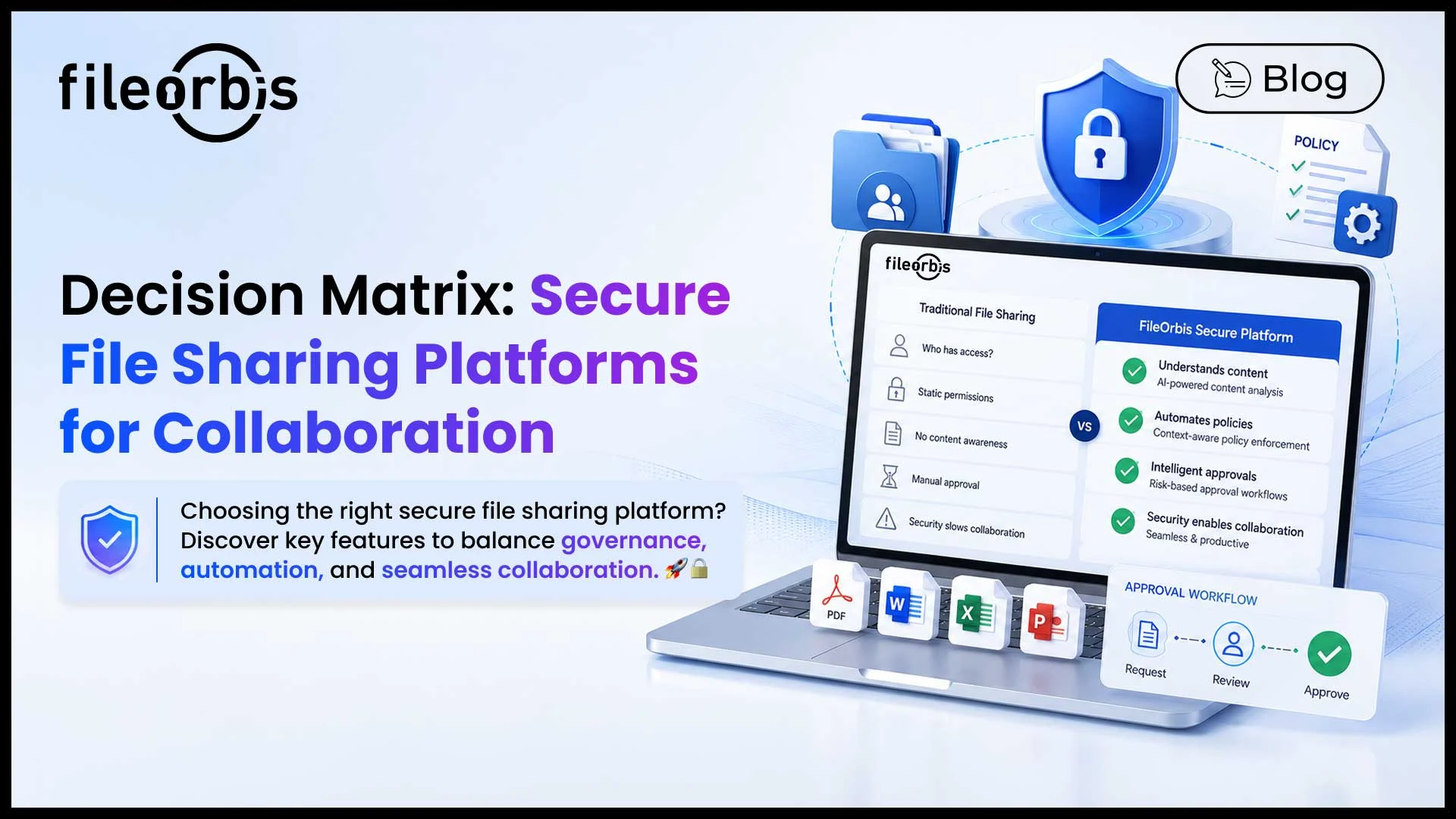
Decision Matrix: Secure File Sharing Platforms for Collaboration
Secure file sharing is encrypting files and controlling who can access them. Enterprise collaboration spans internal teams, external partners, file servers, M365, cloud repositories, and untructured data.
For organizations evaluating secure file-sharing platforms for collaboration, the key question is whether a platform can protect sensitive content throughout the collaboration lifecycle while supporting governance, compliance, and workflows.
The decision matrix below highlights the capabilities that businesses should evaluate before selecting a platform.
Secure File Sharing Platform Decision Matrix
End-to-End Encryption
Encryption remains a necessity for secure collaboration. Files should be protected both while they are stored and while they are being transferred between users and systems.
Pay attention to the following:
- Strong encryption standards
- Encryption at rest and in transit
- Customer-controlled encryption options where required
Encryption is essential, but it should be viewed as a foundation rather than a complete security strategy.
Two-Factor Authentication
Compromised credentials can turn legitimate file access into a data breach. Two-factor authentication provides an additional layer of protection before users can access sensitive content.
Pay attention to the following:
- MFA
- 2FA support
- Enterprise identity integration
- Role-based authentication policies
Data Loss Prevention Tools
DLP helps prevent sensitive information from leaving approved boundaries.
From a corporate collaboration perspective, DLP must go beyond static rules and understand what information a document actually contains.
Pay attention to the following:
- Automated policy enforcement
- Content inspection
- Sharing restrictions
- Sensitive data detection
- Automated policy enforcement
- Integration with existing DLP Technologies
For example, FileOrbis can examine file contents and dynamically apply controls such as approving, blocking, or watermarking.
User Access Controls
Not every user should have access to every file.
Granular access controls help organizations enforce the principle of least privilege while maintaining productive collaboration.
Pay attention to the following:
- Role-based access
- Complete access logging
- Granular file permissions
- Permission-aware governance
- Internal and external user controls
User Training and Support
Security controls are effective when users and administrators are able to implement them correctly.
Evaluate:
- User onboarding
- Administrator documentation
- Technical support
- Ongoing platform support
- Deployment assistance
Regulatory Compliance
Organizations should assess whether a platform supports the regulations and security frameworks relevant to their industries and areas of jurisdiction.
Depending on the organization, these may include the following:
FileOrbis supports governance, security, compliance, and capabilities across regulated environments, including on-premises and hybrid architectures.
Go Beyond Traditional Secure File Sharing
Encryption, DLP, authentication, and access control remain important; however, modern enterprise collaboration requires another layer of intelligence and automation.
Dynamic Watermarking
Dynamic watermarking helps prevent unauthorized redistribution by adding contextual information, such as the user’s identity, to sensitive documents.
This is particularly important for confidential information subject to external collaboration and regulationsFileOrbis can dynamically apply watermarking when content or policy conditions are triggered.
A secure collaboration platform should understand not only where a file is stored, but also what it contains.
Content-aware controls can do the following:
- Detect sensitive information
- Apply policies based on content
- Use existing classification labels
- Trigger watermarking or blocking
- Initiate approval workflows
FileOrbis combines real-time content inspection with classification and policy logic to manage sensitive information before it leaves organizational control.
Security Integrations
Secure file sharing should work in conjunction with the existing cybersecurity architecture rather than creating a separate layer of control.
Evaluate integration with the following technologies:
- DLP
- SIEM
- SOAR
- Identity platforms
- Sandbox
- Malware analysis
- Security and governance APIs
As a result, file activity and policy enforcement to become part of broader enterprise security operations.
Compliance Checks
Compliance should be enforced during collaboration, they should not be reviewed only after an incident has occurred.
Platforms should be able to apply controls based on content, user, destination, classification, and sharing context while maintaining auditability. FileOrbis supports content-based policy enforcement and logs policy decisions and actions.
Content Orchestration
Enterprise files move between users, applications, repositories, business processes, and security controls.
Content orchestration helps organizations manage these workflows consistently while maintaining governance and security across on-premises, hybrid environments, and cloud.
Automated Approvals
Sensitive files should not always leave the organization simply because a user clicks the “Share” button.
Automated approvals can route high-risk transactions to managers, compliance teams, or designated auditors based on the following criteria:
- File content
- File location
- Sharing destination
- User or department
- Classification
FileOrbis supports content-aware approval workflows in which predefined rules automatically initiate and track the required approval process.
In Summaary
Choosing a secure file sharing platform for collaboration requires looking beyond encryption and authentication.
Enterprises should evaluate how effectively a platform can understand sensitive content, control access, integrate with security infrastructure, enforce compliance policies, orchestrate content, and automate approval processes.
FileOrbis brings these capabilities together through content-aware sharing, policy enforcement, dynamic controls, automated workflows, and governance in enterprise file environments, helping organizations collaborate without compromising security.

Emre Demiray
Founder – FileOrbis
Subscribe to our Newsletter
About FileOrbis
Aiming to manage the user and file relationship within an institutional framework, FileOrbis is constantly being developed in order to meet different industry and customer needs in terms of file management and sharing. Since 2018, FileOrbis continues to be developed with the excitement of the first day. FileOrbis focuses on high security, rich integration, ease of use and integrated management criteria.