File Server Modernization: Unifying and Securing Hybrid File Infrastructure
Enterprise file infrastructure now extends beyond traditional Windows file servers. Organizations manage files across NAS systems, remote offices, and cloud storage, often using different access methods and management tools.
As environments become more distributed, IT teams face increasing complexity in maintaining consistent access, performance, and security.
File server modernization helps enterprises address these challenges by improving how existing storage systems are connected, accessed, and managed.
Why Traditional File Infrastructure Needs Modernization
Traditional file servers remain essential for enterprise operations, but managing them in hybrid environments introduces several challenges:
- Fragmented storage: Files are distributed across multiple platforms and repositories.
- Remote access limitations: VPN dependencies and traditional network drives can restrict flexibility.
- Complex permissions: Inconsistent access controls increase the risk of excessive access.
- Operational overhead: Maintaining separate storage systems and branch infrastructure increases administrative effort.
- Performance bottlenecks: Remote offices may experience latency when accessing centrally stored files.
Modernization requires an architecture that addresses these limitations without disrupting existing operations.
What Does a Modern File Server Infrastructure Look Like?
A modern file server architecture provides a unified access and management layer across distributed storage systems.
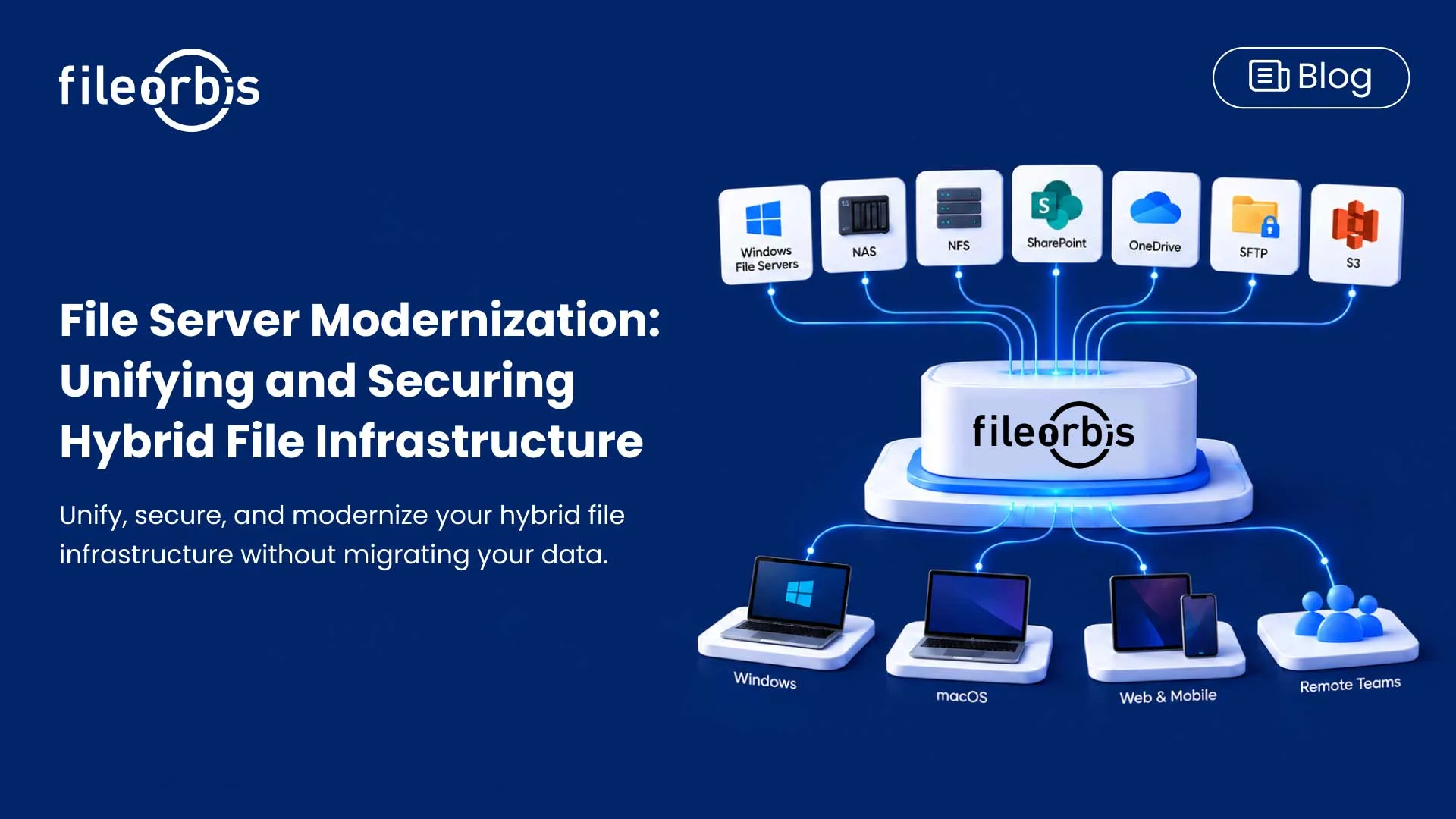
Through file system federation, organizations can connect on premises and cloud storage while keeping files in their original locations.
This approach supports:
- Unified access: A consistent way to work with files across repositories
- Centralized governance: Consistent visibility and control over file access.
- Hybrid integration: Connectivity between traditional file servers and cloud storage.
- Infrastructure flexibility: Continued use of existing storage investments.
Instead of treating each repository as a separate environment, IT teams can manage file infrastructure more consistently.
Key Capabilities for Enterprise File Server Modernization
File System Federation in Hybrid Storage Environments
Enterprise storage environments typically include Windows file servers, NFS, NAS, and cloud storage.
File system federation connects these systems through a common file structure, reducing the need for separate access paths and management interfaces.
It also enables organizations to modernize file access without requiring a large-scale storage migration.
Centralized File Access and Permission Management
Distributed repositories make it difficult to determine who can access sensitive files and whether those permissions are appropriate.
A modern file server platform should support:
- Integration with existing identity and access management systems.
- Periodic permission reviews and least privilege access.
- Centralized visibility into file and folder permissions.
- Audit logging for access and permission changes.
These controls help reduce excessive access and strengthen accountability.
Edge Caching for Remote Office Performance
Accessing centrally stored files over wide area networks can cause delays, especially for teams working with large documents.
Edge caching reduces repetitive transfers and improves response time by keeping frequently accessed content closer to remote users.
This can help enterprises improve branch productivity and reduce reliance on dedicated local file servers.
Secure Remote File Access
The need for employees to access enterprise files from outside corporate networks is increasing.
Modern solutions can provide controlled access via desktop, web, and mobile interfaces without requiring extensive network-level connectivity.
Identity verification, multi-factor authentication (MFA), and existing file permissions help protect sensitive content while supporting distributed work.
How FileOrbis Helps
FileOrbis NextGen FileServer brings together infrastructure connectivity, permission management, file access, and performance optimization.
Its capabilities include:
- Multi-Protocol File Federation: Connect Windows file servers, NFS, NAS, SharePoint, OneDrive SFTP, and S3-compatible storage.
- Unified Permission Management: Provide centralized permission visibility while preserving existing AD/NTFS access controls.
- Virtual Drive Access: Enable Windows and macOS users to access enterprise files on demand without full synchronization.
- Secure Remote Access: Support HTTPS-based access with MFA and policy-based controls.
- FileOrbis Edge Cache: Improve access to frequently used files through optional caching in remote locations.
- Access Governance and Audit Logging: Enable access reviews, ownership-based controls, and file activity monitoring.
FileOrbis helps organizations extend the value of existing infrastructure while strengthening file governance, without requiring data migration.
In Summary
File server modernization is about improving enterprise file access, security, and management rather than simply replacing storage hardware.
For hybrid enterprises, the priorities are clear:
- Connect fragmented file infrastructure.
- Enable secure access for distributed employees.
- Simplify permission management and governance.
- Preserve existing storage investments.
- Improve remote performance through edge caching.
FileOrbis NextGen FileServer helps these priorities with a unified approach to enterprise file infrastructure.
Frequently Asked Questions
What is file server modernization?
File server modernization improves how organizations access, manage, and secure enterprise files across their existing storage infrastructure.
Can file servers be modernized without data migration?
Yes. File system federation allows organizations to connect and manage existing repositories while keeping files in their original locations.
How Does FileOrbis help modernize enterprise file servers?
FileOrbis unifies existing file servers, NAS, and cloud storage through federation, enabling centralized permissions, edge caching, and secure remote access without data migration.

Faris Suleiman
Presales Manager, KSA & Egypt
Subscribe to our Newsletter
About FileOrbis
Aiming to manage the user and file relationship within an institutional framework, FileOrbis is constantly being developed in order to meet different industry and customer needs in terms of file management and sharing. Since 2018, FileOrbis continues to be developed with the excitement of the first day. FileOrbis focuses on high security, rich integration, ease of use and integrated management criteria.