
From Detection to Remediation: Automated Batch Governance at the File Layer
There’s a quiet moment in most data-security projects where everything stalls. The scan finishes. The report lands. It says, with great confidence, that there are tens of thousands of sensitive files sitting in places they shouldn’t.
And then nothing happens because the next step is “have a human fix forty thousand files,” and there aren’t enough humans.
Detection is the easy half of data security. Remediation is where programs succeed or quietly fail.
The Remediation Gap
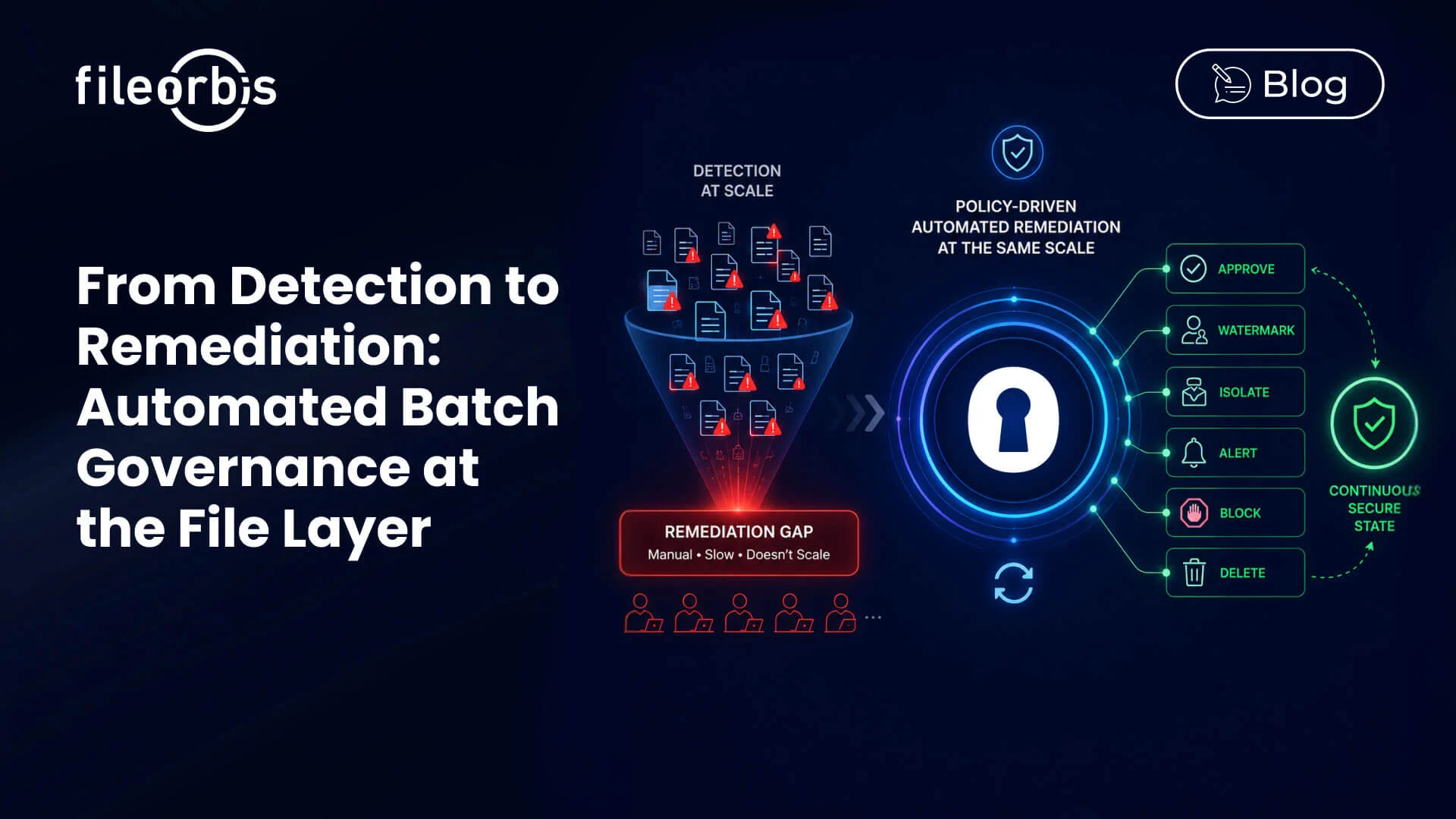
The reason so many DSPM and classification efforts produce a dashboard but not an improvement is structural: detection scales effortlessly, manual remediation doesn’t. A scanner can flag a million files in a night. A person can re-permission, encrypt, or delete a few hundred a day, on a good day, between other work.
So the backlog grows faster than it can be cleared, the risk score stays red, and the project’s value never materializes. The organization knows exactly how exposed it is — and stays that way.
Closing that gap means making remediation scale like detection does. That means automation, driven by the same content awareness that found the problem.
Content-Based Batch Operations
FileOrbis treats remediation as a first-class capability rather than an afterthought. When sensitive content is detected, it can automatically trigger policy-driven actions across all matching files at the scale the detection produced.
The action set is deliberately broad, because “fix it” means different things in different situations:
- Approval: Route the file into an approval flow before it can be shared or moved.
- Watermark: Apply identifying marks so the content carries its own traceability.
- Isolation: Quarantine content that shouldn’t be openly accessible.
- Alarm: Raise an alert for review without disrupting the file.
- Block: Prevent an action outright.
- Delete: Remove redundant, obsolete, or trivial data that has no business surviving.
These run as batch operations with multi-threaded execution and rich filtering, so the remediation keeps pace with the discovery rather than trailing it by months.
Policy, Not Heroics
The deeper shift is from remediation as a project to remediation as a policy. Instead of periodically scanning, reporting, and launching a clean-up campaign, governance policies automatically enforce the right action as conditions are met, such as when sensitive content appears, when it is about to be shared, or when it ages past its relevance.
That changes the economics:
- The first big clean-up still matters, but after it, posture is maintained continuously by policy rather than recovered repeatedly by effort.
- The red dashboard turns green and stays green because the system is doing the work that used to require a campaign.
Why It Has to Be at the File Laye
Remediation only works if it can actually touch the content. A tool that detects across your estate but can only act within one silo leaves most of the backlog untouched.
Because FileOrbis governs files and permissions across NTFS and non-NTFS systems, on premises and in the cloud, remediation reaches the same breadth as detection. There is no “we found it but can’t fix it there” gap.
The Takeaway
Every data security program eventually reaches the point where the report says, “Fix forty thousand files.” The ones that succeed have already answered that question with automated, content-based, policy-driven remediation that scales the same way detection does.
Finding the risk is table stakes. Fixing it at scale, through policy, with a record of every action taken, is what actually strengthens your security posture.
Drowning in a remediation backlog? Talk to FileOrbis about automating it.

Gamze Mat
Product Manager
Subscribe to our Newsletter
About FileOrbis
Aiming to manage the user and file relationship within an institutional framework, FileOrbis is constantly being developed in order to meet different industry and customer needs in terms of file management and sharing. Since 2018, FileOrbis continues to be developed with the excitement of the first day. FileOrbis focuses on high security, rich integration, ease of use and integrated management criteria.