
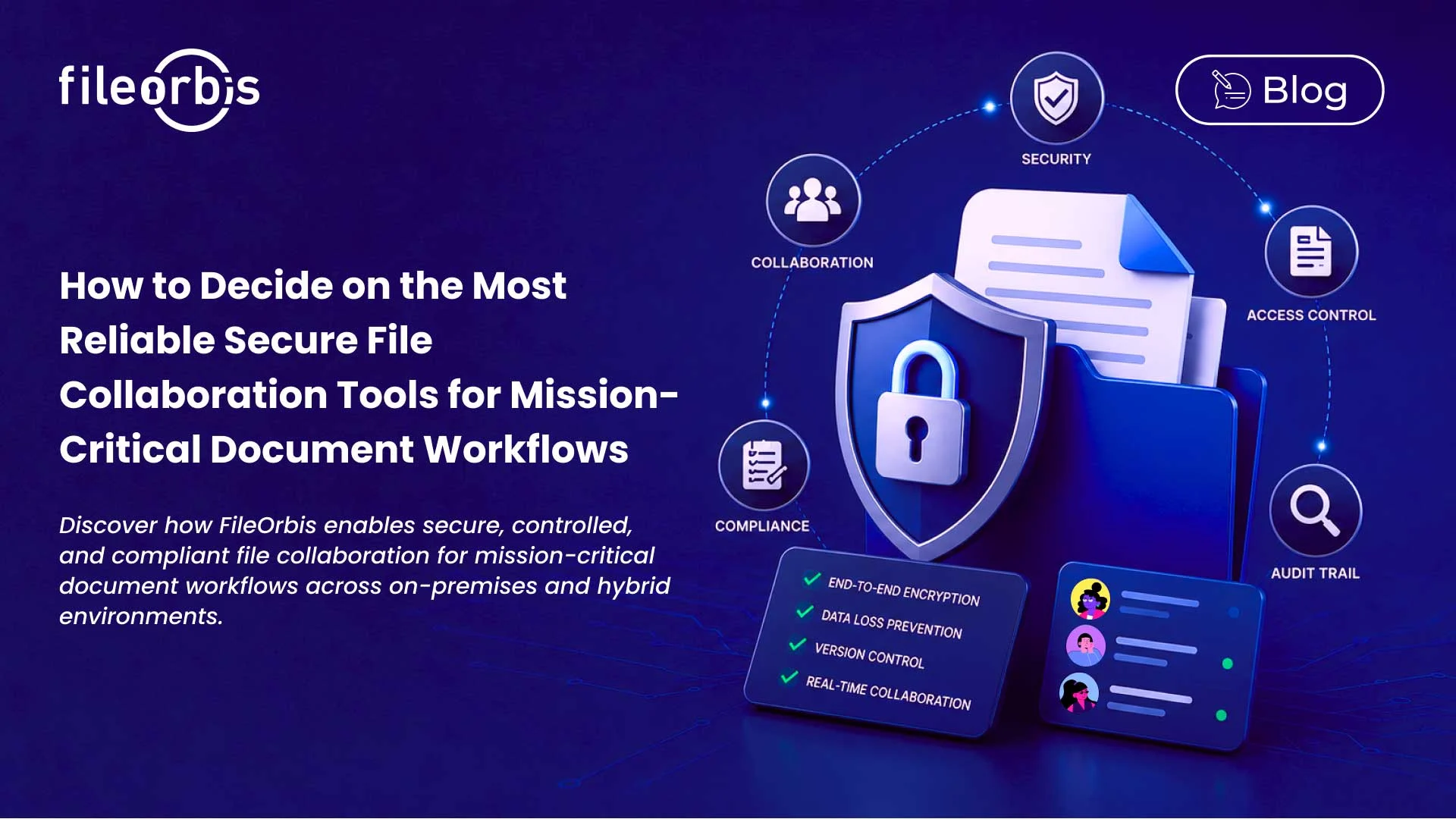
How to Decide on the Most Reliable Secure File Collaboration Tools for Mission-Critical Document Workflows
Mission-critical document workflows require more than basic file sharing. Organizations that handle regulatory, sensitive, or business-critical information need to control where files reside, how they can be shared, who can access them, and what users can do with them.
A reliable and secure file collaboration platform should combine granular access control, content-aware management, digital rights management, controlled sharing, traceability, audit logging, workflow automation, and integration with existing security technologies.
FileOrbis brings these capabilities together across on-premises and hybrid environments, helping enterprises collaborate securely while maintaining organizational control over sensitive data.
Built for Strict Data Privacy and Highly Regulated Industries
FileOrbis is designed for environments where strict data privacy and governance requirements are central to document collaboration. Its on-premises and hybrid deployment options allow organizations to enforce centralized security and governance policies while maintaining control over where sensitive files reside.
This approach can help organizations meet regulatory requirements by keeping sensitive data under organizational control, monitoring file activity, enforcing access policies, and maintaining auditable document workflows.
Granular Access Control for Sensitive Documents
Access control should determine not only who can access a document, but also what they are allowed to do with it.
FileOrbis combines multiple layers of access control:
- Content-based access: Consider file sensitivity and classification when implementing controls.
- Role-based access control: Grant access permissions based on defined user roles and responsibilities.
- Policy-defined access: Determine access according to centrally defined security policies.
- Policy-defined permissions: Control actions permitted according to organizational rules.
For organizations using Active Directory and NTFS, FileOrbis can work with existing permission structures instead of requiring a separate access model.
Content-Aware Management for Sensitive Data
Mission-critical documents should not be managed solely based on their storage location or folder permissions. Security decisions should also consider what the file actually contains.
FileOrbis uses content-aware management to identify sensitive information and implement controls based on content, classification, and organizational policies.
Organizations can do the following:
- Discover sensitive content in enterprise file environments.
- Classify files based on their content and sensitivity.
- Apply context-aware policies for access and sharing.
- Enforce DLP controls when sensitive information is identified.
- Apply tags and protection based on classification.
- Combine content and permissions when making security decisions.
This takes management beyond folder-based security and allows controls to track the actual content and context of the file.
Controlled Sharing and Digital Rights Management
Mission-critical documents often need to be shared with clients, partners, suppliers, auditors, or other external users. FileOrbis helps organizations maintain control during these sharing processes in the following ways:
- Recipient-specific sharing
- Time-bound and revocable access
- Download restrictions
- Usage-based restrictions
- Watermarking
- Approval before external sharing
Organizations can also define how many times or how log content can be used. For example, access may expire after a certain period, or a document may be limited to a specific number of openings or downloads.
With DRM integrations such as Seclore, organizations can extend protection with granular digital rights management capabilities, including screenshot blocking and remote access controls.
Traceability and Audit Logging
For mission-critical workflows, organizations need visibility into how documents are used.
FileOrbis provides audit logging for related activities such as the following:
- File access and views
- Downloads
- Edits
- Permission-related activities
- Other controlled document actions
- Shares
These audit logs provide traceability across sensitive document workflows for security, compliance, and governance teams, and support investigation and reporting requirements.
Integration with Existing Security Technologies
Secure file collaboration should strengthen the existing security architecture rather than creating a new, isolated layer of control.
FileOrbis integrates with enterprise security technologies such as the following:
- Active Directory and identity systems
- SIEM platforms
- Anti-malware technologies
- DLP solutions
- Sandbox solutions
- Other enterprise security systems
Secure Collaboration Across On-Premises and Hybrid Environments
Highly regulated organizations may need modern collaboration without moving sensitive files into a new cloud repository.
FileOrbis supports on-premises and hybrid environments and can manage existing file servers. Organizations can maintain control over data location and existing permissions, while adding centralized management and secure collaboration capabilities.
This allows enterprises to modernize file collaboration without making data migration a prerequisite.
Workflow Automation for Mission-Critical Documents
Security depends on how documents move within business processes. FileOrbis supports controlled workflows such as the following:
- Approval chains
- External sharing approvals
- Classification
- Policy-driven routing
- Retention processes
Automation helps organizations consistently apply management steps instead of relying entirely on manual user decisions.
This is especially valuable for document-heavy processes involving financial records, case files, claims, contracts, and other regulated information.
eDiscovery and Enterprise Search
Compliance, legal, risk, and security teams need to locate relevant information quickly.
FileOrbis supports eDiscovery and enterprise search, helping authorized users find documents in managed file environments while respecting access controls applied to the core content.
This supports investigations, compliance reviews, legal processes, and other use cases where organizations need to access relevant information without creating uncontrolled access.
Supporting Regulatory Requirements
Secure file collaboration must comply with the regulatory and governance requirements under which organizations operate.
Depending on the jurisdiction and industry, FileOrbis capabilities can support controls related to the following:
For example, FileOrbis combines context-aware controls, auditing capabilities, granular access, and flexible deployment to support organizations meeting NIS2, DORA, and GDPR requirements.
Instead of treating compliance as a label, organizations can use these controls to enforce and demonstrate how sensitive documents are governed.
In Summary
Mission- Critical document workflows require more than just secure file transfer. Organizations need to have continuous control over how sensitive information is accessed, shared, classified, and governed.
FileOrbis combines content-aware management, role-based access, controlled sharing, DRM integration, audit logging, workflow automation, eDiscovery, and security integrations across on-premises and hybrid environments.
These features make FileOrbis an ideal solution for highly regulated industries with strict data privacy requirements and mission- critical document workflows.

Gamze Karslı
Head of Marketing
Subscribe to our Newsletter
About FileOrbis
Aiming to manage the user and file relationship within an institutional framework, FileOrbis is constantly being developed in order to meet different industry and customer needs in terms of file management and sharing. Since 2018, FileOrbis continues to be developed with the excitement of the first day. FileOrbis focuses on high security, rich integration, ease of use and integrated management criteria.