
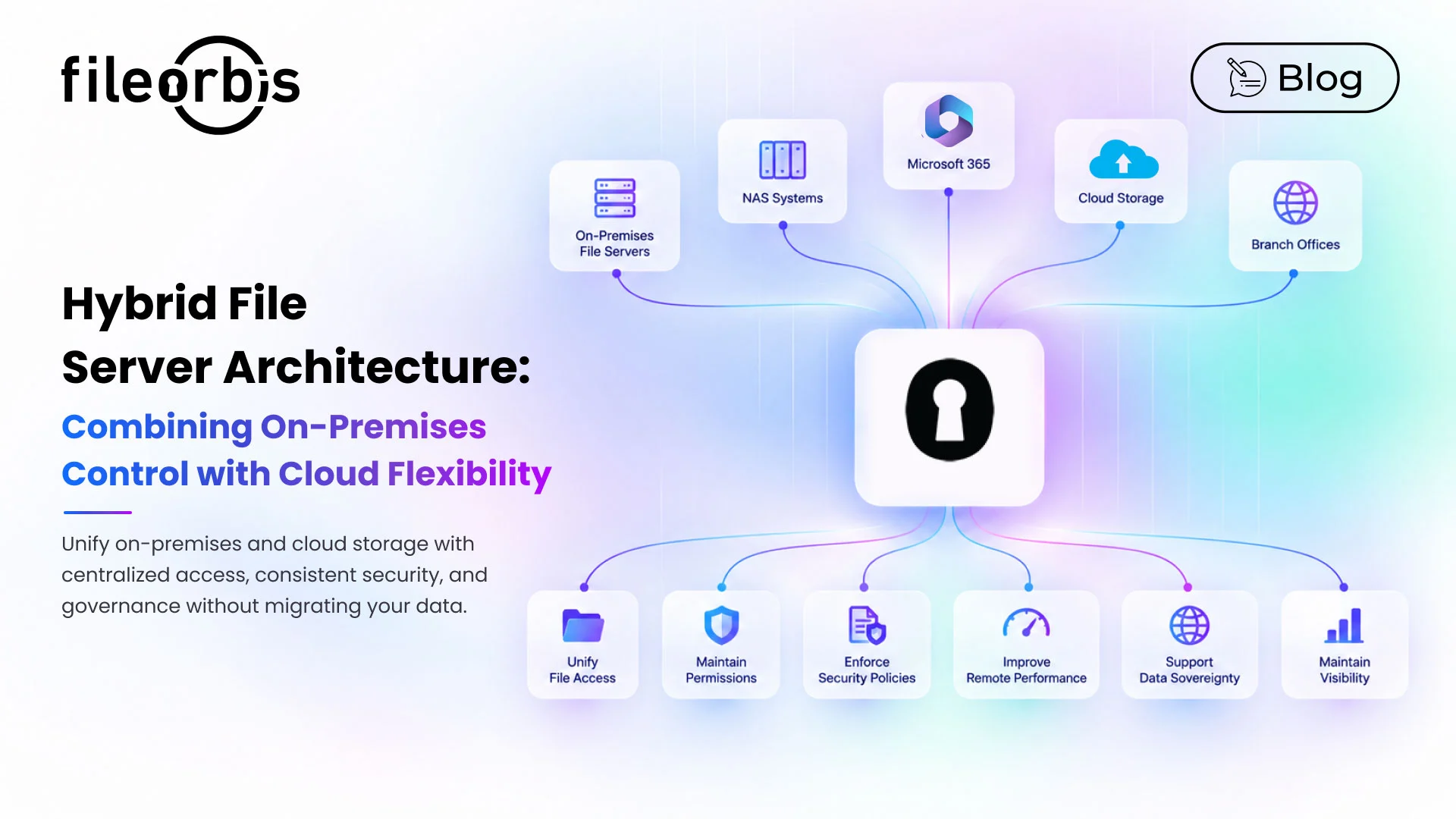
Hybrid File Server Architecture: Combining On-Premises Control with Cloud Flexibility
Enterprises rarely operate entirely on-premises or entirely in the cloud. File servers, NAS systems, M365, object storage, branch offices, and cloud storage are typically found together.
A hybrid file server architecture connects these environments while allowing organizations to decide where different data and workloads should live.
A well-designed architecture should provide:
- Unified access across distributed storage
- Centralized identity and permissions
- Consistent security policies
- Fast access for remote locations
- Flexible workload placement
- Centralized audit logging
- Control over data sovereignty
What is a Hybrid File Server?
A hybrid file server combines on-premises file infrastructure with cloud or object storage while providing consistent access and governance.
Instead of moving all enterprise data to a single repository, organizations can connect different storage environments and manage them as part of a single architecture.
A typical hybrid file server architecture provides users and applications with a unified access layer across file servers, NAS, object storage, and cloud storage. Centralized identity management, security policies, and audit logging ensure consistent governance, while edge caching improves file access performance for remote locations.
Files remain in the storage environment best suited to each workload, while access and governance are managed centrally.
Creating a Central Namespace
Users may have to navigate between separate file shares, NAS systems, SharePoint libraries, or cloud storage depending on where their information is stored.
A central namespace provides a unified structure across these environments.
This can help organizations:
- Simplify file access
- Reduce storage silos
- Connect legacy and modern repositories
- Modernize without migrating every file
FileOrbis follows this approach by connecting existing file and cloud storage without requiring organizations to move their data first.
Use Edge Caching for Remote Locations
Centralized infrastructure can create performance challenges for branch offices and distributed teams, especially when users regularly access large files over WAN connections.
Edge caching keeps frequently accessed content closer to users.
It can help:
- Improve file access performance
- Keep frequently used files available locally
- Reduce WAN traffic
- Avoid replicating the entire file estate
This allows organizations to centralize control while maintaining local performance.
Place Workloads Where They Fit Best
Hybrid architecture should not treat cloud and on-premises infrastructure as competing destinations.
On-premises may be appropriate for:
- Sensitive or regulated data
- Large, stable datasets
- Latency-sensitive workloads
- Workloads requiring direct infrastructure control
Cloud repositories may be appropriate for:
- Elastic capacity
- Cloud-native applications
- Distributed accessibility
- Variable storage requirements
Workload placement should consider performance, regulatory requirements, data sensitivity, operational dependencies, scalability, and cost.
The goal is intentional workload placement, not moving everything to the cloud by default.
Keep Identity and Permissions Consistent
Storage may be distributed, but identity and authorization should remain consistent.
A hybrid file server should integrate with enterprise identity systems and maintain existing access controls as much as possible.
Key considerations include:
- Enterprise identity integration
- MFA where appropriate
- Existing user and group permissions
- Permission-aware file access
- Least-privilege access
Maintaining a consistent authorization model helps reduce over-access and administrative complexity.
Connecting repositories through one interface does not automatically create consistent security.
Organizations still need policies that work across different storage environments.
These may include:
- Sensitive data classification
- External sharing controls
- DLP
- Retention policies
- Download restrictions
- Approval workflows
A common policy layer ensures that security decisions follow data regardless of the underlying repository.
Centralize Audit Logging
Hybrid environments can distribute audit evidence across multiple platforms.
Centralized audit logging should provide visibility into activities such as:
- File access
- Uploads and downloads
- Policy actions
- Sharing
- Permission changes
- Administrative activity
This provides security and compliance teams with a consistent view of file activity across the hybrid environment.
Design Data Sovereignty into the Architecture
One of the advantages of hybrid architecture is that not every file needs to reside in the same location.
Sensitive or regulated data can remain on-premises or within a required jurisdiction, while appropriate workloads can utilize cloud infrastructure.
Organizations should consider:
- Data sensitivity
- Data residency and jurisdiction
- Regulatory requirements
- Administrative access
- Encryption key control
- Cloud dependencies
Data sovereignty is not only about physical file location. Organizations should also understand how metadata, logs, administrative access, identity services, and supporting infrastructure are controlled.
Building a Practical Hybrid File Server Strategy
Organizations should start with workload and data requirements rather than choosing a storage destination first.
Key questions include:
- Where does the data need to reside?
- Which workloads benefit from cloud flexibility?
- Which workloads require local performance?
- Are existing identities and permissions preserved?
- Can repositories share a centralized namespace?
- Do remote offices require edge caching?
- Can policies and audit logging span storage locations?
The answers to these questions help determine where the data should reside and how the architecture should operate.
How FileOrbis Helps
FileOrbis enables enterprises to modernize their hybrid file server architecture without migrating existing data or replacing their storage infrastructure.
By connecting on-premises file servers, NAS, and cloud repositories under a unified governance layer,
FileOrbis helps organizations:
- Unify file access: Connect distributed repositories through a centralized namespace.
- Maintain existing permissions: Maintain identity-based access controls and least-privilege access.
- Enforce consistent policies: Apply content-aware security and sharing controls across storage environments.
- Improve remote performance: Use Edge Cache to accelerate file access across branch offices.
- Support data sovereignty: Keep sensitive files in their existing locations while enabling secure collaboration.
- Maintain visibility: Centralize audit logging and file activity monitoring.
In Summary
A hybrid file server architecture combines on-premise control with cloud flexibility without making migration the default strategy.
Centralized access, edge caching, consistent identities and policies, audit logging, and informed workload placement enable diverse storage environments to operate as a single architecture.
FileOrbis supports this model by connecting existing file and cloud storage, allowing organizations to manage data where it already lives.

Emre Demiray
Founder – FileOrbis
Subscribe to our Newsletter
About FileOrbis
Aiming to manage the user and file relationship within an institutional framework, FileOrbis is constantly being developed in order to meet different industry and customer needs in terms of file management and sharing. Since 2018, FileOrbis continues to be developed with the excitement of the first day. FileOrbis focuses on high security, rich integration, ease of use and integrated management criteria.