
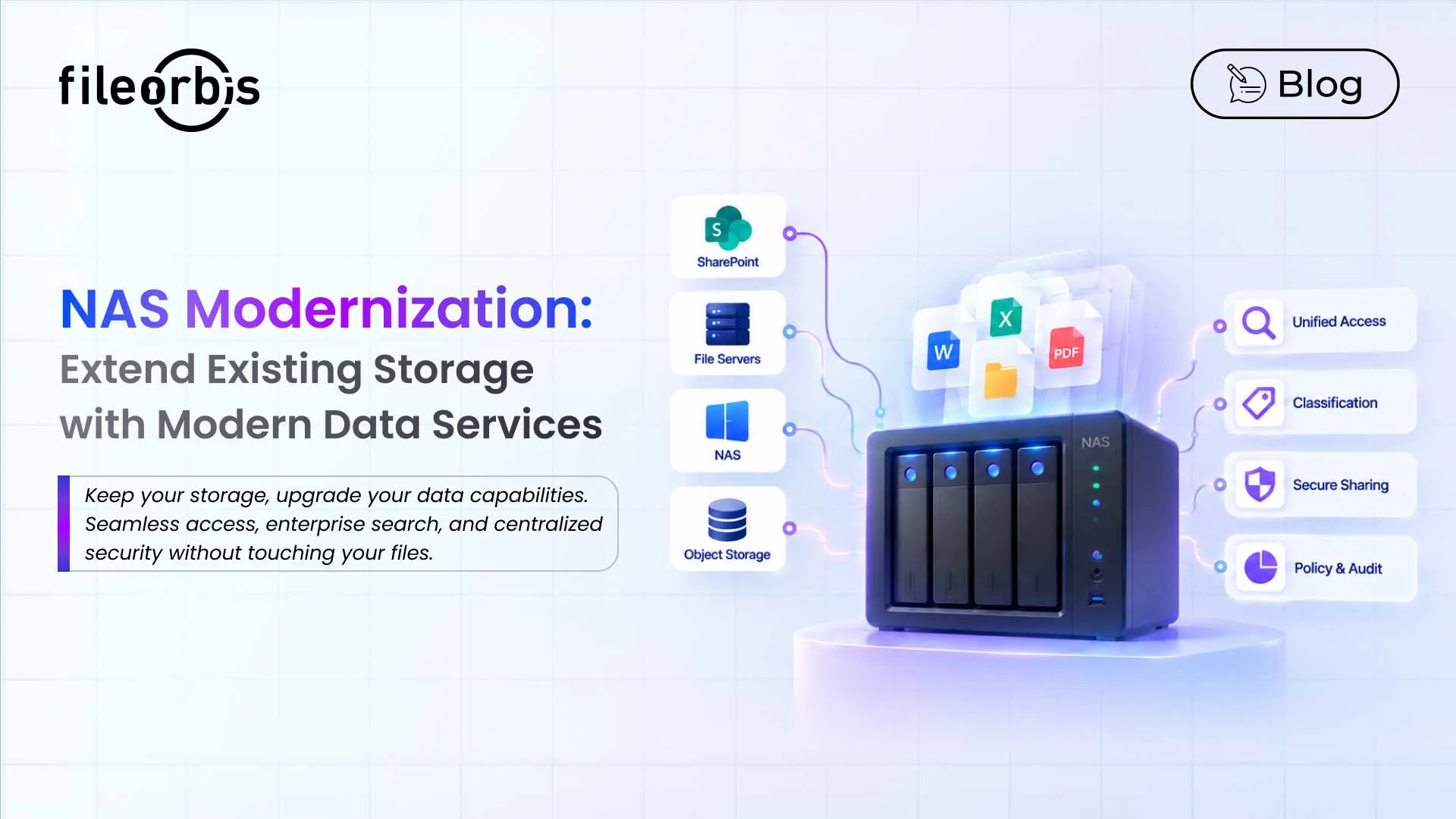
NAS Modernization: Extend Existing Storage with Modern Data Services
Enterprise storage environments are rarely depend on a single platform. Years of infrastructure growth, regional requirements, acquisitions, and capacity expansion typically result in a mix of file servers, NAS systems, object storage, and cloud storage.
The storage unit itself may still perform well. The challenge is that users and IT teams increasingly need better access, search, secure sharing, governance, and visibility.
NAS modernization addresses the gap not by simply replacing the storage unit, but by expanding existing storage space with modern data services.
Why Modernize NAS Systems Instead of Replacing It?
Replacing an existing NAS platform simply to gain modern capabilities can introduce unnecessary costs and operational risks. Large environments can contain terabytes or petabytes of files, application dependencies, complex permissions, and established workflows.
A more flexible approach is to separate storage capacity from data services. While existing systems continue to store files, a service layer provides the capabilities needed by users, security teams, and IT operations.
This approach can help enterprises:
- Protect existing NAS and storage investments
- Maintain current infrastructure preferences
- Reduce large-scale migration requirements
- Avoid unnecessary storage provider dependency
- Add new capabilities gradually
- Modernize file access without redesigning every storage unit
Challenges of Multi-Vendor NAS Environments
Many businesses use different NAS platforms across business units, regions, data centers, or acquired organizations. Each system may have its own unique management model, permissions, search capabilities, and sharing processes.
In conclusion:
- Users need to know where files are stored
- Search experiences vary across data repositories
- Access and sharing controls differ
- Metadata may be inconsistent
- Standardizing governance becomes more difficult
- IT teams manage multiple interfaces and policies
Therefore, instead of forcing everything into a single storage system, NAS modernization should focus on creating a consistent data services layer across storage systems.
Modern Data Services to Add Above Existing NAS
Unified Access
Users should not need to understand the underlying storage architecture to find and work with files.
A unified access layer can bring together NAS, file servers, SharePoint, object storage, and cloud storage while allowing files to remain in their current locations.
Classification and Metadata
Traditional folder structures provide limited business context. Modern data services can enrich files with classifications and metadata such as:
- Department
- Document type
- Project
- Sensitivity level
- Business context
- Custom tags
This information can support more effective search, lifecycle management, governance, and policy enforcement processes.
Federated Enterprise Search
Enterprise search should operate across storage boundaries while respecting existing permissions.
Key capabilities include the following:
- Full-text indexing
- Metadata-based search
- Unified content and metadata queries
- Filters and redirects
- Permission-aware security trimming
Users receive a consistent search experience without accessing content they don’t have permission to view.
Secure External Sharing
Traditional NAS platforms are primarily designed for internal file access. Modernization can expand them through controlled external collaboration without creating another unmanaged storage silo.
Organizations can apply controls such as the following:
- Recipient restrictions
- Connection expiration
- Access revocation
- Approval workflows
- Download restrictions
- Watermarking
- Audit logging
Centralized Policy Controls
When files are distributed across multiple systems, governance policies can become inconsistent. A centralized control layer can enforce common rules on:
- Access permissions
- Sensitive data protection
- Data classification
- External sharing
- Retention duration
- Approval workflows
- File activity monitoring
This helps IT and security teams apply policy consistently across heterogeneous storage environments.
Visibility and Analytics
Storage usage alone does not explain how enterprise data is used.
Modern data services can provide visibility into file activity, permissions, access patterns, sharing events, sensitive content, and governance actions. This gives infrastructure and security teams a better context to manage risk and optimize file environments.
Why Separate Storage Capacity from Data Services?
Storage infrastructure and enterprise data services don’t need to evolve at the same pace.
By separating these two structures, organizations can continue to use NAS platforms that meet their capacity and performance requirements, while independently improving search, governance, security, collaboration, and user access.
This allows infrastructure teams to make future storage decisions based on capacity, lifecycle, performance, and business requirements, rather than simply replacing systems because they lack modern data services.
How FileOrbis Helps
FileOrbis provides a unified layer between NAS, Windows file servers, SharePoint, object storage, and cloud environments.
Organizations can extend their existing file infrastructure with the following:
- Unified access across different storage locations
- Metadata and data classification
- Full-text and metadata-based enterprise search
- Permission-aware access controls
- Content-aware secure sharing
- Centralized policy enforcement
- Integration with existing security infrastructure
- File activity visibility and audit logging
FileOrbis enables organizations to modernize their file services while maintaining their infrastructure choice by providing data governance where it already resides.
In multi-vendor environments, this creates a consistent layer of access and governance across storage systems, rather than creating another isolated repository.
In Summary
NAS modernization doesn’t have to start with replacing the storage unit. Enterprises can maintain their existing infrastructure while adding unified access, enterprise search, metadata, secure sharing, policy controls, and analytics.
Separating storage capacity from data services offers a more flexible path to modernization and allows organizations to upgrade their file environments without making large-scale migration a prerequisite.
Frequently Asked Questions
What is NAS modernization?
NAS modernization extends existing network-attached storage systems with capabilities such as unified access, enterprise search, metadata, secure sharing, governance, and analytics.
Does NAS modernization require data migration?
Not necessarily. The data services layer can provide modern capabilities while files remain on existing NAS and storage systems.
How does FileOrbis help with NAS modernization?
FileOrbis connects NAS and other enterprise file environments through a unified access and governance layer, enabling data to be managed where it already resides while adding search, classification, secure sharing, policy enforcement, and auditability.

Emre Demiray
Founder – FileOrbis
Subscribe to our Newsletter
About FileOrbis
Aiming to manage the user and file relationship within an institutional framework, FileOrbis is constantly being developed in order to meet different industry and customer needs in terms of file management and sharing. Since 2018, FileOrbis continues to be developed with the excitement of the first day. FileOrbis focuses on high security, rich integration, ease of use and integrated management criteria.