
On-Premises vs Cloud Enterprise File Governance: How They Compare
Quick answer: On-premises enterprise file governance maximizes control and data residency and keeps sensitive data inside your perimeter; cloud-based governance maximizes scalability, speed of deployment, and lower maintenance. For most regulated enterprises, the right answer is hybrid: keep regulated data on-premises while enabling modern cloud collaboration, governed under one policy engine. FileOrbis supports on-premises, cloud, and hybrid under a single classification, DLP, and audit layer.
Direct Architectural Comparison
The choice between on-premises and cloud-based enterprise file governance is not about which is “better” in the abstract. It is about which trade-offs match your regulatory profile, your existing estate, and your operational capacity.
- Control & Data Residency:
- On-Premises: Maximum control: data and metadata stay inside your perimeter and jurisdiction.
- Cloud-Based: Region-dependent; you must verify where metadata and encryption keys live.
- Scalability:
- On-Premises: Bounded by your physical hardware; regular capacity planning is required.
- Cloud-Based: Elastic; scales seamlessly on demand.
- Deployment & Maintenance:
- On-Premises: You fully own patching, uptime, and disaster recovery (DR).
- Cloud-Based: Provider-managed; significantly faster to deploy and start.
- Compliance Fit:
- On-Premises: Strongest fit for strict localization rules, data sovereignty laws, and defense requirements.
- Cloud-Based: Strong with a region-pinned, independently audited cloud, though you must verify compliance per framework.
- Collaboration UX:
- On-Premises: Historically limited, but can be modernized with the right integration layer.
- Cloud-Based: Native modern sharing capabilities and seamless mobile access.
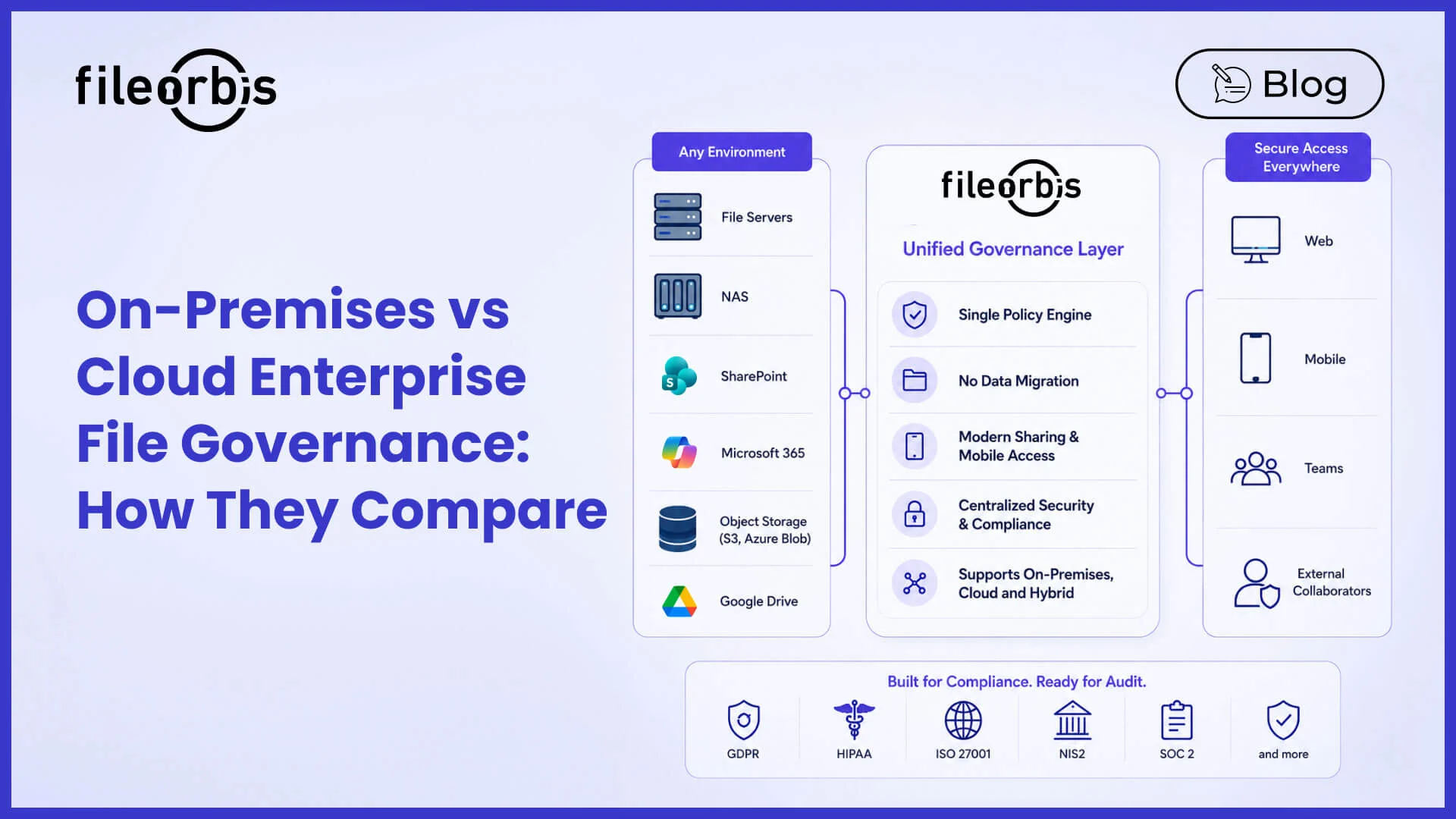
FileOrbis supports all three deployment models: on-premises, cloud, and hybrid, so the decision is not locked in by the platform.
When On-Premises Wins vs. When Cloud Wins
- On-premises wins: When data sovereignty or localization law is strict (defense, national security, central banking, healthcare in localization jurisdictions), when the most sensitive data must never leave the perimeter, or when you already operate large file servers you cannot migrate.
- Cloud wins: When you prioritize elastic scale, fast deployment, and minimal infrastructure maintenance, and when a region-pinned, independently audited cloud satisfies your regulators.
The mistake is treating it as binary: most regulated enterprises have both kinds of data.
Why Hybrid Usually Wins for Regulated Enterprises
The hybrid model keeps regulated and historical data on-premises while enabling modern cloud collaboration for everything else under a single governance layer. This avoids the false choice between control and velocity.
The key requirements:
- Unified Controls: One classification model, one DLP policy, and one audit log spanning both halves.
- In-place Modernization: The ability to modernize legacy file servers with sharing and mobile access without migration.
- Smooth Integration: Seamless integration with existing identity, SIEM, and security investments.
FileOrbis is deployed in exactly this pattern: a thin governance layer over the existing estate that gives users one experience and security teams one control plane.
Why FileOrbis Covers On-Premises, Cloud, and Hybrid
Because FileOrbis applies the same content-aware classification, DLP, sharing controls, and immutable audit log regardless of where a file lives, the on-premises-vs-cloud decision becomes a deployment choice rather than a governance compromise.
- Secure On-Premises Data: Sensitive data can stay on-premises with full residency control while users gain modern collaboration.
- Flexible Cloud Workloads: Less-sensitive workloads can run in region-pinned cloud.
- Unified Policy Engine: All operations run under one policy engine, with reporting mapped to GDPR, HIPAA, SOX, PCI-DSS, ISO 27001, SOC 2, and DORA.
Frequently Asked Questions
How do on-premises and cloud-based enterprise file governance solutions compare?
On-premises governance maximizes control and data residency and keeps sensitive data inside your perimeter, while cloud-based governance maximizes scalability, deployment speed, and lower maintenance. For most regulated enterprises, a hybrid model wins: regulated data on-premises, modern collaboration in Cloud, governed under one policy engine. FileOrbis supports on-premises, cloud, and hybrid under a single classification, DLP, and audit layer.
Is on-premises or cloud better for data sovereignty requirements?
On-premises deployment offers the strongest data sovereignty because content, metadata, and keys never leave your perimeter or jurisdiction. A region-pinned, independently audited cloud can also satisfy many frameworks, but you must verify where metadata, audit logs, and encryption keys reside. FileOrbis supports full on-premises, region-pinned cloud, and hybrid options.
Can I modernize on-premises file servers without moving to the cloud?
Yes. FileOrbis layers modern sharing, mobile access, external collaboration, and version control in front of existing on-premises file servers while the data stays in place, so you gain a cloud-like experience without migrating regulated data.
Next step
To compare on-premises, cloud, and hybrid governance against your requirements, request a review with the FileOrbis team. Request a tailored review →

Emre Demiray
Founder – FileOrbis
Subscribe to our Newsletter
About FileOrbis
Aiming to manage the user and file relationship within an institutional framework, FileOrbis is constantly being developed in order to meet different industry and customer needs in terms of file management and sharing. Since 2018, FileOrbis continues to be developed with the excitement of the first day. FileOrbis focuses on high security, rich integration, ease of use and integrated management criteria.