
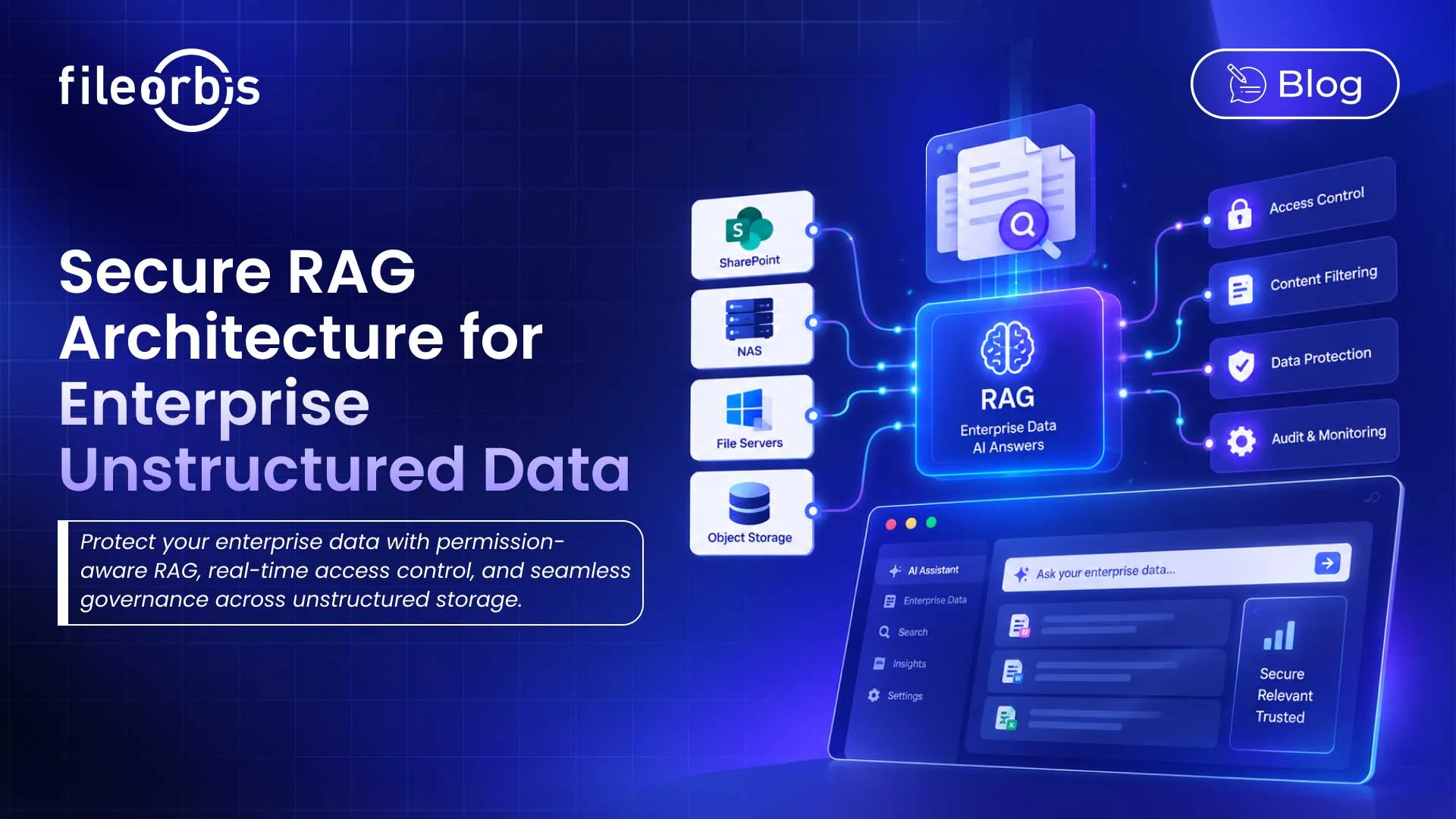
Secure RAG Architecture for Enterprise Unstructured Data
Retrieval-Augmented Generation (RAG) allows enterprises to use internal documents as AI-powered data sources. However, as file servers, NAS, SharePoint, cloud storage, and other repositories connect to AI, existing security controls must work throughout the RAG pipeline.
A secure RAG architecture must control who can access information, what content can reach the model, which model can process it, and what the AI can return.
Why Enterprise RAG Needs a Security Architecture
A typical RAG pipeline includes repository connection, vector storage, retrieval, indexing, LLM processing, and response generation. As a result, security gaps at any stage can expose sensitive enterprise data.
Key risks include the following:
- Loss of repository permissions during indexing
- Use of outdated permissions during retrieval
- Unauthorized retrieval of restricted documents
- Intrusion of sensitive content into prompts or embeds
- Directing data to an inappropriate AI model
- AI responses revealing restricted information
Therefore, secure RAG requires security controls throughout the entire process.
Establish Identity at the Time of Query
Every request should begin with a verified corporate identity. Then, the RAG system must know who is requesting the information before deciding what information can be retrieved.
Key controls include the following:
- Enterprise identity integration
- Role-basec access control and authorization context
- User and group mapping
- Session validation
- Least privilege access
Identity forms the basis for permission-aware access.
Maintaining Repository Security Context
Connecting a repository shouldn’t flatten the security model. The RAG pipeline should protect:
- File and folder permissions
- Repository location
- Classification and metadata
- Ownership and security groups
- File modification state
As a result, this keeps AI access consistent with the original source controls.
Synchronizing Permissions with Data Retrieval
Enterprise permissions change often as employee roles shift, teams reorganize, and files are moved.
Therefore, a secure RAG architecture should synchronize these changes and apply existing permissions when retrieving information.
Being indexed should never mean being authorized.
For example, if users cannot access a document in the source repository, they should not be able to retrieve their information via AI either.
Securing Vector Databases
Vector databases are part of the enterprise security perimeter because embedded data and metadata can contain sensitive enterprise data.
Key controls include the following:
- Authentication and authorization
- Encryption
- Metadata-based access filtering
- Tenant or business unit isolation
- Secure deletion and reindexing
- Index lifecycle controls
- Synchronization with source permissions
Therefore, a vector repository should never become a path around repository security.
Apply Content-Aware Filtering
However, permission alone may not enough. An authorized document may contain information that should not be processed by a specific model or included in the AI response.
Context-aware controls can identify:
- Personal or financial information
- Identity information and secrets
- Sensitivity classifications
- Confidential business data
- Regulatory records
As a result, policies can then restrict, anonymize, mask, or exclude sensitive content before model processing.
Permission-aware access controls which documents can be retrieved, while content-aware filtering controls how the information within those documents can be used.
Control Model Routing
Enterprises can use local models, custom AI environments, and approved cloud LLMs for different workloads.
Model routing policies should consider:
- User context
- Repository
- Data classification
- Data location requirements
- Processing location
- Approved AI providers
For example, highly sensitive information may be restricted to validated custom or local models.
Validating AI Responses
Security should continue even after generation. Before the response reaches the user, validation checks can verify the following:
- Sensitive information
- Restricted topics
- Policy violations
- Source authorization
- Citation validity
This helps prevent unauthorized data exposure, even after data retrieval and model processing.
Log RAG Activity
Security and compliance teams need visibility into how AI uses enterprise data.
The audit log should include:
- User identity and query
- Sources retrieved
- Permission decisions
- Content filtering actions
- Policy decisions
- Model selected
- Response generated
- Timestamp and result
In addition, relevant events can also be fed into existing SIEM and security monitoring workflows.
Common Secure RAG Failure Scenarios
- Legacy permissions: Access to the source repository is removed but remains available through AI retrieval.
- Vector-store exposure: Users retrieve embedded data or metadata outside their authorized scope
- Over-broad indexing: Sensitive repositories enter the knowledge base without proper scope controls.
- Wrong model routing: Sensitive data is processed by an unapproved model or location.
- Sensitive content leakage: Restricted information reaches the model without masking or filtering.
- Cross-user leakage: Context retrieved from one user becomes accessible to another user.
- Missing audit evidence: Teams cannot determine which sources or policies contributed to an AI response.
Secure RAG Architecture Checklist
Before deploying enterprise RAG, ensure the architecture icludes:
- Enterprise identity authentication
- Secure repository connections
- Permission enforcement upon access
- Continuous permission synchronization
- Sensitive data discovery and classification
- Content masking, restriction, or anonymization.
- Policy-based model routing
- Vector index access controls and isolation
- Response validation and security measures
- Query and access audit logging
- Source attribution
- Integration with security monitoring
How Fileorbis Helps
FileOrbis integrates AI and RAG workflows into enterprise file governance through the following:
- Sensitive data discovery and AI-based classification
- Awareness of existing permissions and ACLs
- Permission-aware access
- Real-time content and permission synchronization
- Content-aware filtering and anonymization
- Support for local and cloud models
- AI guardrails
- AI interaction monitoring and audit logging
As a result, FileOrbis helps organizations enable governed AI access without requiring repository migration by applying content-aware and permission-aware controls where enterprise data already resides.
In Summary
Secure RAG is more than just a protected vector database or a private LLM. It connects identity, classification, permissions, content controls, response validation, model routing, and audit logging processes across the RAG pipeline.
For enterprise unstructured data, this approach helps prevent AI from becoming a new path around governance policies, and existing security.
Frequently asked Questions
What is secure RAG?
Secure RAG protects enterprise data with identity, permission, model, content, and tracking controls.
Why are repository permissions important for RAG?
They ensure that users can only access information for which they have authorization.
How does FileOrbis help with the secure RAG?
FileOrbis helps secure RAG with permission-aware access, content-aware controls, guardrails, AI-based classification, and audit logs.

Faris Suleiman
Presales Manager, KSA & Egypt
Subscribe to our Newsletter
About FileOrbis
Aiming to manage the user and file relationship within an institutional framework, FileOrbis is constantly being developed in order to meet different industry and customer needs in terms of file management and sharing. Since 2018, FileOrbis continues to be developed with the excitement of the first day. FileOrbis focuses on high security, rich integration, ease of use and integrated management criteria.