
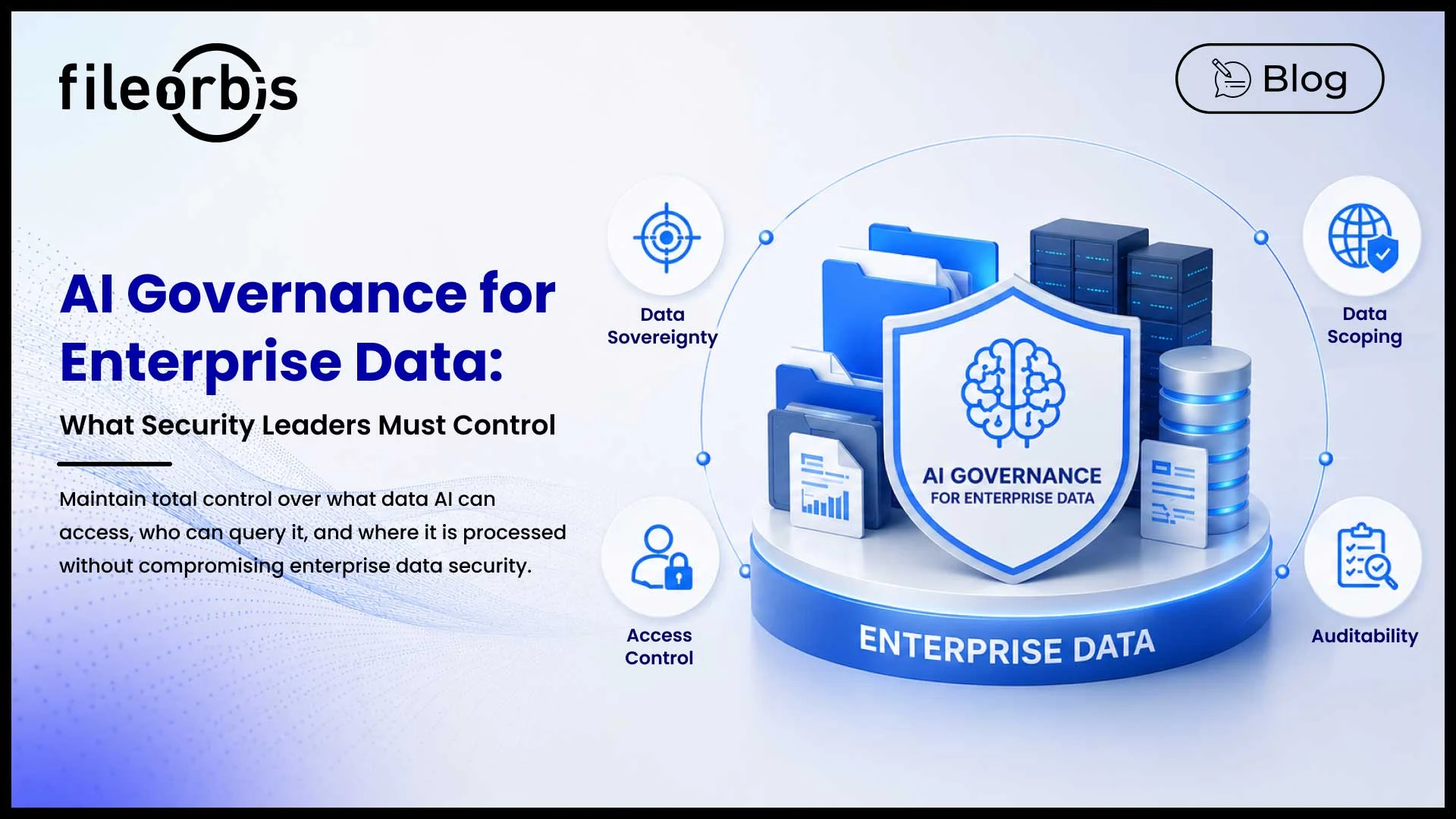
AI Governance for Enterprise Data: What Security Leaders Must Control
Enterprise AI is changing the way employees access, analyze, and interact with corporate information. But as AI systems gain access to internal documents, file shares, M365 environments, SharePoint environments, object storage, and other data repositories, a new security challenge arises: Which corporate data should AI be allowed to access?
This is where AI governance becomes critically important.
From a data security perspective, AI governance is not just about responsible model behavior. It is about controlling the relationship between users, enterprise data, and AI systems: encompassing what data goes into AI workflows, who can access that data, where the data is processed, what permissions apply, and how each interaction is monitored.
What Is AI Governance?
AI governance is the set of policies, controls, and oversight mechanisms used to ensure that AI systems operate within an organization’s compliance, privacy, and security boundaries.
Effective AI governance of enterprise data shoul answer fundamental questions:
- What data can AI access?
- Who is allowed to query this data?
- Where are retreived content, prompts, and embeddings processed?
- Can AI interactions and data access be monitored?
- Do existing permissions continue to apply in AI workflows?
Control Which Data AI Can Use
AI should not have access to every document simply because it can connect to the repository.
Enterprise environments contain contracts, financial records, intellectual property, identification information, employee information, customer data, and other sensitive content.
Therefore, AI governance begins with understanding and controlling the data that is made available to the AI.
Security teams should be able to following:
- Discover sensitive data across repositories.
- Enforce classification-based policies.
- Categorize files based on their content and sensitivity.
- Exclude restricted files, folders, or data classes from AI processing.
- Mask, anonymize, or block sensitive information before AI processing.
This situation directly links AI governance to unstructured data governance. If an organization does not know the contents of its files, it cannot reliably decide which AI should be allowed to be used.
Control Who Can Access Enterprise Data
Access to an AI system should never mean access to every file behind that system.
Existing permissions, including ACLs, NTFS permissions, Active Directory, roles, and security groups, should continue to determine what each user can access.
An AI architecture that considers permissions checks user authorization during information access, so the AI only uses information that the requesting user already has access to. Without this control, the AI could find a new way to existing permissions.
Control Where the AI Processing Is Taking Place
AI governance should encompass not only where files are stored, but also where their contents are processed.
Security leaders should understand the following:
- Where the prompts are processed.
- Where embedded vectors and indexes are stored.
- Whether the retrieved content reaches external LLMs.
- Whether native models can be used.
- Whether sensitive information can be anonymized.
This is especially important for organizations with privacy, data sovereignty, or regulatory requirements.
Monitoring AI Access and Outputs
Compliance and security teams also need information regarding AI interactions.
Organizations should be able to identify the following:
- Who sent the query?
- Which documents contributed to the answer?
- Which data sources were used?
- Was sensitive information blocked or anonymized?
- What response did the AI generate?
- Which governance policies were triggered?
This creates a controllable chain between the user, the command prompt, policy decision, enterprise data, and the AI response.
Extending Existing Permissions to AI
AI should not create a separate permission model.
If a document is restricted, the availability of AI should change accordingly.If access to a file is revoked, AI access should also be revoked.
Therefore, effective AI governance connects the following:
- Data classification
- Identity and access permissions
- File and folder access control lists (ACLs)
- Retrieva policies
- AI indexes and knowledge bases
This ensures that access to AI remains compliant with existing enterprise data controls.
AI Governance Begins with Data Governance
AI governance should not be treated as an entirely separate security layer. It builds upon the controls that organizations already use for enterprise data:
- AI-based classification
- Sensitive data discovery
- Permission analysis
- Data loss prevention and policy enforcement
- Data residency
- Least privileged access
- Auditability
The difference is that these controls now need to track data all the way to AI access, embeddings, prompts, and generated responses.
How FileOrbis is Expanding Data Governance to AI?
Instead of creating a separate AI permission model, FileOrbis integrates existing file governance controls with enterprise AI.
It helps organizations with the following:
- Discover and classify sensitive corporate data.
- Filter or anonymize sensitive content.
- Control which content is accessible to AI.
- Enforce existing user permissions during data retrieval.
- Support local or cloud-based AI processing models.
- Synchronize content and permission changes with AI.
- Monitor AI interactions.
This allows enterprise data to be governed where it already resides, while also extending content and permission-driven governance to AI workflows.
In Summary
AI governance is fundamentally a data control problem.
Security leaders need to know what AI can access, who can access this information, where the information is processed, which policies apply, and whether these interactions are verifiable.
Extending existing unstructured data governance to AI allows enterprises to adopt AI without creating an uncontrolled pathway to sensitive information.
Frequently Asked Questions
What is AI governance?
AI governance brings together policies and technical controls that determine how AI systems access, process, and use enterprise data, while protecting privacy, security, and accountability.
Why is AI governance important for enterprise data?
AI is creating a new way to access sensitive information. Governance ensures that AI uses verified data while guaranteeing that existing access and security controls remain effective.
How does FileOrbis support AI governance?
FileOrbis combines discovery, classification, policy enforcement, permission-aware access, sensitive data protection, and auditing to control how AI systems access and use enterprise data.

Emre Demiray
Founder – FileOrbis
Subscribe to our Newsletter
About FileOrbis
Aiming to manage the user and file relationship within an institutional framework, FileOrbis is constantly being developed in order to meet different industry and customer needs in terms of file management and sharing. Since 2018, FileOrbis continues to be developed with the excitement of the first day. FileOrbis focuses on high security, rich integration, ease of use and integrated management criteria.