
Unstructured Data for AI: How to Prepare and Govern Enterprise Data
Enterprise AI applications rely on unstructured data for AI stored across file servers, NAS systems, SharePoint, and cloud repositories. These environments contain valuable business knowledge, but they also hold sensitive documents, inconsistent permissions, and outdated information.
To effectively use unstructured data for AI, organizations need to prepare existing content for retrieval while maintaining security and governance controls. Without this preparation, AI applications may struggle to distinguish relevant business information from content that should remain restricted.
What is Unstructured Data for AI?
Unstructured data for AI refers to enterprise content that AI applications can analyze or retrieve without relying on predefined database structures.
Examples include:
- Financial Records: Financial statements and invoices.
- Business Documents: Contracts, reports, and policies.
- Employee Records: HR documents and personnel files.
- Technical Content: Engineering drawings and specifications.
- Knowledge Repositories: Presentations, PDFs, and archived documents.
Retrieval-Augmented Generation (RAG) allows AI applications to use this information as context when generating responses.
For example, employees can ask questions about technical documentation or internal procedures and receive answers based on relevant enterprise files instead of manually searching multiple repositories.
Key Challenges of Using Unstructured Data for AI
Connecting enterprise files to AI applications introduces several challenges:
- Sensitive Data Exposure: Confidential information may enter AI workflows without appropriate restrictions.
- Fragmented Storage: Distributed storage makes enterprise content difficult to discover and manage.
- Excessive Permissions: Broad file access rights can increase the risk of unauthorized AI retrieval.
- Outdated Content: Obsolete information can reduce the accuracy of AI-generated responses.
- Missing Classification: Unlabeled documents make sensitivity-based policies difficult to enforce.
- Limited Auditability: Organizations may lack visibility into AI access and retrieval activities.
These challenges become even more significant as organizations expand the use of AI across departments and connect additional corporate data sources.
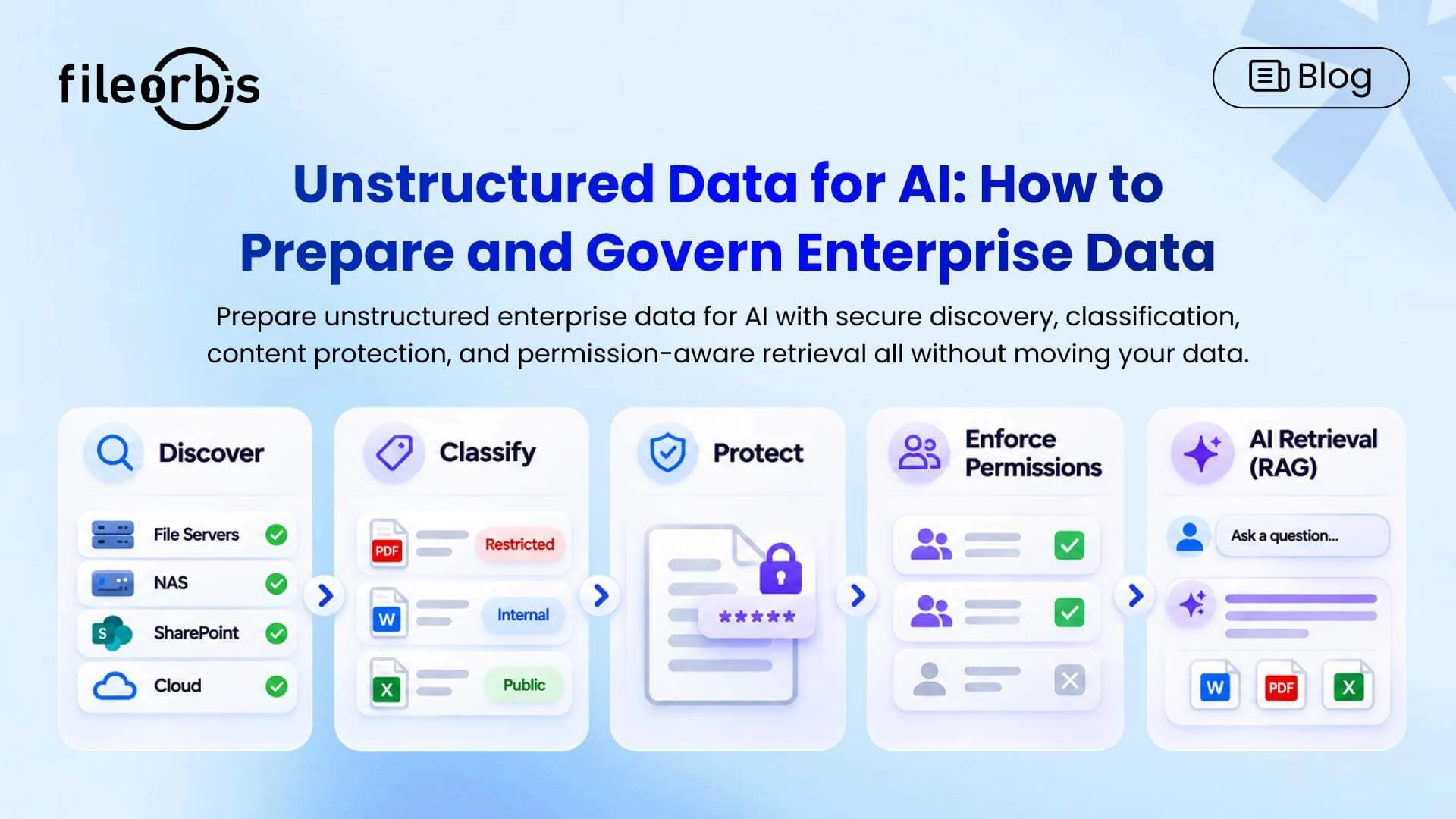
How to Prepare Unstructured Data for AI
- Discover Enterprise Content
Identify relevant files across on-premises and cloud repositories. Understand where sensitive information resides before connecting data sources to AI applications.
Data discovery also helps identify outdated or redundant documents that could reduce the relevance of AI retrieval results.
- Classify Sensitive Information
Use content-based classification to distinguish public, confidential, internal, and restricted information. Apply these classifications when defining AI access policies.
This allows organizations to establish different processing rules for general business documents and highly sensitive records.
- Apply Content-Aware Protection
Protect sensitive information before it enters AI processing workflows.
Depending on security requirements, organizations can:
- Exclude restricted files.
- Anonymize confidential identifiers.
- Mask personally identifiable information (PII).
- Filter documents using content-based policies.
- Enforce File Access Permissions
Ensure AI retrieval respects existing user permissions, including NTFS and ACL-based access controls.
Permission checks should be performed during file retrieval to prevent AI applications from disclosing information beyond the user’s authorized access.
- Keep AI Retrieval Current and Auditable
Account for document updates and permission changes so that AI applications can retrieve relevant and authorized information.
Maintain audit records to support investigations and security reviews. These records also help organizations assess whether their AI access policies are working as intended.
How FileOrbis Helps
FileOrbis AI Governance extends enterprise file governance into AI applications without requiring organizations to migrate their existing files.
Its capabilities include:
- AI-Based Discovery and Classification: Identify sensitive enterprise content across distributed repositories.
- Content-Aware Protection: Filter, anonymize, or mask sensitive information before AI processing.
- Permission-Aware RAG: Apply existing file permissions to AI retrieval.
- Granular Policy Enforcement: Control AI access based on file location, type, size, and classification.
- Flexible Deployment: Integrate with local or cloud-based language models.
- Monitoring and Audit Logging: Track AI interactions and security policy decisions.
Instead of creating separate copies of enterprise information for AI, FileOrbis helps organizations apply governance controls to existing data sources. This approach supports secure AI adoption while reducing the need for infrastructure changes.
Learn more about FileOrbis AI Governance.
In Summary
Unstructured data can make enterprise AI more useful, but unmanaged content can undermine security and response quality.
Organizations that build effective data preparation and governance practices can support AI adoption without losing control over sensitive information.
FileOrbis AI Governance helps organizations achieve this by extending existing file security and governance controls to AI workflows without requiring data migration.
Frequently Asked Questions
- What types of unstructured data can enterprise AI use?
Enterprise AI can use contracts, reports, technical documentation, spreadsheets, PDFs, and other business files, depending on the application’s retrieval capabilities.
- Why are file permissions important for enterprise AI?
File permissions determine what information users are authorized to access. Enforcing these during AI data retrieval helps prevent the disclosure of restricted documents through generated responses.
- Can FileOrbis govern unstructured data for AI without data migration?
Yes. FileOrbis AI Governance connects to existing enterprise repositories and applies permission-aware and content-aware controls without requiring source files to be migrated.

Mert Topaloğlu
Senior Presales Consultant
Subscribe to our Newsletter
About FileOrbis
Aiming to manage the user and file relationship within an institutional framework, FileOrbis is constantly being developed in order to meet different industry and customer needs in terms of file management and sharing. Since 2018, FileOrbis continues to be developed with the excitement of the first day. FileOrbis focuses on high security, rich integration, ease of use and integrated management criteria.