
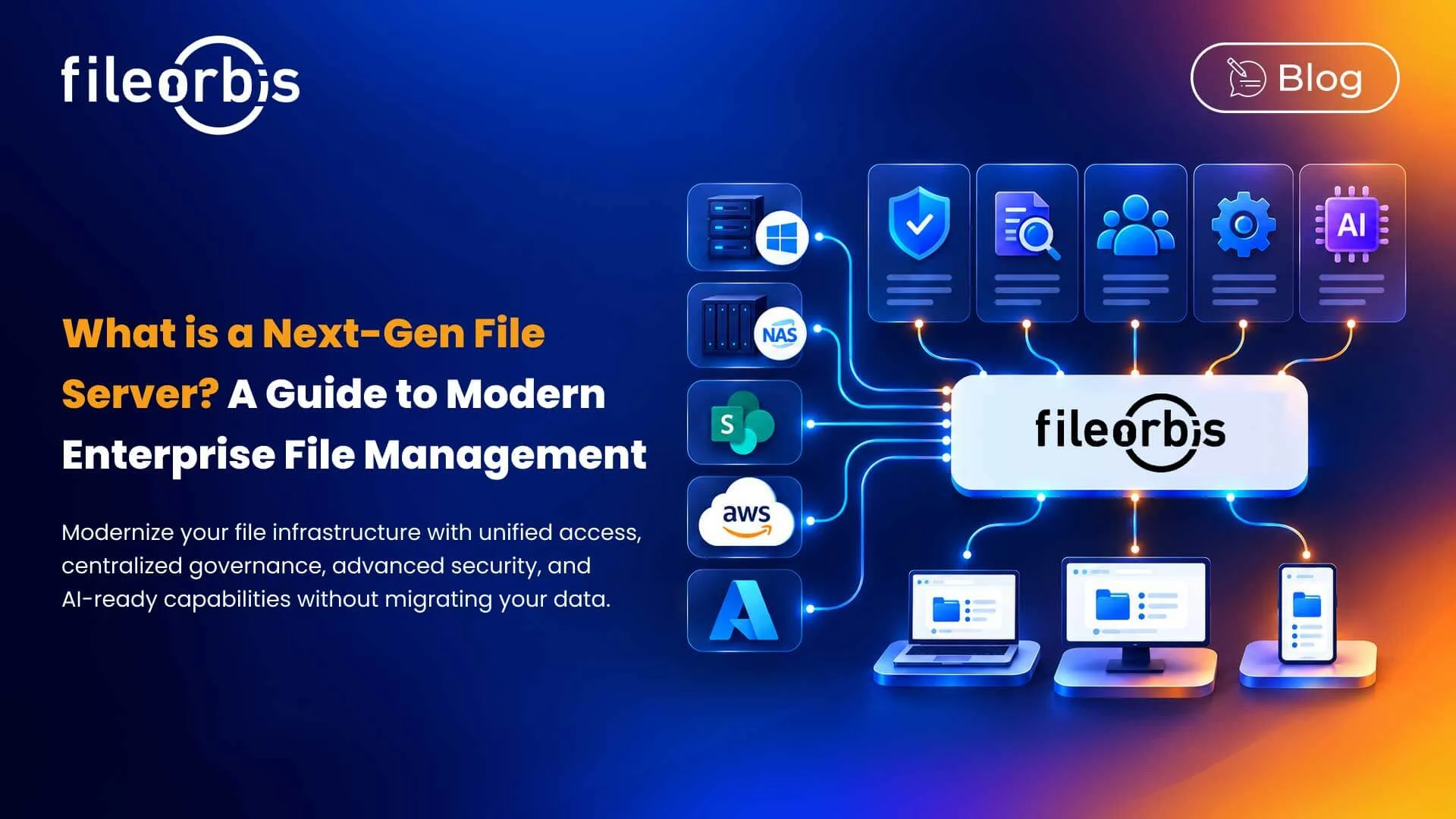
What is a Next-Gen File Server? A Guide to Modern Enterprise File Management
Enterprise file servers have supported business operations for decades. However, growing data volumes, remote workforces, hybrid infrastructures, and evolving cybersecurity threats are changing how organizations manage their files.
With enterprise data distributed across NAS devices, on-premises servers, and cloud repositories, IT teams face increasing complexity in maintaining secure access, operational efficiency, and consistent policies.
A next-gen file server addresses these challenges by bringing centralized management, modern security, and AI-ready capabilities to existing file infrastructure.
What is a Next-Gen File Server?
A next-gen file server is a modern approach to enterprise file management that connects distributed storage environments through a unified access and governance layer.
Instead of replacing existing infrastructure, next-gen file server solutions extend capabilities to support hybrid storage, centralized control, and secure collaboration.
Key benefits include:
- Centralized Governance: Manage access policies and file activities across distributed environments.
- Unified File Access: Connect on-premises and cloud repositories through a consistent interface.
- Improved Security: Identify sensitive information and reduce unauthorized exposure.
- AI Readiness: Enable governed access to enterprise content for AI applications.
- Operational Efficiency: Simplify file management and support remote collaboration.
Traditional and Next-Gen File Servers: What’s the Difference?
Traditional file servers primarily focus on storing files and managing access across individual environments. While effective for established workloads, they can create challenges as enterprise infrastructures expand.
Next-gen file servers offer capabilities that address these limitations:
- Storage: Move from isolated file environments to unified access across multiple repositories.
- Security: Extending file-level permissions with sensitive data discovery, policy enforcement, and classification.
- Governance: Increasing visibility into file activities, permissions, and data exposure risks.
- Accessibility: Supporting secure browser-based and virtual drive access beyond traditional VPN-dependent workflows.
- AI Integration: Enabling controlled access to enterprise information for AI and Retrieval-Augmented Generation (RAG).
The key distinction is the ability to modernize how access and protection are handled without fundamentally changing where enterprise files reside.
6 Essential Capabilities of a Next-Gen File Server
For enterprise IT and cybersecurity teams evaluating next-gen file server solutions, six capabilities are particularly important.
File System Federation and Unified Access
Enterprise files often span Windows file servers, NAS, SharePoint, S3, and other repositories. File system federation brings these environments together through a consistent access layer.
This reduces management complexity and enables organizations to use existing storage investments more effectively.
Content-Aware Data Security
File permissions alone do not indicate whether content contains sensitive information.
AI-based classification and sensitive data discovery help organizations identify confidential records, and intellectual property, personal information.
Content-aware policies can then restrict inappropriate storage, unauthorized sharing, and other risky activities depending on file sensitivity and business requirements.
Centralized Permission and Access Governance
Complex permission structures can lead to over access, unauthorized exposure, and outdated privileges.
Effective access governance should include:
- Integration with existing Active Directory (AD) and NTFS permissions.
- Identification of excessive permissions.
- Ensuring the enforcement of the least privileged access.
- Centralized permission analysis and audit logging.
These controls help security teams strengthen access governance while maintaining established permission structures.
Automated File Governance and Lifecycle Management
Enterprise file management requires consistent policies throughout the data lifecycle.
Automation can help organizations manage:
- File retention and archival.
- Policy-based file deletion.
- Content-aware sharing and approval workflows.
- Audit logging and activity monitoring.
This reduces manual administrative effort and supports organizational management requirements.
Secure Remote Access and Edge Performance
Remote employees and branch offices need reliable access to enterprise files without creating unnecessary security risks.
Browser-based access and virtual drives support secure collaboration, while edge caching improves performance for geographically distributed teams by reducing repeated data transfers and bandwidth consumption.
AI applications require access to relevant enterprise information, but unrestricted retrieval can expose confidential content.
Content-aware and permission-aware RAG helps organizations extend established security controls to AI workflows.
Key capabilities include:
- Accessing enterprise knowledge without migrating source files.
- Applying classification and sensitivity policies to retrieved content.
- Extending AD/NTFS permissions to AI retrieval.
- Reflecting file and permission changes in retrieval processes.
This allows organizations to adopt enterprise AI while maintaining control over information access.
How FileOrbis Helps
FileOrbis modernizes existing file infrastructure without changing storage systems or migrating data. Its Next-Gen File Server capabilities offer a unified approach to enterprise file management, security, and AI readiness.
Key capabilities include:
- File System Federation: Unify access to NAS, on-premises file servers, and cloud repositories through a centralized platform.
- Secure Remote Access: Enable controlled file access and collaboration across distributed teams.
- Data Security and Governance: Strengthen protection through AI-based classification, permission analysis, content-aware sharing, policy enforcement, and audit logging.
- Edge Caching: Improve file access performance and reduce bandwidth consumption across remote locations.
- AI-Ready Infrastructure: Enable content-aware and permission-aware RAG while preserving existing access controls.
By managing data where it already lives, FileOrbis helps organizations reduce infrastructure complexity, support enterprise AI adoption, and strengthen security.
In Summary
The next-gen file server goes beyond traditional storage and file access. It provides the foundation for centralized, secure, and AI-ready enterprise file management.
For organizations managing hybrid environments, modernization does not have to mean changing infrastructure or migrating data. The priority is to increase visibility, enforce consistent security controls, and make existing corporate information more accessible and manageable.

Faris Suleiman
Presales Manager, KSA & Egypt
Subscribe to our Newsletter
About FileOrbis
Aiming to manage the user and file relationship within an institutional framework, FileOrbis is constantly being developed in order to meet different industry and customer needs in terms of file management and sharing. Since 2018, FileOrbis continues to be developed with the excitement of the first day. FileOrbis focuses on high security, rich integration, ease of use and integrated management criteria.