
Why Adoption Is a Security Feature: The Redesigned FileOrbis Experience
There’s an uncomfortable truth most security teams have learned the hard way: the strongest control in the world protects nothing if people route around it. Every clunky secure-sharing portal that drove users back to personal email, every heavyweight encryption tool quietly disabled, and every governance step skipped because it added three clicks were real controls defeated not by an attacker, but by friction.
Which leads to a conclusion that sounds soft but is hard-nosed: usability is a security feature. If the governed path is also the easy path, people stay on it. If it isn’t, they leave and take your data with them.
Friction Is a Vulnerability
It’s worth stating plainly, because security culture tends to treat user experience as cosmetic. It isn’t:
- The vulnerability of complexity: When the secure way to do something is harder than the insecure way, you’ve created a vulnerability that no amount of policy closes.
- User behavior: People aren’t malicious; they’re busy, and they optimize for getting work done. A governance step that’s slow or confusing is, functionally, a control with a built-in bypass.
- The role of UI: Improving the experience isn’t a nicety layered on top of security. It is part of security. The interface is where governance either gets adopted or gets abandoned.
What “Digital Dexterity” Means Here
The phrase points at something specific: how fluently people can do their work within the secure environment, without fighting it. A redesigned FileOrbis experience is built around that idea, making the governed action the natural one.
In practice, that means:
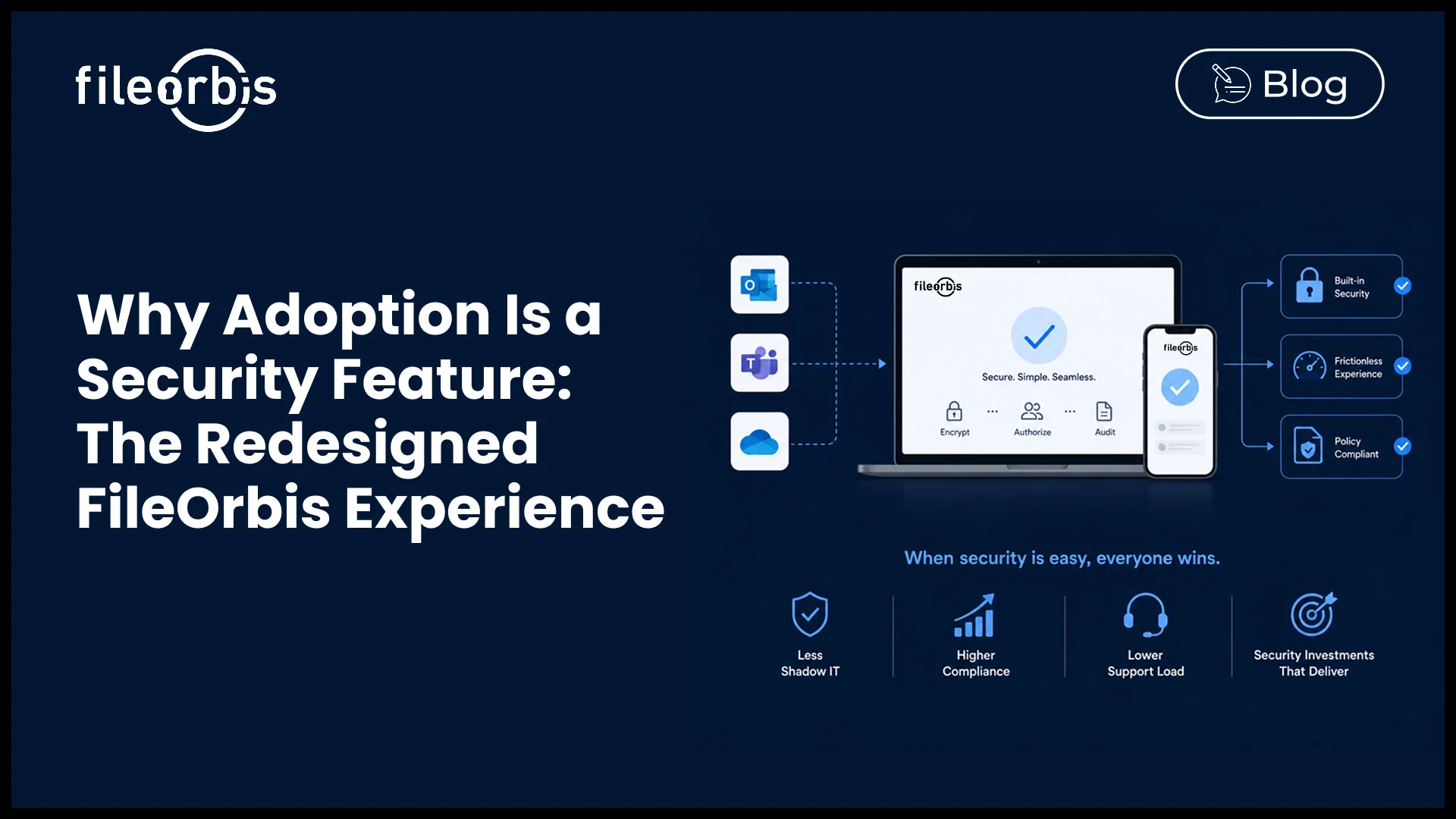
- Familiar access channels: Reaching files the way people already think about reaching files: through the web, a virtual drive, desktop, and mobile, and directly from the tools they live in, including Outlook, Teams, and Office.
- Frictionless sharing: Sharing securely being a right-click, not a detour to a separate portal.
- Clean interface: A cleaner, more intuitive interface so the controls fade into the background of normal work rather than standing in front of it.
The governance is all still there: classification, policy, encryption, approval, and audit. It runs underneath an experience that doesn’t make people resent it.
The Adoption Dividend
When the secure path is the path of least resistance, several good things happen at once and reinforce each other:
- Shadow IT shrinks: The sanctioned tools are genuinely easier than the unsanctioned ones, reducing the reliance on unapproved alternatives.
- Policy compliance rises: Staying compliant does not require extra effort from the user.
- Support load drops: Intuitive tools naturally generate fewer support tickets.
- Controls deliver value: The security controls you invested in actually deliver their protection because they are being used as designed instead of circumvented.
That’s the return on usability: not a nicer-looking screen, but security controls that finally hold because people stopped working around them.
The Takeaway
The history of enterprise security is littered with excellent controls undone by friction. The lesson isn’t to weaken the controls; it’s to remove the friction so the controls survive contact with real users.
A well-designed secure experience treats adoption as the security objective it really is: make the governed way the easy way, and governance stops being something people escape and becomes simply how the work gets done.
Want governance your users actually adopt? See the FileOrbis experience.

Gamze Karslı
Head of Marketing
Subscribe to our Newsletter
About FileOrbis
Aiming to manage the user and file relationship within an institutional framework, FileOrbis is constantly being developed in order to meet different industry and customer needs in terms of file management and sharing. Since 2018, FileOrbis continues to be developed with the excitement of the first day. FileOrbis focuses on high security, rich integration, ease of use and integrated management criteria.