
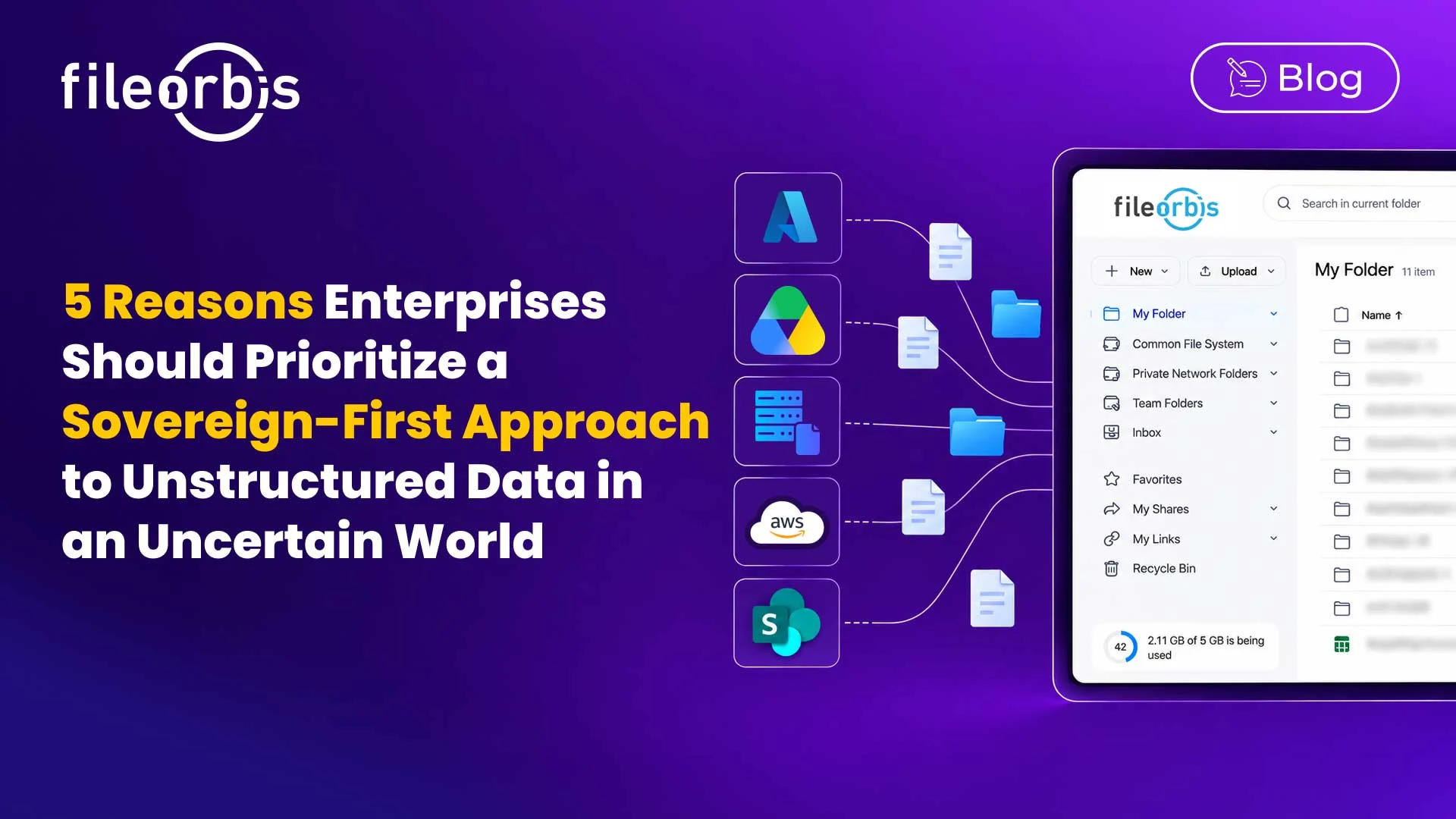
5 Reasons Enterprises Should Prioritize a Sovereign-First Approach to Unstructured Data in an Uncertain World
Geopolitical tensions, regulatory changes, supply chain disruptions, cloud concentration, and rapid AI adoption are changing the way enterprises think about their data.
For years, data strategies largely focused on availability, cost, and scalability. Today, organizations must also consider whether they can maintain control of critical information when external conditions change.
This is especially important for unstructured data. Contracts, engineering documents, financial records, customer information, intellectual property, and operational files are often distributed across file servers, NAS, M365, and cloud storage.
A sovereign unstructured data approach puts corporate control at the center of how this information is stored, accessed, shared, governed, and processed.
Here are five reasons why enterprises should prioritize this approach.
1. Data Residency Alone Does Not Guarantee Sovereignty
Knowing where a file is stored is important, but location alone doesn’t provide complete control.
Organizations also need to understand:
- Who controls the infrastructure?
- Who manages access?
- How sensitive files shared externally?
- Where are directories, metadata, and logs stored?
- Which third parties can process the data?
A file may remain in the necessary region while its content is processed, indexed, or accessed under different conditions.
Therefore, for sovereign unstructured data, the question extends from where the information resides to how it is controlled and used.
2. Vendor Dependence Can Reduce Operational Flexibility
Cloud platforms provide scalability and flexibility, but excessive dependence on a single provider, platform, or storage environment can limit an organization’s options when business or regulatory requirements change.
A sovereign-first strategy can help businesses:
- Choose on-premises, private cloud, or public cloud based on workload requirements
- Keep critical data in controlled infrastructure if necessary
- Avoid unnecessary storage migrations
- Reduce dependency on a single platform
- Enforce consistent governance across environments
Cloud and on-premises infrastructure don’t have to be competing models. Enterprises can use both while maintaining consistent control across data assets.
3. Geopolitical Change Can Quickly Become Data Risks
Enterprise data infrastructure often spans multiple countries, jurisdictions, and technology providers, and cloud regions.
Geopolitical conflicts, sanctions, regulatory changes, export restrictions, or new cross-border data rules can alter how organizations access or manage information.
A sovereign-first approach helps organizations gain visibility into:
- Where sensitive files are stored
- Who can access critical information
- Which providers are involved
- Which jurisdictions apply
- How data moves between environments
The goal is not isolation. It is to prevent critical data from becoming unnecessarily dependent on infrastructure or jurisdictions outside the organization’s control.
4. Business Continuity Depends on Access to Critical Information
Resilience is not just about backups and disaster recovery. Organizations also need reliable and controlled access to files essential for continued operations.
During a disruption, teams need to know:
- Where critical information is resides
- Who has access authorization
- Whether security policies are enforceable
- Which external dependencies are necessary
- Whether file activity is auditable
Making data sovereignty a part of resilience planning helps organizations maintain controlled access to business-critical information even as operational conditions change.
5. AI Makes Data Sovereignty a Processing Question
Enterprise AI is adding a new layer to data movement.
A sensitive file might remain on an internal file server while the extracted information is sent to an external AI service. Prompts, embeddings, vector indexes, retrieved snippets, and generated outputs can create additional data streams.
Organizations should ask:
- Which enterprise files can AI access?
- Which models can process sensitive information?
- Where are embeddings and indexes stored?
- Where does AI inference occur?
- Is AI activity logged and auditable?
- Are existing file permissions respected during retrieval?
This means that sovereign unstructured data needs to extend beyond storage to AI retrieval and processing.
Content-aware and permission-aware controls can help determine what information AI systems can access and which models can process it.
What Should a Sovereignty-First Unstructured Data Strategy Include?
Organizations don’t need to move every file to a new repository to strengthen sovereignty. Instead, they need consistent governance in environments where data already resides.
Key capabilities include:
- Data discovery: Identifying unstructured data across distributed repositories.
- Location control: Understanding and governing where critical information resides.
- AI-based classification: Identifying sensitive and regulated information.
- Least privileged access: Identifying and reducing over access.
- Context-aware sharing: Applying controls based on file sensitivity.
- AI governance: Controlling what content enterprise AI and RAG systems can access.
- Deployment flexibility: Supporting on-premises, private cloud, and hybrid architectures.
- Audit logging: Maintaining visibility into access and file activity.
How FileOrbis Helps
FileOrbis enables enterprises to govern unstructured data across existing file servers, NAS, M365, and cloud environments without requiring a migration to a new repository.
Organizations can use FileOrbis to:
- Discover and classify sensitive information
- Apply content-aware and permission-aware controls
- Analyze permissions and support least-privileged access
- Govern external file sharing
- Extend existing access controls to enterprise AI and RAG
- Maintain a centralized audit log
This allows organizations to modernize collaborative and AI access while maintaining governance compliant with infrastructure and data sovereignty requirements.
In Summary
Enterprises cannot predict every geopolitical conflict, technological change, regulatory shift, or supplier dependency. However, they can design data architectures to maintain control and resilience when these conditions change.
A sovereign, unstructured data strategy helps organizations maintain control over critical information across on-premises, hybrid, cloud, and AI environments without forcing everything into a single repository.
The goal is not to avoid the cloud, AI, or global collaboration, but to utilize them without losing control.

Hammam Abunaser
Sales Director, MEA
Subscribe to our Newsletter
About FileOrbis
Aiming to manage the user and file relationship within an institutional framework, FileOrbis is constantly being developed in order to meet different industry and customer needs in terms of file management and sharing. Since 2018, FileOrbis continues to be developed with the excitement of the first day. FileOrbis focuses on high security, rich integration, ease of use and integrated management criteria.