
File Sharing Approval Workflow: How to Prevent Unauthorized Data Exposure
Enterprise file sharing is essential for collaboration, but not every document should be shared without review. Financial records, contracts, customer information, and confidential business files often require additional controls before reaching external recipients.
A file sharing approval workflow helps organizations prevent unauthorized data exposure by introducing review and authorization steps based on file sensitivity, security policies, and access permissions.
When combined with content-aware controls, these workflows protect sensitive information without unnecessarily slowing down business operations.
What is File Sharing Approval Workflow?
A file-sharing approval workflow is a structured process that determines whether a file can be shared based on predefined organizational policies.
Instead of automatically allowing every file transfer, the workflow introduces approval requirements when specific security conditions are met.
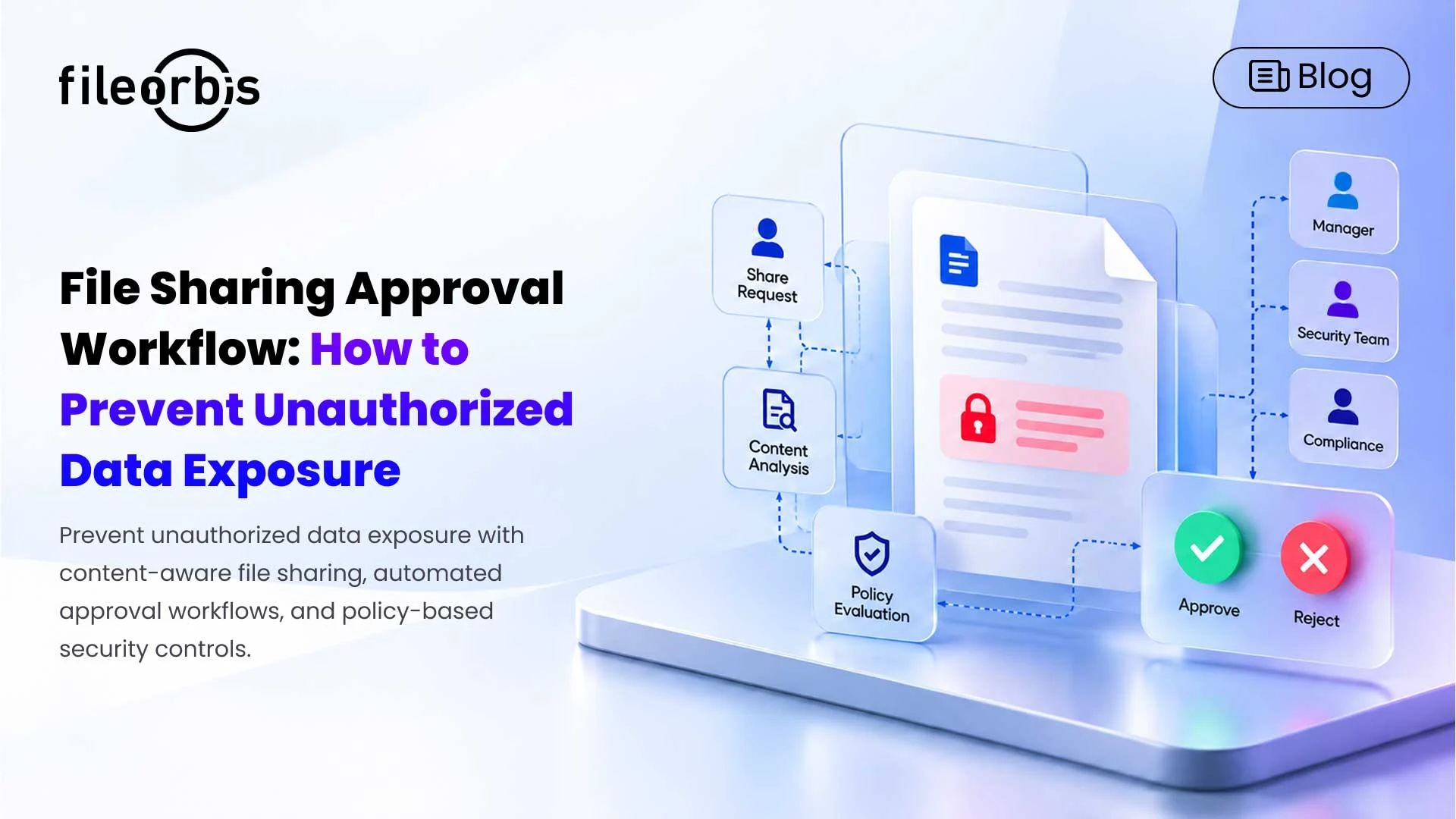
A typical process includes:
- Sharing Request: A user initiates a file-sharing request.
- Policy Evaluation: The system checks file sensitivity, sharing conditions, and permissions.
- Approval Routing: Requests requiring authorization are routed to an appropriate reviewer.
- Approval Decision: The request is approved or rejected.
- Audit Log: Approval decisions and sharing activities are logged.
This process helps organizations audit sensitive file transfers.
Why Traditional File Sharing Approvals Fall Short
Traditional approval processes often depend on manual reviews, broad access permissions, or email requests.
These approaches create several challenges:
- Inconsistent Enforcement: Different departments may apply different sharing rules.
- Limited Content Visibility: Approvers may not know whether a document contains sensitive information.
- Unauthorized Exposure: Confidential files may be shared without appropriate oversight.
- Approval Delays: Manual reviews can slow down routine collaboration.
- Audit Gaps: Organizations may not have reliable records of approval decisions.
Addressing these limitations requires a more automated, risk-based approach.
How Content-Aware File Sharing Approval Works
Content-aware approval workflows evaluate what a file contains before deciding whether additional authorization is needed.
Instead of applying the same approval process to every document, organizations can define different requirements based on sensitivity and business context.
Key controls include:
- Content Inspection: Identify personal information, confidential data, and financial records.
- Classification-Based Policies: Apply approval requirements according to file sensitivity.
- Policy-Based Decisions: Allow, block, restrict, or route sharing requests for approval.
- Permission Validation: Verify that sharing respects existing access rights.
- Audit Log: Record approval outcomes for accountability.
For example, employees can directly share publicly available documents, while confidential financial reports require management approval before external distribution.
Key Benefits of Automated File Sharing Approval Workflows
Automated file sharing approval workflows help organizations improve security and operational efficiency.
Key benefits include:
- Consistent Security Controls: Apply standardized sharing policies across departments.
- Reduced Data Exposure: Prevent unauthorized sharing of sensitive documents.
- Greater Accountability: Maintain visibility into sharing and approval activities.
- Faster Collaboration: Reduce unnecessary manual reviews for low-risk files.
- Compliance Support: Generate audit evidence to help organizations in addressing NIS2, DORA, GDPR, and other relevant requirements.
How FileOrbis Helps
FileOrbis Content Aware Sharing combines content-aware security, policy enforcement, and approval workflows to help organizations control sensitive file transfers.
Its capabilities include:
- Content-Aware Approval Workflows: Require authorization before sharing sensitive documents.
- AI-Based Data Classification: Identify sensitive information and classify files based on content.
- Permission-Aware Access: Enforce existing Active Directory and NTFS permissions.
- Policy-Based Sharing Controls: Restricts or blocks transfers that violate security policies.
- Controlled External Sharing: Enforces expiration, revocation, and access restrictions.
- Audit Logging: Monitors file sharing activities and approval decisions.
FileOrbis applies these controls to existing enterprise file environments without requiring data migration, helping organizations strengthen security while maintaining collaboration.
In Summary
A file sharing approval workflow should go beyond manual authorization to ensure that sensitive information is shared only under appropriate security conditions.
By combining content-aware controls, policy enforcement, automated approvals, and organizations can reduce unauthorized data exposure while maintaining efficient collaboration.
FileOrbis Content-Aware Sharing helps organizations apply these controls on existing file environments without the need for data migration, providing greater control and visibility over sensitive file transfers.
Frequently Asked Questions
What is the purpose of a file sharing approval workflow?
A file sharing approval workflow helps organizations prevent unauthorized exposure and maintain accountability by ensuring sensitive documents receive appropriate authorization before being shared.
Can file sharing approval workflows be automated?
Yes. Automated workflows use predefined security policies and content classification to identify sharing requests that require approval, reducing manual intervention.
How does FileOrbis help prevent unauthorized data exposure during file sharing?
FileOrbis Content Aware Sharing uses content-aware policies, permission-based controls, and automated approvals to prevent unauthorized sharing and maintain audit visibility without data migration.

Gamze Mat
Product Manager
Subscribe to our Newsletter
About FileOrbis
Aiming to manage the user and file relationship within an institutional framework, FileOrbis is constantly being developed in order to meet different industry and customer needs in terms of file management and sharing. Since 2018, FileOrbis continues to be developed with the excitement of the first day. FileOrbis focuses on high security, rich integration, ease of use and integrated management criteria.